


Germany's governing coalition of conservatives and Social Democrats suffered big losses on Sunday in a regional election in the northern port of Bremen, as three opposition parties, particularly the new Left Party, made significant gains.
Preliminary results gave the Social Democrats 36.9 percent of the vote in Bremen, trailed by Chancellor Angela Merkel's Christian Democrats with 25.1 percent, and the Greens with 16.5 percent. The Left Party, entering the Bremen election for the first time, stunned the Social Democrats by winning 8.7 percent of the vote. Gregor Gysi, one of the Left Party leaders, said the result showed that the new party could have an impact on the federal level.
In a disappointment for Kurt Beck, the leader of the Social Democrats, his party's total was several percentage points lower than in the 2003 election. The party has been in power in Bremen since 1947, but its share of the vote has decreased in almost every regional election.
Although the Social Democrats remain the strongest party, the heavy losses may accelerate the debate over Beck's future as its leader -- if not the party's role in the federal ruling coalition.
Beck said on Sunday that his party had a "clear victory" in Bremen, adding: "We are the largest party. No one can govern against us."
The Christian Democrats also did badly, falling nearly 5 percent from four years ago.
The result raised the question of whether the Christian Democrats would have enough influence to insist that the "grand coalition" that has functioned in this city for the past 12 years would continue.
Roland Pofalla, the party's general secretary, said on Sunday night that the voters had "opted for a continuation of the grand coalition in Bremen." But he added that the "ball is now in the court of the Social Democrats."
Pofalla warned the Social Democrats against forming a coalition with the Greens, the party that would be the king-maker in any new government in Bremen should the Social Democrats decide to end the grand coalition.
The vote for the Greens jumped almost 4 percent from 12.8 percent, which would allow the Social Democrats and the Greens to establish a coalition. Together, the two parties would be able to muster enough votes to have a combined absolute majority of 42 seats in the 83-seat legislature.
Claudia Roth, a leader of the Greens, said the results were "the best ever on the state level for the party." She added that it was a signal for the federal government.
"The people want different policies," she said.
The Greens have been in opposition at the federal level since 2005 after serving seven years as the junior partner in Gerhard Schroeder's Social Democratic-led government.
Established two years ago, the Left Party consists of trade unionists from western Germany who believe the Social Democrats have moved too much to the center, and the Party of Democratic Socialists, which was created from the former East German Communist Party.
During the campaign, the Left Party -- led by Oskar Lafontaine, who for a short time was finance minister in the first Green-Social Democratic coalition government led by Schroeder -- criticized the Social Democrats for betraying the party's old leftist principles.
The Left Party also appealed to many of the unemployed; Bremen has an unemployment rate of 13.1 percent, the highest among the western German states.
The strong performance of the Left Party and the poor showing of the Social Democrats could lead to a serious discussion of Beck's future.
Since becoming leader of the party more than a year ago, he has trailed well behind Merkel in terms of popularity, while his party on the federal level is at least 9 percentage points behind Merkel's conservative bloc.
Another party, the pro-business Free Democrats, managed to overcome the 5 percent hurdle, the minimum required to enter the regional legislature. The party won 5.5 percent of the vote in Bremen, which would give them about five seats in the legislature.
Guido Westerwelle, the leader of the Free Democrats, ran an aggressive campaign, criticizing the performance of the grand coalition on the federal level and promising to cut taxes and bureaucracy.
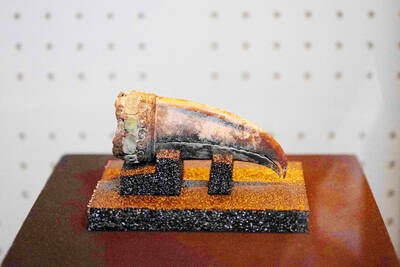
Archeologists in Peru on Thursday said they found the 5,000-year-old remains of a noblewoman at the sacred city of Caral, revealing the important role played by women in the oldest center of civilization in the Americas. “What has been discovered corresponds to a woman who apparently had elevated status, an elite woman,” archeologist David Palomino said. The mummy was found in Aspero, a sacred site within the city of Caral that was a garbage dump for more than 30 years until becoming an archeological site in the 1990s. Palomino said the carefully preserved remains, dating to 3,000BC, contained skin, part of the

TRUMP EFFECT: The win capped one of the most dramatic turnarounds in Canadian political history after the Conservatives had led the Liberals by more than 20 points Canadian Prime Minister Mark Carney yesterday pledged to win US President Donald Trump’s trade war after winning Canada’s election and leading his Liberal Party to another term in power. Following a campaign dominated by Trump’s tariffs and annexation threats, Carney promised to chart “a new path forward” in a world “fundamentally changed” by a US that is newly hostile to free trade. “We are over the shock of the American betrayal, but we should never forget the lessons,” said Carney, who led the central banks of Canada and the UK before entering politics earlier this year. “We will win this trade war and
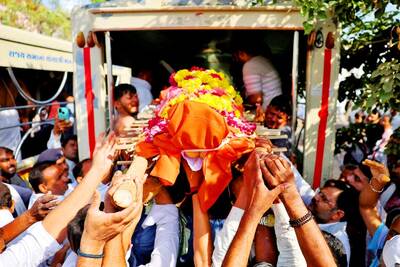
‘WATER WARFARE’: A Pakistani official called India’s suspension of a 65-year-old treaty on the sharing of waters from the Indus River ‘a cowardly, illegal move’ Pakistan yesterday canceled visas for Indian nationals, closed its airspace for all Indian-owned or operated airlines, and suspended all trade with India, including to and from any third country. The retaliatory measures follow India’s decision to suspend visas for Pakistani nationals in the aftermath of a deadly attack by shooters in Kashmir that killed 26 people, mostly tourists. The rare attack on civilians shocked and outraged India and prompted calls for action against their country’s archenemy, Pakistan. New Delhi did not publicly produce evidence connecting the attack to its neighbor, but said it had “cross-border” links to Pakistan. Pakistan denied any connection to

Armed with 4,000 eggs and a truckload of sugar and cream, French pastry chefs on Wednesday completed a 121.8m-long strawberry cake that they have claimed is the world’s longest ever made. Youssef El Gatou brought together 20 chefs to make the 1.2 tonne masterpiece that took a week to complete and was set out on tables in an ice rink in the Paris suburb town of Argenteuil for residents to inspect. The effort overtook a 100.48m-long strawberry cake made in the Italian town of San Mauro Torinese in 2019. El Gatou’s cake also used 350kg of strawberries, 150kg of sugar and 415kg of


 RSS
RSS