


On a dark street in the restive Iraqi town of Samarra a young man masked with a bandana and a baseball cap looks over his shoulder before pulling out an aerosol can and spray-painting across a wall.
A US army officer standing behind him squints at the flowing Arabic script, then turns to a reporter traveling with his platoon.
"What does that say?" he asks.
The young vandal is an army translator whom the soldiers call Matthew -- publishing his real name would put him in danger.
Matthew is charged with sowing seeds of strife between the town's two main insurgent groups, al-Qaeda in Iraq and the Islamic Army of Iraq.
While al-Qaeda takes its inspiration from Osama bin Laden's international Islamist struggle, the Islamic Army is a coalition of Iraqi Islamists and Baathist supporters of late dictator Saddam Hussein.
And while both groups are fighting to expel US forces from Iraq, there are also signs of growing conflict between them -- a conflict the local security forces and their US allies are keen to exploit.
The two groups have clashed on the Internet, with the more nationalist Islamic Army criticizing al-Qaeda for targeting Iraqi civilians and for its attempts to impose a harsh Saudi-inspired version of Islamic law.
Within Samarra, the Islamic Army enjoys wide popularity because of its single-minded focus on attacking US forces, while al-Qaeda intimidates local residents with spectacular bombings and coordinated attacks on police.
The commander of the US Army's 82nd Airborne, 3rd Brigade, Charlie Company, based in Samarra, agrees that both groups pose a threat to security in the town but says there are important differences.
The Islamic Army "is against coalition forces and ISF [Iraqi Security Forces] that work with the coalition," says Captain Eugene "Buddy" Ferris.
"Al-Qaeda will blow up bombs in markets. Al-Jaish al-Islami [the Islamic Army] won't," Ferris adds.
Both insurgent groups tag the walls with slogans, threats and boasts.
Al-Qaeda's street artists write: "The Samarra police are infidels, so we will bring you young men who love martyrdom," and "We will destroy all those who cooperate with the Americans".
The Islamic Army scribes write much the same thing, but threaten "the occupiers" instead of the local security forces and collaborators.
Matthew's job is to redirect the artistic impulses of each group against the other.
"It's a way to destabilize their unification efforts," says First Lieutenant Charlie Hodges, who leads one of the graffiti patrols.
Abu Tiba, the alleged leader of al-Qaeda in Samarra, is a frequent subject.
Hodges tells Matthew to write something really terrible about Abu Tiba, something that the Islamic Army of Iraq might say about him, something that will start a fight.
Matthew nods. Then in bright red paint he writes: "Abu Tiba is a terrorist and those who work with him are terrorists."
Hodges can't read Arabic, so he asks a reporter travelling with the platoon to translate. Hodges is disappointed. The black propaganda effort needs a lot more street cred than Matthew is giving him.
They climb back into the Humvees, drive around the corner, and try again.
They find a message telling the occupiers to leave. Matthew scribbles over it. Then Hodges tries again.
"This time, I want you to write that al-Qaeda has killed many in the Islamic Army," he says.
"Al-Qaeda has killed many from the Islamic Army," Matthew writes.
Then the local Iraqi police step in to offer suggestions on how to spice up his prose.
An argument ensues between Matthew and the police -- three men in mismatched uniforms with AK-47 assault rifles slung around their necks.
One cop finally suggests something that is greeted with enthusiasm. Matthew amends the message.
"Al-Qaeda has killed many FIGHTERS from the Islamic Army."
The paint is running out. Hodges tells Matthew his writing is too large, and orders everyone back to the vehicles.
The heavily armed US soldiers who had fanned out along the darkened street return to the Humvees, the police climb into their pickup trucks and they head back to base.
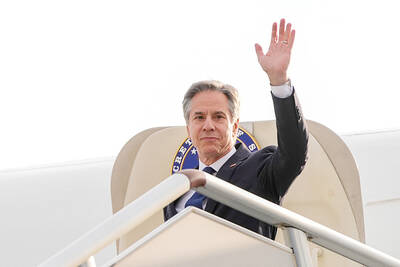
‘IN A DIFFERENT PLACE’: The envoy first visited Shanghai, where he attended a Chinese basketball playoff match, and is to meet top officials in Beijing tomorrow US Secretary of State Antony Blinken yesterday arrived in China on his second visit in a year as the US ramps up pressure on its rival over its support for Russia while also seeking to manage tensions with Beijing. The US diplomat tomorrow is to meet China’s top brass in Beijing, where he is also expected to plead for restraint as Taiwan inaugurates president-elect William Lai (賴清德), and to raise US concerns on Chinese trade practices. However, Blinken is also seeking to stabilize ties, with tensions between the world’s two largest economies easing since his previous visit in June last year. At the
Nearly half of China’s major cities are suffering “moderate to severe” levels of subsidence, putting millions of people at risk of flooding, especially as sea levels rise, according to a study of nationwide satellite data released yesterday. The authors of the paper, published by the journal Science, found that 45 percent of China’s urban land was sinking faster than 3mm per year, with 16 percent at more than 10mm per year, driven not only by declining water tables, but also the sheer weight of the built environment. With China’s urban population already in excess of 900 million people, “even a small portion

UNSETTLING IMAGES: The scene took place in front of TV crews covering the Trump trial, with a CNN anchor calling it an ‘emotional and unbelievably disturbing moment’ A man who doused himself in an accelerant and set himself on fire outside the courthouse where former US president Donald Trump is on trial has died, police said yesterday. The New York City Police Department (NYPD) said the man was declared dead by staff at an area hospital. The man was in Collect Pond Park at about 1:30pm on Friday when he took out pamphlets espousing conspiracy theories, tossed them around, then doused himself in an accelerant and set himself on fire, officials and witnesses said. A large number of police officers were nearby when it happened. Some officers and bystanders rushed

Beijing is continuing to commit genocide and crimes against humanity against Uyghurs and other Muslim minorities in its western Xinjiang province, U.S. Secretary of State Antony Blinken said in a report published on Monday, ahead of his planned visit to China this week. The State Department’s annual human rights report, which documents abuses recorded all over the world during the previous calendar year, repeated language from previous years on the treatment of Muslims in Xinjiang, but the publication raises the issue ahead of delicate talks, including on the war in Ukraine and global trade, between the top U.S. diplomat and Chinese


 RSS
RSS