


"Explore the World," promised the signboard outside.
Inside Norling Cyberworld, in a second-floor corner of a busy shopping arcade, Dorji Wangchuk rolled up the sleeve of his Puma sweatshirt and offered a glimpse of his worldly explorations. Inscribed in blue-black ink on the pale inside of his left forearm was the image of a dragon, a tattoo that he had drawn himself, with instructions from the Internet.
On this night he was surfing www.tattoodles.com and plotting to draw a new one on himself -- another dragon, the national symbol of Bhutan. Never mind that tattoos are a taboo here.
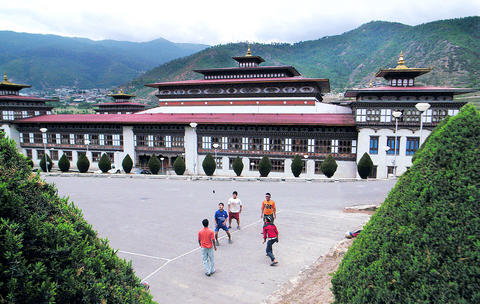
PHOTO: NY TIMES NEWS SERVICE
"According to our culture, it's not good," Wangchuk, 24, conceded, only to add with a grin: "It's my hobby. I can't help it."
Once, Bhutan had guarded itself from the world outside so ardently that it allowed in satellite TV only seven years ago. Today, globalization is officially sanctioned, and it is rushing in fast.
Wangchuk is part of the first generation here to come of age with all the trappings of global youth culture: unrestricted Internet, nearly unrestricted satellite TV, basketball, brand-name sneakers and, as it turns out, tattoos.
Today, at least here in the capital, outside and inside coexist. Tall white prayer flags grace the side of a hill as offerings of good will to what Buddhists call sentient beings, even as the naughty rhymes of Snoop Dogg throb at the disco.
The government has on occasion found the dissonance disconcerting. A sports channel, called Ten Sports, was taken off the air shortly after the introduction of satellite TV, because its wrestling programs had become so popular that boys across Bhutan were mimicking them and upsetting the authorities.
MTV was quietly taken off the air too, along with Fashion TV, which Karma Ura, a prominent academic here, described as antithetical to Bhutanese Buddhist tradition.
Fashion TV, as he put it, had "no suffering alleviation value."
He disconnected his own TV set altogether, having discovered that despite the occasional stimulation, it was ruining his eyes and his mind.
"You basically give away your consciousness," said Ura, director of the Center for Bhutan Studies, a government-funded organization that cogitates on issues of culture and identity.
Young people dominate Bhutan. Of its roughly 700,000 people, 49 percent are under 21, according to the census, and what they will do to support themselves when they are fully grown is an emerging concern.
The unemployment rate among Bhutanese youth, which comprises those 15 to 24, hovers at 5.5 percent, nearly twice the national average, which has also sharply risen in recent years. How to address unemployment has become a subject of regular hand-wringing in newspapers articles and the legislature.
It is hardly surprising, considering how quickly Bhutanese are gaining education. The literacy rate has soared from 20 percent in 1992 to close to 60 percent today, making it that much more important to offer Bhutan's youth something other than farming rice.
Like many people, Wangchuk attended college abroad. The country has very few colleges.
More surprising, perhaps, than the sentiments Ura expressed is the ambivalence of Nyema Zam, an Indian-educated 26-year-old who runs the satellite TV unit for state-owned Bhutan Broadcasting Service. She took pains to note the benefits of opening up to foreign media.
"Television has been the medium through which our people get to find out about other cultures," she said.
At the same time, foreign TV has wrought changes that make her deeply uncomfortable. Her grandparents now watch Indian soap operas in Hindi, a language that would have been foreign to their ears a few years ago.
"Before we would sit together at home and eat dinner ... Now everyone is watching television," Zam said. "In the long run ... it may not be good for the culture that we have worked so hard to protect."
Clearly, the strange riches of the world outside have reached only a small portion of Bhutan's people. Only 33,000 TV sets are in the entire country, and more than half are estimated to have satellite connections that offer up to 30 channels, Zam said. As for the Internet, the universe is even smaller.
Nationwide, the number of Internet users is estimated at 25,000, according to Druknet, the state-owned Internet service provider.
To Singye Dema, 17, the Internet has proved irresistible. Her page on the chat Web site www.hi5.com, is a sparkling pink creation, with a cheerful photograph of her and a description of her interests, including "playing with kids." Her page is festooned with family pictures and a string of conversations she has been having with friends from home and strangers abroad.
Dema, an 11th-grader, finds herself coming back for these online chats almost daily -- and on the weekends, she confessed half disgustedly, sometimes twice a day, for up to three hours at a time.

‘IN A DIFFERENT PLACE’: The envoy first visited Shanghai, where he attended a Chinese basketball playoff match, and is to meet top officials in Beijing tomorrow US Secretary of State Antony Blinken yesterday arrived in China on his second visit in a year as the US ramps up pressure on its rival over its support for Russia while also seeking to manage tensions with Beijing. The US diplomat tomorrow is to meet China’s top brass in Beijing, where he is also expected to plead for restraint as Taiwan inaugurates president-elect William Lai (賴清德), and to raise US concerns on Chinese trade practices. However, Blinken is also seeking to stabilize ties, with tensions between the world’s two largest economies easing since his previous visit in June last year. At the
Nearly half of China’s major cities are suffering “moderate to severe” levels of subsidence, putting millions of people at risk of flooding, especially as sea levels rise, according to a study of nationwide satellite data released yesterday. The authors of the paper, published by the journal Science, found that 45 percent of China’s urban land was sinking faster than 3mm per year, with 16 percent at more than 10mm per year, driven not only by declining water tables, but also the sheer weight of the built environment. With China’s urban population already in excess of 900 million people, “even a small portion

UNSETTLING IMAGES: The scene took place in front of TV crews covering the Trump trial, with a CNN anchor calling it an ‘emotional and unbelievably disturbing moment’ A man who doused himself in an accelerant and set himself on fire outside the courthouse where former US president Donald Trump is on trial has died, police said yesterday. The New York City Police Department (NYPD) said the man was declared dead by staff at an area hospital. The man was in Collect Pond Park at about 1:30pm on Friday when he took out pamphlets espousing conspiracy theories, tossed them around, then doused himself in an accelerant and set himself on fire, officials and witnesses said. A large number of police officers were nearby when it happened. Some officers and bystanders rushed

Beijing is continuing to commit genocide and crimes against humanity against Uyghurs and other Muslim minorities in its western Xinjiang province, U.S. Secretary of State Antony Blinken said in a report published on Monday, ahead of his planned visit to China this week. The State Department’s annual human rights report, which documents abuses recorded all over the world during the previous calendar year, repeated language from previous years on the treatment of Muslims in Xinjiang, but the publication raises the issue ahead of delicate talks, including on the war in Ukraine and global trade, between the top U.S. diplomat and Chinese


 RSS
RSS