


Pro-Kremlin youth groups on Thursday ended a blockade of the Estonian embassy in Moscow, where activists protested for days over the relocation of a statue of a Soviet soldier in the Estonian capital.
The move could ease tensions sparked by the raucous protests, which have been the most visible Russian response to Estonia's action and have drawn sharp criticism from the EU and NATO.
But Russia's bitter dispute with Estonia over the relocation of the Bronze Soldier memorial is likely to persist -- and continue to fray relations between Russia and the West -- ahead of celebrations of the anniversary of the World War II victory over Nazi Germany next week.
Russians regard the Bronze Soldier monument statue in Tallinn as a tribute to the millions of Soviet soldiers who died fighting the Nazis -- and, in Russia's view, liberating nations such as Estonia -- but for many Estonians it is a bitter reminder of five decades of often oppressive postwar Soviet rule.
The statue's removal to a military cemetery prompted cries of blasphemy from Russian officials, triggered violent protests last week from Estonia's ethnic Russian minority and prompted youth groups loyal to Russian President Vladimir Putin to begin a round-the-clock demonstration at Estonia's Embassy in Moscow.
The leader of Nashi (Ours), Vasily Yakemenko, said his group and others would end their demonstration outside the Estonian embassy because the Estonian ambassador, Marina Kaljurand, had left Russia.
"The Estonian ambassador's cowardly flight is a victory for Nashi" and the other youth groups that protested, Yakemenko told activists outside the embassy. "But it is not a complete victory."
"We will lift the blockade of the Estonian Embassy today," he said, adding that protests will continue "until the repressions against Russian-speaking population of Estonia stop."
He announced a march yesterday to European Commission delegation headquarters in Moscow.
The Estonian Foreign Ministry announced that Kaljurand would go on a two-week vacation, which it said had been postponed because of the situation in Moscow.
"There is no political or health reason for her vacation," said the ministry's secretary-general, Matti Maasikas.
The persistent protest has disrupted the embassy's operation and prompted Estonia to send spouses and children of diplomats home.
A flag was ripped off the embassy grounds and Kaljurand said stones were thrown at the building.
On Wednesday, Kaljurand was mobbed by dozens of activists from Nashi and other groups who stormed into a building where she was to give a news conference.
The conduct of the protesters has highlighted tension in Russia-EU relations, already strained by concerns over resource-rich Russia's intentions in the energy industry and over what critics say is the trampling of democracy and civil rights under Putin.
Estonian and EU officials have criticized the protests and demanded Russia ensure the safety of diplomats and the unfettered operation of the embassy.
NATO said on Thursday that it was "deeply concerned by threats to the physical safety of Estonian diplomatic staff" in Moscow, adding: "These actions are unacceptable, and must be stopped immediately."
On Wednesday, the US said Estonian authorities were within their rights to move the monument and expressed concern over "continuing reports of violence and harassment, including harassment of Estonian diplomatic personnel and premises, in Moscow."
Kaljurand told AP Television News that the protests appeared to be highly organized, rather than spontaneous expressions of anger by Russians.
"I don't want to accuse anyone, but I am sure that these actions are very well organized, financed and orchestrated," she said, noting that youngsters had set up camp outside the embassy for seven days.
Nashi has close ties to the Kremlin, and another group that protested is the youth wing of Russia's dominant pro-Kremlin party, United Russia.
Asked whether the decision to stop the blockade was a directive from Russia's political leadership, Nashi spokeswoman Anastasia Suslova described the notion "nonsense."

‘IN A DIFFERENT PLACE’: The envoy first visited Shanghai, where he attended a Chinese basketball playoff match, and is to meet top officials in Beijing tomorrow US Secretary of State Antony Blinken yesterday arrived in China on his second visit in a year as the US ramps up pressure on its rival over its support for Russia while also seeking to manage tensions with Beijing. The US diplomat tomorrow is to meet China’s top brass in Beijing, where he is also expected to plead for restraint as Taiwan inaugurates president-elect William Lai (賴清德), and to raise US concerns on Chinese trade practices. However, Blinken is also seeking to stabilize ties, with tensions between the world’s two largest economies easing since his previous visit in June last year. At the
Nearly half of China’s major cities are suffering “moderate to severe” levels of subsidence, putting millions of people at risk of flooding, especially as sea levels rise, according to a study of nationwide satellite data released yesterday. The authors of the paper, published by the journal Science, found that 45 percent of China’s urban land was sinking faster than 3mm per year, with 16 percent at more than 10mm per year, driven not only by declining water tables, but also the sheer weight of the built environment. With China’s urban population already in excess of 900 million people, “even a small portion

UNSETTLING IMAGES: The scene took place in front of TV crews covering the Trump trial, with a CNN anchor calling it an ‘emotional and unbelievably disturbing moment’ A man who doused himself in an accelerant and set himself on fire outside the courthouse where former US president Donald Trump is on trial has died, police said yesterday. The New York City Police Department (NYPD) said the man was declared dead by staff at an area hospital. The man was in Collect Pond Park at about 1:30pm on Friday when he took out pamphlets espousing conspiracy theories, tossed them around, then doused himself in an accelerant and set himself on fire, officials and witnesses said. A large number of police officers were nearby when it happened. Some officers and bystanders rushed
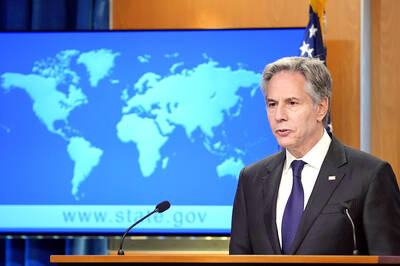
Beijing is continuing to commit genocide and crimes against humanity against Uyghurs and other Muslim minorities in its western Xinjiang province, U.S. Secretary of State Antony Blinken said in a report published on Monday, ahead of his planned visit to China this week. The State Department’s annual human rights report, which documents abuses recorded all over the world during the previous calendar year, repeated language from previous years on the treatment of Muslims in Xinjiang, but the publication raises the issue ahead of delicate talks, including on the war in Ukraine and global trade, between the top U.S. diplomat and Chinese


 RSS
RSS