


Violent clashes marred huge May Day rallies around the world on Tuesday, as Fidel Castro failed to show up for Cuba's celebrations.
As other South American presidents marched at the heads of large rallies, Castro disappointed many supporters by staying away from Havana's annual May Day, which would have been his first public appearance since undergoing major surgery nine months ago.
It was only the third time since he took power in 1949 that Castro missed a May Day fete; the other two occasions were only because he was traveling at the time.
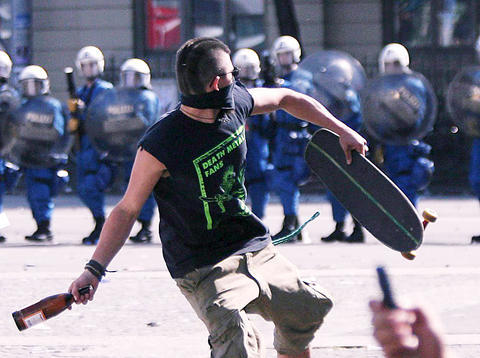
PHOTO: AP
Workers marched through towns and cities around the world in a show of global solidarity, calling for better pay and conditions, and highlighting social and political inequities. But in many places tensions and political divisions spilled over into clashes between extremists or with police.
The worst violence was in Istanbul, where police fired shots in the air and used tear gas and water cannons to disperse left-wing demonstrators intent on holding a banned rally in a central city square. More than 700 people were detained, according to police.
In Chile police arrested a dozen people at a rally of about 10,000 people after clashes broke out.
There was violence too in other parts of the world.
In Berlin some 120 people were arrested in violence between demonstrators and police, as neo-Nazis and counter-protesters faced off across the country.
Anarchist groups and far-right groups also seized on the day to provoke trouble in the Czech Republic, with police saying they had arrested dozens of people.
Ecuador's President Rafael Correa, an economist, led a large demonstration in Quito and railed against the power of foreign multinationals in his country where unemployment has soared to 10.3 percent.
"We are being exploited by the wealthy multinationals. They are on the lookout for the country which gives them the greatest benefit and the best returns for their capital. This has to end," he told thousands of protesters.
In Nicaragua, Sandinista leader Daniel Ortega, who returned to power at the beginning of the year, also led a march of young civil servants, students and poor people, many of whom had travelled in from the provinces.
Meanwhile, history was made in the South Korean city of Changwon, when 2,000 workers, including 60 from North Korea, waved "unification flags" during a special rally for reuniting the Korean Peninsula.
It was the first time since the Korean War that North Korean workers had visited the South for the annual labor festival.
Hundreds of Iranians took to the streets of Tehran to demand better working conditions, while 100,000 Italian union activists marched in Turin and more than 117,000 took to the streets in France.
Although the May Day rallies were inspired by a first march held in Chicago in 1886, the day is not marked by labor groups in the US.
However, for the second year running tens of thousands marched in several US cities, notably Los Angeles and Chicago, to demand more rights for the 12 million illegal immigrants who do many of the menial jobs which US citizens snub.
For some there was cause to celebrate though. Kenyan President Mwai Kibaki promised free education in public secondary schools starting next year, while Burundi President Pierre Nkurunziza awarded overnment workers a 34 percent pay rise.
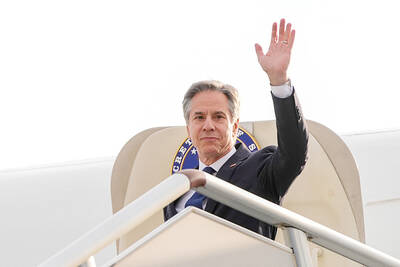
‘IN A DIFFERENT PLACE’: The envoy first visited Shanghai, where he attended a Chinese basketball playoff match, and is to meet top officials in Beijing tomorrow US Secretary of State Antony Blinken yesterday arrived in China on his second visit in a year as the US ramps up pressure on its rival over its support for Russia while also seeking to manage tensions with Beijing. The US diplomat tomorrow is to meet China’s top brass in Beijing, where he is also expected to plead for restraint as Taiwan inaugurates president-elect William Lai (賴清德), and to raise US concerns on Chinese trade practices. However, Blinken is also seeking to stabilize ties, with tensions between the world’s two largest economies easing since his previous visit in June last year. At the

UNSETTLING IMAGES: The scene took place in front of TV crews covering the Trump trial, with a CNN anchor calling it an ‘emotional and unbelievably disturbing moment’ A man who doused himself in an accelerant and set himself on fire outside the courthouse where former US president Donald Trump is on trial has died, police said yesterday. The New York City Police Department (NYPD) said the man was declared dead by staff at an area hospital. The man was in Collect Pond Park at about 1:30pm on Friday when he took out pamphlets espousing conspiracy theories, tossed them around, then doused himself in an accelerant and set himself on fire, officials and witnesses said. A large number of police officers were nearby when it happened. Some officers and bystanders rushed
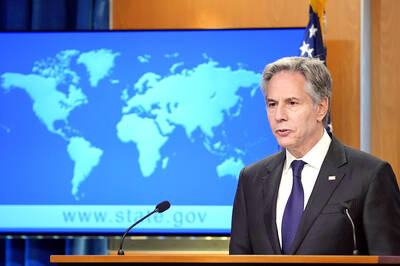
Beijing is continuing to commit genocide and crimes against humanity against Uyghurs and other Muslim minorities in its western Xinjiang province, U.S. Secretary of State Antony Blinken said in a report published on Monday, ahead of his planned visit to China this week. The State Department’s annual human rights report, which documents abuses recorded all over the world during the previous calendar year, repeated language from previous years on the treatment of Muslims in Xinjiang, but the publication raises the issue ahead of delicate talks, including on the war in Ukraine and global trade, between the top U.S. diplomat and Chinese
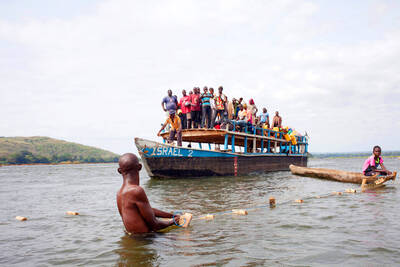
RIVER TRAGEDY: Local fishers and residents helped rescue people after the vessel capsized, while motorbike taxis evacuated some of the injured At least 58 people going to a funeral died after their overloaded river boat capsized in the Central African Republic’s (CAR) capital, Bangui, the head of civil protection said on Saturday. “We were able to extract 58 lifeless bodies,” Thomas Djimasse told Radio Guira. “We don’t know the total number of people who are underwater. According to witnesses and videos on social media, the wooden boat was carrying more than 300 people — some standing and others perched on wooden structures — when it sank on the Mpoko River on Friday. The vessel was heading to the funeral of a village chief in


 RSS
RSS