


A demand by China, India and Brazil that rich nations accept that they are mainly responsible for global warming has held up progress at a key UN climate change conference here, delegates said yesterday.
The three nations' insistence since the talks started on Monday that the developed world recognize their dominant role in climate change has taken up precious time meant for debate on how best to tackle global warming, they said.
"Progress is slow," one delegate from a European nation, who asked not to be identified, said.
"Brazil, India and China are trying to put on the shoulders of industrialized nations the historic responsibility for greenhouse gas emissions in order to clear their own emissions [of blame] and to protect themselves in any discussion," the delegate said.
At least 400 scientists and experts from about 120 countries are attending the week-long third session of the Intergovernmental Panel on Climate Change (IPCC), the UN's leading authority on global warming.
Their report, expected to be released at the end of their meeting tomorrow, aims to lay out ways to reduce greenhouse gas emissions and prevent a climate catastrophe without seriously hurting the global economy.
But China has also insisted on specific figures, which lay the blame for global warming on rich nations, be inserted into the conclusions, according to documents obtained by Agence France- Presse.
Industrialized countries should formally recognize that they were responsible for 95 percent of greenhouse gas emissions from the pre-industrial era to 1950, and for 77 percent from 1950 to 2000, according to China's submission to the IPCC.
One of the French delegates, Renaud Crassous, said China was proving to be a dominant force in this week's talks.
"China is distrustful regarding everything that could draw a conclusion that it is easy to reduce emissions," Crassous said.
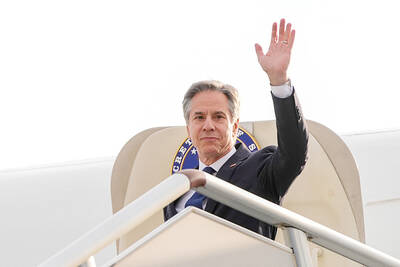
‘IN A DIFFERENT PLACE’: The envoy first visited Shanghai, where he attended a Chinese basketball playoff match, and is to meet top officials in Beijing tomorrow US Secretary of State Antony Blinken yesterday arrived in China on his second visit in a year as the US ramps up pressure on its rival over its support for Russia while also seeking to manage tensions with Beijing. The US diplomat tomorrow is to meet China’s top brass in Beijing, where he is also expected to plead for restraint as Taiwan inaugurates president-elect William Lai (賴清德), and to raise US concerns on Chinese trade practices. However, Blinken is also seeking to stabilize ties, with tensions between the world’s two largest economies easing since his previous visit in June last year. At the
Nearly half of China’s major cities are suffering “moderate to severe” levels of subsidence, putting millions of people at risk of flooding, especially as sea levels rise, according to a study of nationwide satellite data released yesterday. The authors of the paper, published by the journal Science, found that 45 percent of China’s urban land was sinking faster than 3mm per year, with 16 percent at more than 10mm per year, driven not only by declining water tables, but also the sheer weight of the built environment. With China’s urban population already in excess of 900 million people, “even a small portion

UNSETTLING IMAGES: The scene took place in front of TV crews covering the Trump trial, with a CNN anchor calling it an ‘emotional and unbelievably disturbing moment’ A man who doused himself in an accelerant and set himself on fire outside the courthouse where former US president Donald Trump is on trial has died, police said yesterday. The New York City Police Department (NYPD) said the man was declared dead by staff at an area hospital. The man was in Collect Pond Park at about 1:30pm on Friday when he took out pamphlets espousing conspiracy theories, tossed them around, then doused himself in an accelerant and set himself on fire, officials and witnesses said. A large number of police officers were nearby when it happened. Some officers and bystanders rushed
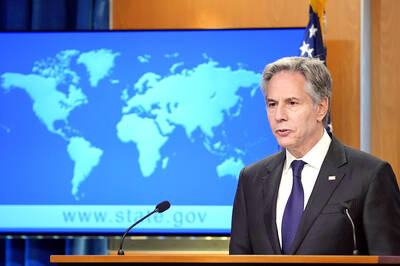
Beijing is continuing to commit genocide and crimes against humanity against Uyghurs and other Muslim minorities in its western Xinjiang province, U.S. Secretary of State Antony Blinken said in a report published on Monday, ahead of his planned visit to China this week. The State Department’s annual human rights report, which documents abuses recorded all over the world during the previous calendar year, repeated language from previous years on the treatment of Muslims in Xinjiang, but the publication raises the issue ahead of delicate talks, including on the war in Ukraine and global trade, between the top U.S. diplomat and Chinese


 RSS
RSS