


Two suicide car bombers rammed their vehicles into a Baghdad police station yesterday, killing 12 people in one of the worst attacks aimed at Iraq's security forces since a security crackdown was launched in the city.
The bombings in the mostly Shiite al-Bayaa neighborhood in southwestern Baghdad wounded 95, police said.
Most of the dead were civilians, police said, reversing earlier statements that mainly police had been killed.
The blasts damaged the police station and also largely destroyed a garage next door, collapsing rubble onto a dozen cars.
"Look at the situation Iraqis are living in. You see blasts whenever you try to go out to earn a living," said one witness.
In a separate attack, a car bomb in a Shiite enclave in the mostly Sunni neighborhood of Saidiya in southern Baghdad killed up to five civilians and wounded 25 people, police said.
A source at Yarmouk hospital said the hospital had received seven bodies after the blast. A policeman who arrived in the area shortly after the attack was killed when his vehicle was hit by a roadside bomb, police said.
Meanwhile, unidentified gunmen dragged 23 members of northern Iraq's Yazidi religious minority from a bus yesterday and shot them dead by the roadside, police Brigadier General Mohammed El-Waqa'a said.
"Workers were travelling back from a textile plant in Mosul to their home in Bashika, east of the city," he said. "Several gunmen stopped the buses, chose the Yazidis among the passengers and killed them in front of everybody."
Police said a group of cars blocked the road in the Al-Nur neighborhood of east Mosul, while others set up a cordon to protect the gang that stormed the bus convoy. The captives were executed on a field by the road. Three wounded Yazidis survived, officers said.
The Yazidis, who numbers some 500,000, mainly in northern Iraq, speak a dialect of Kurdish but follow a pre-Islamic religion and have their own cultural traditions.
In other developments, the US commander in Iraq, General David Petraeus, said in remarks published yesterday that a recent troop build-up had yielded modest progress but a rise in suicide bombings made the ultimate success of the crackdown uncertain.
Petraeus and other senior US officers in Iraq told the Washington Post the increase in US and Iraqi troops had improved security in Baghdad and western Anbar Province but that attacks had risen sharply in other regions.
"We have certainly pulled neighborhoods back from the brink," Petraeus was quoted as saying.
But the commanders said the increase in suicide bomb attacks was troubling because of the danger of reigniting sectarian revenge killings and undermining the government of Shiite Prime Minister Nuri al-Maliki.
"I don't think you're ever going to get rid of all the car bombs," Petraeus said. "Iraq is going to have to learn -- as did, say, Northern Ireland -- to live with some degree of sensational attacks."
The US military said yesterday it was putting up concrete walls to protect five neighborhoods in Baghdad. Some residents said the move would isolate them and sharpen sectarian tensions.
"We are not sealing off neighborhoods, we are controlling access to them. It's a tactic, it's not a change in strategy to divide Baghdad along sectarian lines," military spokesman Lieutenant-Colonel Scott Bleichwehl said.
The announcement that more "gated communities" are being built came after the US military said last week it was putting a 5km cement wall around Adhamiya, a mainly Sunni Arab area that is surrounded on three sides by Shiite communities.
Um Othman, 45, a teacher, said residents in Adhamiya regarded the concrete barriers as an "isolating wall."
"It will be like Palestine. The people of Adhamiya and neighboring districts have mutual historical relations, like religious festivals and marriage," she said.

As the sun sets on another scorching Yangon day, the hot and bothered descend on the Myanmar city’s parks, the coolest place to spend an evening during yet another power blackout. A wave of exceptionally hot weather has blasted Southeast Asia this week, sending the mercury to 45°C and prompting thousands of schools to suspend in-person classes. Even before the chaos and conflict unleashed by the military’s 2021 coup, Myanmar’s creaky and outdated electricity grid struggled to keep fans whirling and air conditioners humming during the hot season. Now, infrastructure attacks and dwindling offshore gas reserves mean those who cannot afford expensive diesel

Does Argentine President Javier Milei communicate with a ghost dog whose death he refuses to accept? Forced to respond to questions about his mental health, the president’s office has lashed out at “disrespectful” speculation. Twice this week, presidential spokesman Manuel Adorni was asked about Milei’s English Mastiff, Conan, said to have died seven years ago. Milei, 53, had Conan cloned, and today is believed to own four copies he refers to as “four-legged children.” Or is it five? In an interview with CNN this month, Milei referred to his five dogs, whose faces and names he had engraved on the presidential baton. Conan,

French singer Kendji Girac, who was seriously injured by a gunshot this week, wanted to “fake” his suicide to scare his partner who was threatening to leave him, prosecutors said on Thursday. The 27-year-old former winner of France’s version of The Voice was found wounded after police were called to a traveler camp in Biscarrosse on France’s southwestern coast. Girac told first responders he had accidentally shot himself while tinkering with a Colt .45 automatic pistol he had bought at a junk shop, a source said. On Thursday, regional prosecutor Olivier Janson said, citing the singer, that he wanted to “fake” his suicide
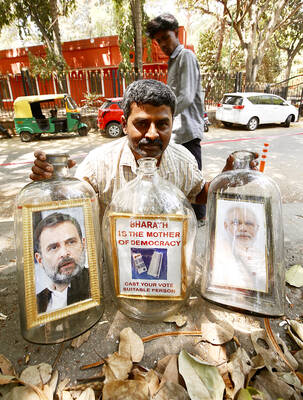
Indian Prime Minister Narendra Modi reaffirmed his pledge to replace India’s religion-based marriage and inheritance laws with a uniform civil code if he returns to office for a third term, a move that some minority groups have opposed. In an interview with the Times of India listing his agenda, Modi said his government would push for making the code a reality. “It is clear that separate laws for communities are detrimental to the health of society,” he said in the interview published yesterday. “We cannot be a nation where one community is progressing with the support of the Constitution while the other


 RSS
RSS