


Chinese Premier Wen Jiabao (
In the first address for 22 years by a Chinese leader to the parliament in Tokyo, Wen urged Japan not to forget its past but acknowledged its people had also been the victims of war.
Earlier, he took his fence-mending visit to Japan to the streets, going for a jog around a Tokyo park and chatting with members of the public.
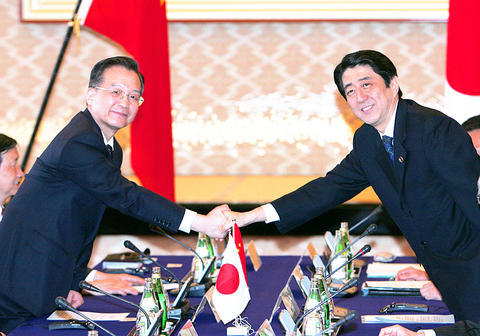
PHOTO: AP
In parliament, the flags of the two countries mounted on the podium behind, Wen called on the two powers to look to the future.
"The Chinese public must foster friendship with Japanese people," he said, and laid the blame for Japan's invasion and 1931-1945 occupation of China -- a running sore for many Chinese -- on a "limited number" of wartime leaders.
"As the Chinese leaders of the past generations have said, the responsibility for the war of aggression should rest with a limited number of militarists."
"The general Japanese public were also victims of the war," added Wen, who is making the first visit here by a Chinese leader in seven years.
Relations between Asia's two largest economies were badly strained during the 2001-2006 premiership of Japan's Junichiro Koizumi, who repeatedly visited a war shrine that Beijing and Seoul associate with imperialism.
Just days after Koizumi left office, Prime Minister Shinzo Abe -- who made his career as a hardliner on emotive history issues -- travelled to Beijing in October.
Wen, who met Abe on Wednesday for dinner of sushi and Japanese beef, said that while the Japanese premier's visit to Beijing broke the ice, he aimed to "melt" the ice with this trip to Tokyo.
But in a possible warning to Abe not to visit the Yasukuni shrine, Wen said he expected Japan to continue to show regret for the past.
"Japanese leaders have expressed their views on history time and time again. They admitted the invasion and expressed their deep regret and apologies to the countries that fell victims," he said.
"The Chinese government and the public appreciate that profoundly. We hope Japan will turn the expression into action as promised."
Earlier, wearing black sportswear bearing the logos of next year's Beijing Olympics, the 64-year-old Wen jogged around a Tokyo park, chatted with members of the public and showed off a few tai chi moves.
"What do you do for a living?" Wen asked one woman through a translator, as security guards looked on.
"I am a barber," she replied in Japanese.
"I am Wen Jiabao," he said.
Despite tensions over their past, China and Japan have become increasingly economically interlinked, with Japan counting on its giant neighbor as a vital source both for workers and for middle-class consumers.
Wen later attended a lunch with Japanese business leaders where he pledged to keep working to fight counterfeiting -- a major concern for investors in China's booming economy.
Takehiko Yamamoto, a professor of international politics at Tokyo's Waseda University, said Wen's visit showed that the two countries saw mutual interests in improving ties.
But he warned that "the gap on their recognition of history is still far apart."
"Any visit to Yasukuni by Abe would be explosive and easily blow relations away," he said.
China, the only Asian nation with veto power on the UN Security Council, in 2005 cited the shrine dispute in scuttling Japan's cherished bid for its own permanent seat on the world body.
Wen appeared to moderate that stance, saying China "will forever remember" Japan's aid since the war and that he understood "Japan's desire to play a yet greater role" in the world.
"China-Japan relations have come under rains and winds," Wen said.
"But the foundation of the friendly ties between the Chinese and Japanese people are as unshakeable as Mount Tai and Mount Fuji."
Editorial: Same old tune, still off-key
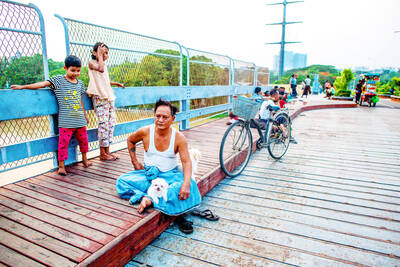
As the sun sets on another scorching Yangon day, the hot and bothered descend on the Myanmar city’s parks, the coolest place to spend an evening during yet another power blackout. A wave of exceptionally hot weather has blasted Southeast Asia this week, sending the mercury to 45°C and prompting thousands of schools to suspend in-person classes. Even before the chaos and conflict unleashed by the military’s 2021 coup, Myanmar’s creaky and outdated electricity grid struggled to keep fans whirling and air conditioners humming during the hot season. Now, infrastructure attacks and dwindling offshore gas reserves mean those who cannot afford expensive diesel

Does Argentine President Javier Milei communicate with a ghost dog whose death he refuses to accept? Forced to respond to questions about his mental health, the president’s office has lashed out at “disrespectful” speculation. Twice this week, presidential spokesman Manuel Adorni was asked about Milei’s English Mastiff, Conan, said to have died seven years ago. Milei, 53, had Conan cloned, and today is believed to own four copies he refers to as “four-legged children.” Or is it five? In an interview with CNN this month, Milei referred to his five dogs, whose faces and names he had engraved on the presidential baton. Conan,

Le Tuan Binh keeps his Moroccan soldier father’s tombstone at his village home north of Hanoi, a treasured reminder of a man whose community in Vietnam has been largely forgotten. Mzid Ben Ali, or “Mohammed” as Binh calls him, was one of tens of thousands of North Africans who served in the French army as it battled to maintain its colonial rule of Indochina. He fought for France against the Viet Minh independence movement in the 1950s, before leaving the military — as either a defector or a captive — and making a life for himself in Vietnam. “It’s very emotional for me,”
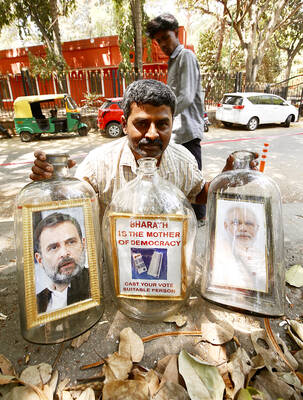
Indian Prime Minister Narendra Modi reaffirmed his pledge to replace India’s religion-based marriage and inheritance laws with a uniform civil code if he returns to office for a third term, a move that some minority groups have opposed. In an interview with the Times of India listing his agenda, Modi said his government would push for making the code a reality. “It is clear that separate laws for communities are detrimental to the health of society,” he said in the interview published yesterday. “We cannot be a nation where one community is progressing with the support of the Constitution while the other


 RSS
RSS