


Canadian Prime Minister Stephen Harper on Sunday began commemorations to mark the 90th anniversary of the battle of Vimy Ridge, a painful World War I victory in France that helped firm Canada's national identity.
"The events here 90 years ago were, for our country, a coming of age," he said in a speech after 300 Canadian soldiers ended a parade through this northern French town that was watched by thousands waving French and Canadian flags.
"At the Battle of Vimy Ridge, troops representing all four divisions of the Canadian Army fought together for the first time, achieving a spectacular victory that affirmed our national identity and national character."
Accompanied by Britain's Queen Elizabeth II and French Prime Minister Dominique de Villepin, the prime minister, was due to lay a wreath yesterday at the Canadian National Vimy Memorial near Arras.
The event will commemorate a battle that began at 5:30am on April 9, 1917, when almost 100,000 Canadian soldiers charged Vimy Ridge, which the German army had fortified heavily with trenches, barbed wire, artillery and machine-gun nests.
A total of 3,598 Canadian troops were killed and 7,004 were wounded over four days of fighting as they slowly took control of the escarpment.
The victory was a strategic breakthrough that had eluded their British and French allies for two years.
"In those few minutes I witnessed the birth of a nation," Brigadier General Alexander Ross, who commanded the 28th Battalion at Vimy, said when a huge memorial was unveiled on the battleground in 1936.
"It was Canada from the Atlantic to the Pacific on parade."
The victory triggered Canadian pride in the courage of its soldiers and defined a sense of nationhood in the former British colony.
A Canadian soldier killed at Vimy Ridge was buried with full military honors on Saturday.
The body of Private Herbert Peterson was discovered in 2003 and identified through DNA testing. He was buried in La Chaudiere cemetery in the shadow of the ridge near Arras at a ceremony attended by relatives.
The delegation due to attend yesterday's ceremony was to hold a minute's silence and the Last Post -- the bugle call performed at military funerals -- was to be played.
The day's events was also to include a parade of flaming torches.
Hundreds of high school students wearing replica World War I tunics stitched with the name of a soldier who fought in the conflict were also expected to attend the dedication of the newly restored memorial.
Some 7,000 Canadians were expected to attend the event.
More than 600,000 Canadians fought in World War I (1914-1918) and some 66,000 died. Only two Canadian veterans of the conflict are still alive.
The Canadian National Vimy Memorial with its twin pylons towering 30m above a sprawling stone platform represents the solidarity of France and Canada, adorned with carved statues symbolizing peace, sacrifice and mourning.
Designed by Canadian architect Walter Seymour Allward, it took 11 years to build.
It was not dedicated to military conquest and glory but recalled the legions who sacrificed their lives -- a sentiment not previously expressed in war memorials.
Ottawa recently spent C$20 million (US$17.4 million) to restore it for this occasion.
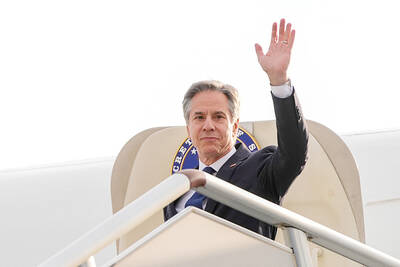
‘IN A DIFFERENT PLACE’: The envoy first visited Shanghai, where he attended a Chinese basketball playoff match, and is to meet top officials in Beijing tomorrow US Secretary of State Antony Blinken yesterday arrived in China on his second visit in a year as the US ramps up pressure on its rival over its support for Russia while also seeking to manage tensions with Beijing. The US diplomat tomorrow is to meet China’s top brass in Beijing, where he is also expected to plead for restraint as Taiwan inaugurates president-elect William Lai (賴清德), and to raise US concerns on Chinese trade practices. However, Blinken is also seeking to stabilize ties, with tensions between the world’s two largest economies easing since his previous visit in June last year. At the

UNSETTLING IMAGES: The scene took place in front of TV crews covering the Trump trial, with a CNN anchor calling it an ‘emotional and unbelievably disturbing moment’ A man who doused himself in an accelerant and set himself on fire outside the courthouse where former US president Donald Trump is on trial has died, police said yesterday. The New York City Police Department (NYPD) said the man was declared dead by staff at an area hospital. The man was in Collect Pond Park at about 1:30pm on Friday when he took out pamphlets espousing conspiracy theories, tossed them around, then doused himself in an accelerant and set himself on fire, officials and witnesses said. A large number of police officers were nearby when it happened. Some officers and bystanders rushed
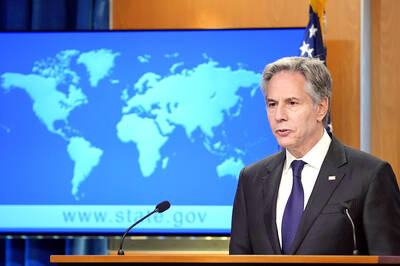
Beijing is continuing to commit genocide and crimes against humanity against Uyghurs and other Muslim minorities in its western Xinjiang province, U.S. Secretary of State Antony Blinken said in a report published on Monday, ahead of his planned visit to China this week. The State Department’s annual human rights report, which documents abuses recorded all over the world during the previous calendar year, repeated language from previous years on the treatment of Muslims in Xinjiang, but the publication raises the issue ahead of delicate talks, including on the war in Ukraine and global trade, between the top U.S. diplomat and Chinese
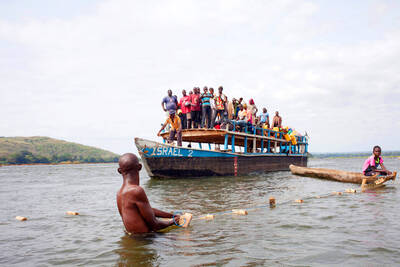
RIVER TRAGEDY: Local fishers and residents helped rescue people after the vessel capsized, while motorbike taxis evacuated some of the injured At least 58 people going to a funeral died after their overloaded river boat capsized in the Central African Republic’s (CAR) capital, Bangui, the head of civil protection said on Saturday. “We were able to extract 58 lifeless bodies,” Thomas Djimasse told Radio Guira. “We don’t know the total number of people who are underwater. According to witnesses and videos on social media, the wooden boat was carrying more than 300 people — some standing and others perched on wooden structures — when it sank on the Mpoko River on Friday. The vessel was heading to the funeral of a village chief in


 RSS
RSS