


The US military -- increasing its reliance on robots in war -- will soon be using explosive-sniffing robots to better detect roadside bombs which account for more than 70 percent of the US casualties in Iraq.
Fido is the first robot with an explosives sensor integrated into its body. iRobot Corp is filling the military's first order of 100 in Dayton, Ohio, and will begin shipping the robots over the next few months.
There are nearly 5,000 robots in Iraq and Afghanistan, up from about 150 in 2004. Soldiers use them to search caves and buildings for insurgents, detect mines and ferret out roadside and car bombs.
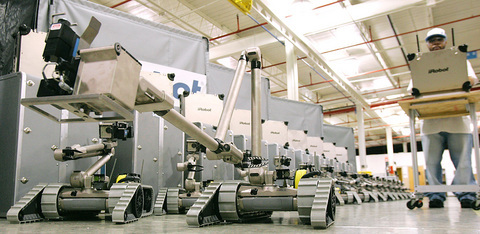
PHOTO: AP
As the war in Iraq enters its fifth year, the US government is spending more money on military robots and the two major US robot makers have increased production.
Foster-Miller Inc, of Waltham, Massachusetts, just delivered 1,000 new robots to the military. iRobot, of Burlington, Massachusetts, cranked out 385 robots last year, up from 252 in 2005.
The government will spend a total of about US$1.7 billion on ground-based military robots between fiscal 2006 and 2012, said Bill Thomasmeyer, head of the National Center for Defense Robotics, a congressionally funded consortium of 160 firms, universities and government labs. That's up from US$100 million in fiscal 2004.
Fido, produced at the GEM City Manufacturing and Engineering plant in Dayton, represents an improvement in bomb-detecting robots, said Colonel Terry Griffin, project manager of the Army and Marine Corps Robotic Systems Joint Project Office in Alabama.
The bomb-sniffing sensor is part of the robot, with its readings displayed on the controller along with camera images. Otherwise, a soldier would have to approach the suspicious object with a sensor or try to attach it to a robot. The new robot also has a 2m-long manipulator arm so it can use the sensor to scan the inside and undercarriages of vehicles for bombs.
Officials would not release details of how the sensors work because of security concerns.
"The sniffer robot is a very good idea because we need some way of understanding ambiguous situations like abandoned cars or suspicious trash piles without putting soldiers' lives on the line," said Loren Thompson, defense analyst with the Washington-based Lexington Institute.
Philip Coyle, senior adviser to the Center for Defense Information in Washington, said the robots could be helpful if they are used in cases where soldiers already suspect a bomb.
But he said explosive-sniffing sensors are susceptible to false positives triggered by explosive residues elsewhere in the area, smoke and other contaminants.
Thompson said all military robots have limitations. Their every move must be dictated by an operator, they can be stopped by barriers or steep grades, they are not highly agile, and they can break down or be damaged, he said.
Robots range in size from as little as 700g to 50kg versions that can move rubble and lift debris. Fido is an upgrade of PackBot, a 23.6kg robot with rubber treads, lights, video cameras that zoom and swivel, obstacle-hurdling flippers and jointed manipulator arms with hand-like grippers designed to disable or destroy bombs.

As the sun sets on another scorching Yangon day, the hot and bothered descend on the Myanmar city’s parks, the coolest place to spend an evening during yet another power blackout. A wave of exceptionally hot weather has blasted Southeast Asia this week, sending the mercury to 45°C and prompting thousands of schools to suspend in-person classes. Even before the chaos and conflict unleashed by the military’s 2021 coup, Myanmar’s creaky and outdated electricity grid struggled to keep fans whirling and air conditioners humming during the hot season. Now, infrastructure attacks and dwindling offshore gas reserves mean those who cannot afford expensive diesel

Does Argentine President Javier Milei communicate with a ghost dog whose death he refuses to accept? Forced to respond to questions about his mental health, the president’s office has lashed out at “disrespectful” speculation. Twice this week, presidential spokesman Manuel Adorni was asked about Milei’s English Mastiff, Conan, said to have died seven years ago. Milei, 53, had Conan cloned, and today is believed to own four copies he refers to as “four-legged children.” Or is it five? In an interview with CNN this month, Milei referred to his five dogs, whose faces and names he had engraved on the presidential baton. Conan,

‘IN A DIFFERENT PLACE’: The envoy first visited Shanghai, where he attended a Chinese basketball playoff match, and is to meet top officials in Beijing tomorrow US Secretary of State Antony Blinken yesterday arrived in China on his second visit in a year as the US ramps up pressure on its rival over its support for Russia while also seeking to manage tensions with Beijing. The US diplomat tomorrow is to meet China’s top brass in Beijing, where he is also expected to plead for restraint as Taiwan inaugurates president-elect William Lai (賴清德), and to raise US concerns on Chinese trade practices. However, Blinken is also seeking to stabilize ties, with tensions between the world’s two largest economies easing since his previous visit in June last year. At the

French singer Kendji Girac, who was seriously injured by a gunshot this week, wanted to “fake” his suicide to scare his partner who was threatening to leave him, prosecutors said on Thursday. The 27-year-old former winner of France’s version of The Voice was found wounded after police were called to a traveler camp in Biscarrosse on France’s southwestern coast. Girac told first responders he had accidentally shot himself while tinkering with a Colt .45 automatic pistol he had bought at a junk shop, a source said. On Thursday, regional prosecutor Olivier Janson said, citing the singer, that he wanted to “fake” his suicide


 RSS
RSS