


China's military is proposing officer exchanges and other confidence-building measures with the US armed forces and may be inching closer to setting up a "hot line" for emergency communication with Washington, the top US general said yesterday.
However, Marine General Peter Pace, chairman of the Joint Chiefs of Staff, said he received no new information in meetings with Chinese military chiefs about Beijing's test of an anti-satellite weapon in January that raised major concerns in Washington.
He said he continued to press China's generals for more transparency about the aims of their military buildup.
"I used the example of the anti-satellite test as how sometimes the international community can be confused because it was a surprise that China did that and it wasn't clear what their intent was," Pace said.
Pace said that he immediately agreed to study the proposals put forward by General Liang Guanglie (
"To me this was a very good, open discussion and one that I found very encouraging," Pace told reporters in Beijing.
He said Liang's proposals included sending Chinese cadets to the US Army academy at West Point, and other academic exchanges, as well as observing or participating in joint exercises and humanitarian and relief-at-sea operations "that might be able to build trust and confidence amongst our forces."
Military exchanges were largely suspended following a collision between a US spy plane and a Chinese jet fighter over the South China Sea in 2001.
The Chinese pilot was killed and the US crew held captive after making an emergency landing at a Chinese air base.
During that crisis, communication between the sides was spotty and at times nonexistent, largely because Washington had no direct channel of communications with the Chinese leadership.
Pace said the sides agreed to keep discussing setting up a "hot line" between either military or civilian leaders that would help ease any future friction.
"The Chinese military understands as well as I do that the opportunity to pick up the phone and talk to somebody you know and smooth out misunderstandings quickly is a very important part of relations between two countries," Pace said.
Deep mistrust remains, however, particularly over Washington's close military ties with Japan and commitment to help ensure the defense of Taiwan, which China has threatened to use force to recover.
China has complained about US plans to sell a batch of more than 400 missiles to Taiwan, but Pace said he had no details and didn't indicate whether the deal was mentioned in discussions.
Asked about the possibility of a conflict over Taiwan, he said: "I believe there are good faith efforts among all the leadership to prevent that."
The general didn't say how the Chinese officers responded to his calls for more transparency.
China raised its military budget by 17.8 percent this year to about US$45 billion -- the biggest jump since 1995.
The Pentagon believes actual Chinese defense spending could be twice as high.
The spending boost and the satellite test in January, in which China became only the third country to destroy an object in space by pulverizing one of its own unused satellites with a missile warhead, heightened the sense of unease in Washington over China's 2.3 million member armed forces.
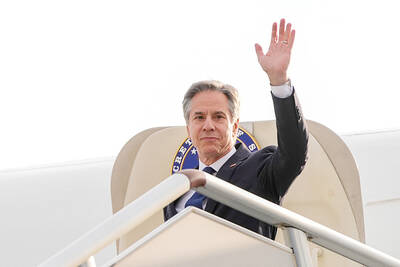
‘IN A DIFFERENT PLACE’: The envoy first visited Shanghai, where he attended a Chinese basketball playoff match, and is to meet top officials in Beijing tomorrow US Secretary of State Antony Blinken yesterday arrived in China on his second visit in a year as the US ramps up pressure on its rival over its support for Russia while also seeking to manage tensions with Beijing. The US diplomat tomorrow is to meet China’s top brass in Beijing, where he is also expected to plead for restraint as Taiwan inaugurates president-elect William Lai (賴清德), and to raise US concerns on Chinese trade practices. However, Blinken is also seeking to stabilize ties, with tensions between the world’s two largest economies easing since his previous visit in June last year. At the
Nearly half of China’s major cities are suffering “moderate to severe” levels of subsidence, putting millions of people at risk of flooding, especially as sea levels rise, according to a study of nationwide satellite data released yesterday. The authors of the paper, published by the journal Science, found that 45 percent of China’s urban land was sinking faster than 3mm per year, with 16 percent at more than 10mm per year, driven not only by declining water tables, but also the sheer weight of the built environment. With China’s urban population already in excess of 900 million people, “even a small portion

UNSETTLING IMAGES: The scene took place in front of TV crews covering the Trump trial, with a CNN anchor calling it an ‘emotional and unbelievably disturbing moment’ A man who doused himself in an accelerant and set himself on fire outside the courthouse where former US president Donald Trump is on trial has died, police said yesterday. The New York City Police Department (NYPD) said the man was declared dead by staff at an area hospital. The man was in Collect Pond Park at about 1:30pm on Friday when he took out pamphlets espousing conspiracy theories, tossed them around, then doused himself in an accelerant and set himself on fire, officials and witnesses said. A large number of police officers were nearby when it happened. Some officers and bystanders rushed
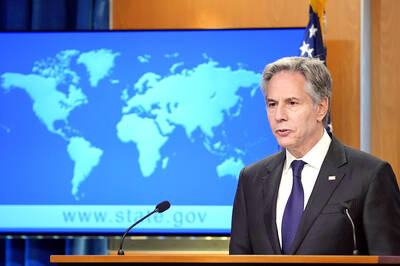
Beijing is continuing to commit genocide and crimes against humanity against Uyghurs and other Muslim minorities in its western Xinjiang province, U.S. Secretary of State Antony Blinken said in a report published on Monday, ahead of his planned visit to China this week. The State Department’s annual human rights report, which documents abuses recorded all over the world during the previous calendar year, repeated language from previous years on the treatment of Muslims in Xinjiang, but the publication raises the issue ahead of delicate talks, including on the war in Ukraine and global trade, between the top U.S. diplomat and Chinese


 RSS
RSS