


South Africa's environment minister offered a new plan on Wednesday to control the nation's booming elephant population that contemplates resuming the much-criticized killing of excess animals, but only after thorough scientific study and as a last resort.
Without some form of population control, elephants will soon overwhelm the public parks and private game reserves where they can still roam free, the minister, Marthinus van Schalkwyk, warned.
Van Schalkwyk's proposal, unveiled at an elephant reserve in the nation's southeast, appeared to defuse for now a looming confrontation between environmentalists and game managers over ways to manage the nation's 20,000 elephants.
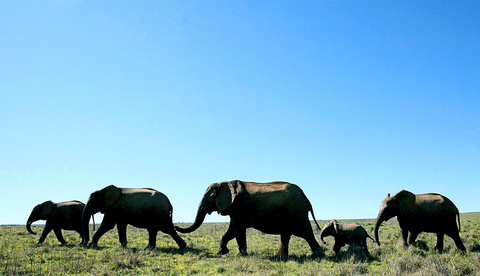
PHOTO: EPA
National park officials have already considered a mass killing, or culling, of the 12,500 or more elephants in Kruger National Park, South Africa's biggest wildlife reserve, contending that the park can support only 7,500 animals. Some conservationists have agreed, saying that preserving the park's biological diversity is more important than saving elephants.
But some environmentalists argue that the killings are both unnecessary and inhumane, given elephants' high intelligence and complex social structure.
South Africa had ordered the killing of more than 14,000 elephants in Kruger until an international outcry helped bring about a moratorium in 1995. Opponents of culling have threatened to start a boycott of South Africa tourism if a new culling campaign is approved.
Van Schalkwyk made it clear on Wednesday that any cullings would be both limited and approved only after other options had been exhausted.
The new proposal envisions a range of methods to address the rising number of elephants, including contraception and luring elephants from crowded parks to vacant spaces.
There are no quick options. Contraception is not a simple solution, in part because it subjects female elephants to great stress from more frequent matings with heavy bulls. Nor is it easy to relocate elephant herds.
Van Schalkwyk also allotted about US$700,000 for scientists to study elephant management techniques and to address some basic questions, including whether the existing population is straining the habitat as much as some say.
That elephants are destructive is unquestioned. African elephants can eat as much as 5 percent of their weight and drink up to 189l of water a day, and herds have been known to reduce forests and bushlands to treeless expanses of weeds, grass and broken stumps.
The government says that South African herds are growing at a rate of 6 percent a year. Left unchecked, officials say, the national elephant population will rise from 20,000 today to 34,000 in 2020.

‘IN A DIFFERENT PLACE’: The envoy first visited Shanghai, where he attended a Chinese basketball playoff match, and is to meet top officials in Beijing tomorrow US Secretary of State Antony Blinken yesterday arrived in China on his second visit in a year as the US ramps up pressure on its rival over its support for Russia while also seeking to manage tensions with Beijing. The US diplomat tomorrow is to meet China’s top brass in Beijing, where he is also expected to plead for restraint as Taiwan inaugurates president-elect William Lai (賴清德), and to raise US concerns on Chinese trade practices. However, Blinken is also seeking to stabilize ties, with tensions between the world’s two largest economies easing since his previous visit in June last year. At the
Nearly half of China’s major cities are suffering “moderate to severe” levels of subsidence, putting millions of people at risk of flooding, especially as sea levels rise, according to a study of nationwide satellite data released yesterday. The authors of the paper, published by the journal Science, found that 45 percent of China’s urban land was sinking faster than 3mm per year, with 16 percent at more than 10mm per year, driven not only by declining water tables, but also the sheer weight of the built environment. With China’s urban population already in excess of 900 million people, “even a small portion

UNSETTLING IMAGES: The scene took place in front of TV crews covering the Trump trial, with a CNN anchor calling it an ‘emotional and unbelievably disturbing moment’ A man who doused himself in an accelerant and set himself on fire outside the courthouse where former US president Donald Trump is on trial has died, police said yesterday. The New York City Police Department (NYPD) said the man was declared dead by staff at an area hospital. The man was in Collect Pond Park at about 1:30pm on Friday when he took out pamphlets espousing conspiracy theories, tossed them around, then doused himself in an accelerant and set himself on fire, officials and witnesses said. A large number of police officers were nearby when it happened. Some officers and bystanders rushed

Beijing is continuing to commit genocide and crimes against humanity against Uyghurs and other Muslim minorities in its western Xinjiang province, U.S. Secretary of State Antony Blinken said in a report published on Monday, ahead of his planned visit to China this week. The State Department’s annual human rights report, which documents abuses recorded all over the world during the previous calendar year, repeated language from previous years on the treatment of Muslims in Xinjiang, but the publication raises the issue ahead of delicate talks, including on the war in Ukraine and global trade, between the top U.S. diplomat and Chinese


 RSS
RSS