


Barbers are scared to shave customers' chins; alleged thieves with blackened faces are paraded through the streets in shame and suspected spies for the US are found beheaded in a ditch.
Tales of Taliban-style justice in Pakistani border regions are proliferating -- a sign that an area already serving as a base for militants fighting in neighboring Afghanistan is slipping further out of government control.
This week, the US voiced growing concern that al-Qaeda was regrouping in the area.

PHOTO: AP
The new director of national intelligence, Mike McConnell, said on Tuesday that Osama bin Laden and his deputy, Ayman al-Zawahri, were believed to be hiding in northwestern Pakistan, trying to set up an operations base there.
A day earlier, US Vice President Dick Cheney -- on a brief visit to Islamabad -- delivered a message of concern to Pakistani President Pervez Musharraf.
Musharraf's recent strategy of seeking peace with pro-Taliban tribesmen, in preference to military confrontation, appears to have backfired.
"The pro-Taliban militants are making their presence felt in some very ugly ways," said Samina Ahmed, South Asia director for the Brussels-based International Crisis Group think tank.
"They seem to be dictating the agenda," Ahmed said.
Residents of Miran Shah, the main town in the North Waziristan area and a militant stronghold, say the Taliban run an office where inhabitants can file complaints and receive a quick ruling based on Islamic law from a 10-member committee.
The committee has reputedly dealt with family feuds and seized suspected thieves.
Shopkeepers say three men accused of stealing cars were driven through jeering crowds in the nearby town of Mir Ali last week, their faces blackened and heads shaved.
The committee has not yet dealt with any major crimes -- partly because the fear of Taliban justice has succeeded in curbing lawlessness, at least in the main towns, residents say.
Further north, several barbers in the Bajur district recently said they would no longer shave customers' beards after receiving a warning that it was "un-Islamic" and being threatened with unspecified punishment.
More ominous are the cases of scores of people who were accused of being aligned with Pakistan's government or being foreign agents, and were later found shot or beheaded, their bodies dumped beside country roads.
In the latest such incident, a schoolteacher's body was found on Tuesday in a sack on a roadside in South Waziristan.
A note found with the corpse identified the slain man as "Akhtar Usman, the one who spied for America."
The word "Hypocrite" was scrawled on the temple of his severed head in Urdu, Pakistan's main language.
There is little indication that authorities are willing or able to confront such developments in an area steeped in Islamic radicalism since it was a base for the mujahidin war against Soviet troops in Afghanistan in the 1980s.
Taliban fighters and al-Qaeda militants -- including Arabs and Central Asians -- poured into Pakistan's rugged border zone in 2001 and 2002 as US-led forces drove them from Afghanistan. They found refuge in the fortress-like houses of sympathetic tribes and Afghan refugee communities.
Under US pressure, Musharraf sent his army into the semiautonomous tribal agencies for the first time in Pakistan's 60-year history to pursue the militants.
Hundreds were killed on both sides in scores of operations in the tribal belt, mostly since 2004.
Musharraf then changed tack. A peace deal struck in North Waziristan last September demanded that militants stop attacks into Afghanistan and halt "Talibanization," in return for Pakistani troops moving out of towns like Miran Shah, while retaining a presence at the border.
A peace agreement also was signed in South Waziristan in 2005.
Ali Mohammed Jan Aurakzai, the top government official in northwestern Pakistan, has defended the peace deal approach.
He recently said that reports of barbers refusing to shave beards and Taliban-style courts were isolated incidents that reflect the area's Pashtun tribal tradition, rather than a fundamentalist takeover.
But tribal elders who act as guarantors for the North Waziristan deal appear powerless to enforce it.
Even Musharraf has acknowledged that some of his security forces have been turning a blind eye to militant infiltration.
US and Afghan officials complain of rising cross-border attacks, and McConnell said that the September deal is helping al-Qaeda's efforts to establish training camps and other operations there.
It remains difficult to verify that statement.
Pakistani Interior Minister Aftab Khan Sherpao denied it on Wednesday, saying the US had shared no such information with Pakistan.
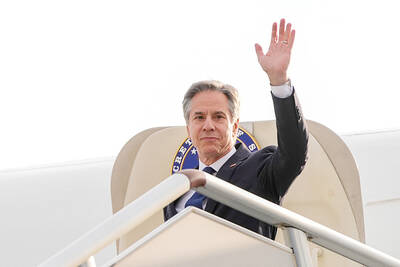
‘IN A DIFFERENT PLACE’: The envoy first visited Shanghai, where he attended a Chinese basketball playoff match, and is to meet top officials in Beijing tomorrow US Secretary of State Antony Blinken yesterday arrived in China on his second visit in a year as the US ramps up pressure on its rival over its support for Russia while also seeking to manage tensions with Beijing. The US diplomat tomorrow is to meet China’s top brass in Beijing, where he is also expected to plead for restraint as Taiwan inaugurates president-elect William Lai (賴清德), and to raise US concerns on Chinese trade practices. However, Blinken is also seeking to stabilize ties, with tensions between the world’s two largest economies easing since his previous visit in June last year. At the
Nearly half of China’s major cities are suffering “moderate to severe” levels of subsidence, putting millions of people at risk of flooding, especially as sea levels rise, according to a study of nationwide satellite data released yesterday. The authors of the paper, published by the journal Science, found that 45 percent of China’s urban land was sinking faster than 3mm per year, with 16 percent at more than 10mm per year, driven not only by declining water tables, but also the sheer weight of the built environment. With China’s urban population already in excess of 900 million people, “even a small portion

UNSETTLING IMAGES: The scene took place in front of TV crews covering the Trump trial, with a CNN anchor calling it an ‘emotional and unbelievably disturbing moment’ A man who doused himself in an accelerant and set himself on fire outside the courthouse where former US president Donald Trump is on trial has died, police said yesterday. The New York City Police Department (NYPD) said the man was declared dead by staff at an area hospital. The man was in Collect Pond Park at about 1:30pm on Friday when he took out pamphlets espousing conspiracy theories, tossed them around, then doused himself in an accelerant and set himself on fire, officials and witnesses said. A large number of police officers were nearby when it happened. Some officers and bystanders rushed
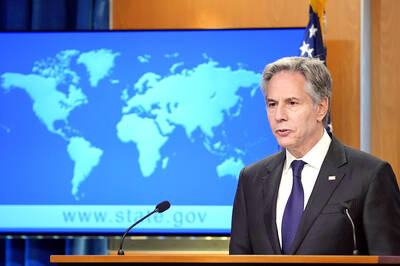
Beijing is continuing to commit genocide and crimes against humanity against Uyghurs and other Muslim minorities in its western Xinjiang province, U.S. Secretary of State Antony Blinken said in a report published on Monday, ahead of his planned visit to China this week. The State Department’s annual human rights report, which documents abuses recorded all over the world during the previous calendar year, repeated language from previous years on the treatment of Muslims in Xinjiang, but the publication raises the issue ahead of delicate talks, including on the war in Ukraine and global trade, between the top U.S. diplomat and Chinese


 RSS
RSS