


Anguish creased the weathered face of the opium farmer as a US-trained eradication team swept through his farm fields in the southern Afghan village of Dobundi.
As helicopters buzzed overhead, dozens of tractors plowed up Sadullah Khan's sprouting poppy plants, which in two months time would have yielded the sticky resin used to make heroin -- and earned him, by Afghan standards, a generous income.
After failing miserably to curb opium production last year, the Afghan government has launched a renewed eradication drive, particularly here in Helmand Province -- which accounted for more than 40 percent of last year's record yield of 6,100 tonnes. The US government estimates the opium trade generates US$3 billion a year in illicit economic activity.

PHOTO: AP
There is some armed resistance to the campaign in Helmand, where drug gangs and Taliban militants form a powerful nexus against President Hamid Karzai's unpopular government.
Still, counter-narcotics officials expect better results this year, if not a resounding success.
That's cold comfort to Khan, a 55-year-old father of nine who owns 10 hectares of land planted with poppies.
"When they are eradicating my poppy, it's just like they are destroying my home," he said, watching the heavily armed Afghan teams at work -- supported by a handful of US contractors, who rode in pairs through the rolling poppy fields on all-terrain vehicles.
There are fears the program could increase support for Taliban insurgents, but Karzai is under growing international pressure to crack down on Afghan drug production, which accounts for more than 90 percent of the global supply.
Last week, US President George W. Bush called poppy cultivation a threat to Afghanistan's fragile democracy. Bush said he had told Karzai that "to gain the confidence of his people, and the confidence of the world, he's got to do something about it, with our help."
Last year saw an alarming 59 percent rise in opium cultivation to 164,995 hectares, deepening fears that Afghanistan is rapidly becoming a narco-state.
A Western counter-narcotics official said it was too early for an accurate prediction of this year's crop, but he noted some positive signs.
Cultivation will likely drop significantly in the north and northeast while increasing slightly parts of the south, said the official, who spoke on condition of anonymity due to the issue's sensitivity.
The government, he said, has launched eradication "earlier and with more determination" than last year, and has warned officials they would be fired if they did not take action.
Lieutenant General Mohammed Daoud Daoud, the deputy interior minister for counter-narcotics, said 3,600 hectares of poppy fields have been destroyed nationwide in the past month.
The target is to destroy almost 14 times that figure -- a total of 50,000 hectares -- before the harvest, which runs from April to July, from the south to the colder north.
The Western official said he doubted that target would be reached. But he said he hoped that 15 percent to 20 percent of the planted fields will be eradicated to demonstrate the "business risk" to poppy growers. Last year, only about 8 percent of planted fields were destroyed.
The campaign, supported mainly by the US and Britain, carries a political and military risk for the government and its Western allies. It could generate more recruits for the Taliban militia, which is threatening a spring offensive against NATO forces.
To mitigate the risk of a backlash by farmers, authorities say they are targeting areas where there is little reason not to grow crops like wheat and vegetables -- rather than dry, remote fields where farmers may feel forced to cultivate opium.
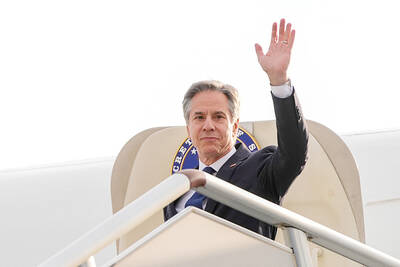
‘IN A DIFFERENT PLACE’: The envoy first visited Shanghai, where he attended a Chinese basketball playoff match, and is to meet top officials in Beijing tomorrow US Secretary of State Antony Blinken yesterday arrived in China on his second visit in a year as the US ramps up pressure on its rival over its support for Russia while also seeking to manage tensions with Beijing. The US diplomat tomorrow is to meet China’s top brass in Beijing, where he is also expected to plead for restraint as Taiwan inaugurates president-elect William Lai (賴清德), and to raise US concerns on Chinese trade practices. However, Blinken is also seeking to stabilize ties, with tensions between the world’s two largest economies easing since his previous visit in June last year. At the
Nearly half of China’s major cities are suffering “moderate to severe” levels of subsidence, putting millions of people at risk of flooding, especially as sea levels rise, according to a study of nationwide satellite data released yesterday. The authors of the paper, published by the journal Science, found that 45 percent of China’s urban land was sinking faster than 3mm per year, with 16 percent at more than 10mm per year, driven not only by declining water tables, but also the sheer weight of the built environment. With China’s urban population already in excess of 900 million people, “even a small portion

UNSETTLING IMAGES: The scene took place in front of TV crews covering the Trump trial, with a CNN anchor calling it an ‘emotional and unbelievably disturbing moment’ A man who doused himself in an accelerant and set himself on fire outside the courthouse where former US president Donald Trump is on trial has died, police said yesterday. The New York City Police Department (NYPD) said the man was declared dead by staff at an area hospital. The man was in Collect Pond Park at about 1:30pm on Friday when he took out pamphlets espousing conspiracy theories, tossed them around, then doused himself in an accelerant and set himself on fire, officials and witnesses said. A large number of police officers were nearby when it happened. Some officers and bystanders rushed
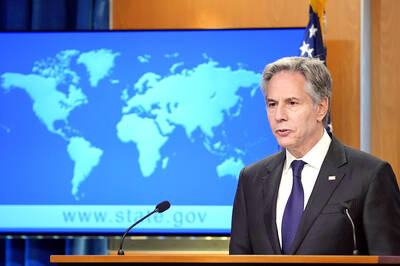
Beijing is continuing to commit genocide and crimes against humanity against Uyghurs and other Muslim minorities in its western Xinjiang province, U.S. Secretary of State Antony Blinken said in a report published on Monday, ahead of his planned visit to China this week. The State Department’s annual human rights report, which documents abuses recorded all over the world during the previous calendar year, repeated language from previous years on the treatment of Muslims in Xinjiang, but the publication raises the issue ahead of delicate talks, including on the war in Ukraine and global trade, between the top U.S. diplomat and Chinese


 RSS
RSS