


Pakistani investigators are probing whether a "serial killer" cleric who assassinated a female minister this week -- having previously confessed to four other murders -- had links to Islamist groups.
In a case that shocked even this unstable Islamic republic, extremist Mohammad Sarwar shot Punjab province social welfare minister Zilla Huma Usman in the head at a public meeting in central Gujranwala city on Tuesday.
Police have said that Sarwar objected to the involvement of women in politics and disapproved of the clothes worn by Usman, a supporter of the moderate and pro-US President Pervez Musharraf.
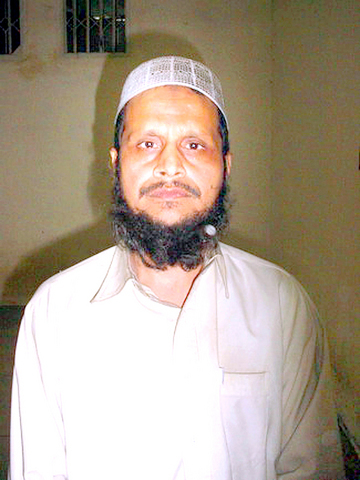
PHOTO: AFP
`Conviction'
"I killed her out of conviction that she was leading an un-Islamic life and spreading an evil influence on other women," he told interrogators, according to a police source.
Police say that in 2003 Sarwar had escaped justice despite publicly admitting that he had killed four prostitutes and injured another four as they waited by roadsides for clients.
"He is a serial killer," said Saud Aziz, the police chief of Gujranwala at the time of the earlier shootings.
Punjab Law Minister Raja Basharat hit out at the Pakistani justice system, saying "fanatic" Sarwar was still on the streets mainly due to "defective police investigation and poor quality of the prosecution."
"We are investigating and there is a possibility that he may have support from some religious group," he said, without elaborating or naming the organization.
Pakistan has dozens of Islamic militant outfits, most of which have been banned by Musharraf.
Prostitute murders
The prostitute murders -- three in conservative Gujranwala and one in the eastern city of Lahore between September 2002 and January 2003 -- puzzled police and caused a public outcry.
Former police inspector Mohammad Naveed finally arrested Sarwar in early 2003 on the basis of information from local religious leaders and witness reports that a cleric was spotted near the scene of the killings.
He said Sarwar's usual method of attack was to fire two or three bullets just above the crotch of his victims. One woman who survived was paralyzed.
"In no time after his arrest [in 2003] he confessed to the murders and provided all the details," Naveed said. "He was produced before the media and he made a confessional statement."
Case collapsed
Yet the case collapsed during the trial. Police said the victims' families took compensation money raised by religious leaders instead of testifying because of the shame of their daughters' "immoral" profession.
A rickshaw driver who used to drive the prostitutes around initially told police he saw Sarwar shooting one of the women, "but backed down, apparently under pressure from local clergy in Gujranwala who supported Sarwar."
Eventually Sarwar -- a father of nine who had been educated at a madrassa or Islamic seminary in Gujranwala and later taught local children the Koran -- withdrew his confession.
His lawyer, Liaqat Sindhu, said he "knew that Sarwar was guilty of the killings" but that he was acquitted because there was no firm evidence and the case was mishandled.
Psychiatric tests on Sarwar in 2003 showed that he was "not deranged," said Saud Aziz, who is now police chief of Rawalpindi, near Islamabad.
"He said he killed the girls after he got divine revelations," he said.
Society
Four years later, the murder of Zilla Huma Usman shows how extremism has corrupted Pakistani society, said Iqbal Haider, secretary general of the independent Human Rights Commission of Pakistan.
"There is no writ of the government, which results in barbaric tragedies like this," said Haider, a former law minister under Benazir Bhutto, the country's first female prime minister.
"Our prosecution and our administration is shamelessly incompetent, corrupt and religiously biased," Haider said.

Crowds in Bangladesh are flocking to snap photographs with an unlikely social media star — an albino buffalo with flowing blond hair nicknamed “Donald Trump” that is due to be sacrificed within days. Owner Zia Uddin Mridha, 38, said his brother named the 700kg bull over its flowing helmet of hair resembling the signature look of the US president. “My younger brother picked this name because of the buffalo’s extraordinary hair,” he said at his farm in Narayanganj, just outside the capital, Dhaka. Mridha said that a constant stream of curious visitors — social media fans, onlookers and children — have come throughout
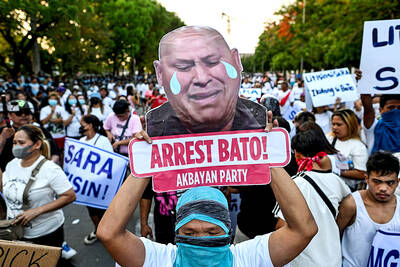
The Philippines said it has asked the country’s Supreme Court to allow it to arrest former Philippine president Rodrigo Duterte’s chief drug war enforcer to stand trial in an international tribunal. The International Criminal Court (ICC) last week unsealed an arrest warrant against Philippine Senator Ronald dela Rosa, accusing him along with Duterte and other “coperpetrators” of the “crime against humanity of murder.” Dela Rosa briefly sought refuge in the Philippine Senate last week while asking the Philippine Supreme Court to stop an ongoing attempt by government agents to arrest him. “By his own conduct, he has placed himself outside the protection of
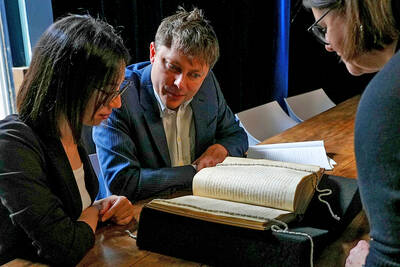
The researchers in Ireland looked at their computer screen, marveling at a medieval book tracked down in a Roman library. They flipped through its digitized pages and found their sought-after treasure: the oldest surviving English poem. “We were extremely surprised. We were speechless. We couldn’t believe our eyes when we first saw that,” said Elisabetta Magnanti, a visiting research fellow at Trinity College Dublin’s school of English. The poem was also within the main body of Latin text, she said, calling it “extraordinary.” Composed in Old English by a Northumbrian agricultural worker in the 7th century, Caedmon’s Hymn appears within some copies of

BIGGER ROLE: Beijing has said it maintains an impartial stance on the war in Ukraine, but by training Russian troops, China is far more involved than previously known China’s armed forces secretly trained about 200 Russian military personnel in China late last year, and some have since returned to fight in Ukraine, according to three European intelligence agencies and documents seen by Reuters. While China and Russia have held a number of joint military exercises since Moscow’s full-scale invasion of Ukraine in 2022, Beijing has repeatedly said that it is neutral in the conflict and presents itself as a peace mediator. The covert training sessions, which predominantly focused on the use of drones, were outlined in a dual-language Russian-Chinese agreement signed by senior Russian and Chinese officers in Beijing on


 RSS
RSS