


Italy summoned Croatia's ambassador to the foreign ministry and canceled a government official's visit to Zagreb after angry exchanges over a speech by Italy's president commemorating World War II massacres by Yugoslav partisans.
The dispute has revived grudges dating back six decades.
It began with Italian President Giorgio Napolitano's speech on Saturday to mark the deaths of thousands of Italians who were pulled from their homes, tortured and shot by Communist Yugoslav partisans during and at the end of the war.
Some victims were thrown -- sometimes still alive -- into alpine crevasses known in local dialect as foibe, and the atrocities became known as the foibe killings.
"There was a wave of hate and bloody fury, and a Slavic expansionist design ... that took on the sinister appearance of an ethnic cleansing," Napolitano said.
The response from Croatia, which was part of Yugoslavia until 1991, was chilly.
President Stipe Mesic said on Monday that Napolitano's speech contained "traces of open racism, historical revisionism and political revanchism."
Mesic said on Tuesday that he would suggest that Italy and Croatia form a commission of forensics experts to investigate how many people died in the killings.
The comments prompted Italian Minister of Foreign Affairs Massimo D'Alema to accuse Mesic of distorting the words of the president and to summon the Croatian ambassador.
In their meeting, D'Alema told the ambassador he was "stunned and pained" by Mesic's words and insisted that there was no reason for the criticism of the Italian president's speech, ministry officials said.
They said that the envoy assured D'Alema he would relay Italy's sentiment to his country's authorities.
D'Alema canceled a visit to Croatia by Foreign Affairs Undersecretary Bobo Craxi, which had been scheduled for yesterday.
Thousands of Italians were tortured and killed in Trieste, Gorizia and on the Istrian peninsula between 1943 and 1945 by Yugoslav Communists on anti-fascist rampages.
The number is unclear, but some estimates put the figure at around 10,000.
Trieste, now part of Italy, and the Istrian peninsula -- most of which is now in Croatia -- came under Italian control after World War I and they were brutally "Italianized'' under dictator Benito Mussolini's fascists.
Official Yugoslav postwar figures showed that about 80,000 Croats, Serbs and Montenegrins perished during the Italian occupation of Dalmatia and Montenegro in 1941 to 1943.
Memories from that time prompted the revenge killings as World War II wound down and Yugoslavs entered the region.
Many ordinary citizens were killed and tortured simply for being Italian or being hostile to annexation by Yugoslavia.
While not denying the killings, some Croatians condemn efforts that remember the victims without addressing the whole history of the tragedy.
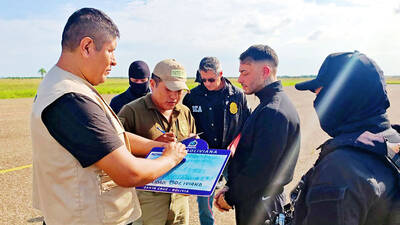
KINGPIN: Marset allegedly laundered the proceeds of his drug enterprise by purchasing and sponsoring professional soccer teams and even put himself in the starting lineups Notorious Latin American narco trafficker Sebastian Marset, who eluded police for years, was handed over to US authorities after his arrest on Friday in Bolivia. Marset, a Uruguayan national who was on the US most-wanted list, was passed to agents of the US Drug Enforcement Administration at Santa Cruz airport in Bolivia, then put on a US airplane, Bolivian state television showed. “The arrest and deportation were carried out pursuant to a court order issued by the US justice system,” Bolivian Minister of Government Marco Antonio Oviedo told reporters. The alleged kingpin was arrested in an upscale neighborhood of Santa

FAKE NEWS? ‘When the government demands the press become a state mouthpiece under the threat of punishment, something has gone very wrong,’ a civic group said The top US broadcast regulator on Saturday threatened media outlets over negative coverage of the Middle East war, after US President Donald Trump slammed critical headlines from the “Fake News Media.” The US president since his first term has derided mainstream media as “fake news” and has sued major outlets over what he sees as unfair coverage. Brendan Carr, head of the US Federal Communications Commission — which oversees the nation’s radio, television and Internet media — said broadcasters risked losing their licenses over news coverage. “The law is clear. Broadcasters must operate in the public interest, and they will
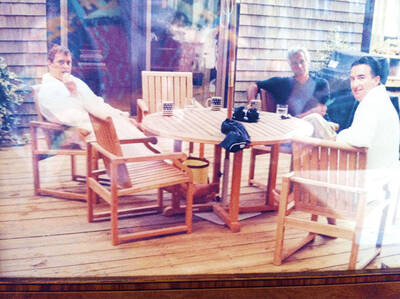
SCANDAL: Other images discovered earlier show Andrew bent over a female and lying across the laps of a number of women, while Mandelson is pictured in his underpants A photograph of former British prince Andrew and veteran politician Peter Mandelson sitting in bathrobes alongside late sex offender Jeffrey Epstein was unearthed on Friday in previously published documents. The image is believed to be the first known photograph of the two men with Epstein. They are currently engulfed in scandal in the UK over their ties to their mutual friend. The undated photograph, first reported by ITV News, shows King Charles III’s disgraced brother and former British ambassador to the US sitting barefoot outside on a wooden deck. They appear to have mugs with a US flag on them
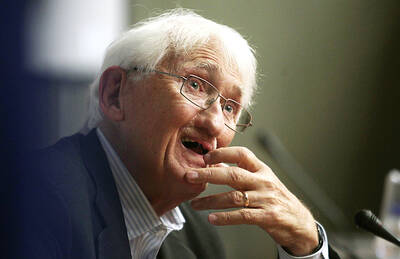
INFLUTENTIAL THEORIST: Habermas was particularly critical of the ‘limited interest’ shown by German politicians in ‘shaping a politically effective Europe Jurgen Habermas, whose work on communication, rationality and sociology made him one of the world’s most influential philosophers and a key intellectual figure in his native Germany, has died. He was 96. Habermas’ publisher, Suhrkamp, said he died on Saturday in Starnberg, near Munich. Habermas frequently weighed in on political matters over several decades. His extensive writing crossed the boundaries of academic and philosophical disciplines, providing a vision of modern society and social interaction. His best-known works included the two-volume Theory of Communicative Action. Habermas, who was 15 at the time of Nazi Germany’s defeat, later recalled the dawn of


 RSS
RSS