


Bolivian President Evo Morales signed a decree nationalizing a tin smelter owned by the Swiss mining company Glencore International, a first step toward his declared ambitions to win his government a larger share of Bolivia's mineral wealth.
Morales did not immediately name the terms for the takeover of the Vinto plant, the country's only operating smelter.
He stressed that Bolivia must not only control its rich mineral resources but also the refinement of raw ore into valuable metals.
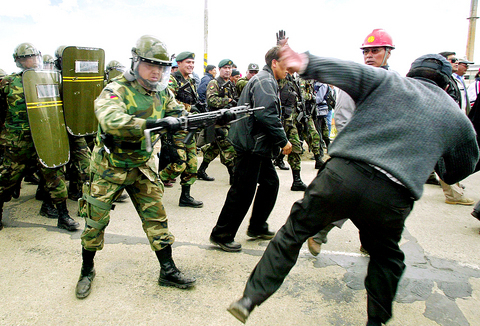
PHOTO: AFP
"Our natural resources have been looted again and again," Morales told the smelter's employees on Friday.
"We have never been permitted to industrialize our own natural resources," he said. "With so many false pretexts ... they tried to keep Bolivia merely an exporter of raw materials. But now the hour has come to industrialize all of our natural resources."
Officials at Glencore and its Bolivian subsidiary Sinchi Wayra could not immediately be reached for comment.
Morales has spoken broadly about nationalizing Bolivia's mining sector, but the industry's complex structure means that it is unlikely to see an across-the-board move similar to last year's oil and gas nationalization.
The Vinto smelter, located near Oruro on the high Andean plain 180km southeast of La Paz, was -- until Friday -- entirely in private hands, but all of Bolivia's extensive mineral deposits are already owned by the government.
State mining company Comibol works a handful of the deposits, but most are mined through private concessions split between independent Bolivian miners' cooperatives -- most still working with hammer and chisel -- and giant international companies, including Glencore and US-based companies Coeur d'Alene Mines and Apex Silver Mines.
Morales has said that only those concessions left idle or lacking investment will be returned to the state.
In the meantime, the president has proposed a tax hike aimed at recovering more of Bolivia's soaring mineral revenues, driven in part by demand from China.
When Vinto was built in the 1970s, Bolivia exported mostly raw mineral ore, allowing other countries to reap the refining profits.
The Bolivian government sold the Vinto smelter in 2001 to Allied Deals, which later sold it to Comsur, a private mining company whose largest stockholder at the time was former Bolivian president Gonzalo Sanchez de Lozada.
Lozada fled Bolivia in October 2003 during riots against his administration and is still being sought in connection with a crackdown on the protests that left more than 60 Bolivians dead.
Glencore bought the plant from Comsur in 2004, but the shadow of Sanchez de Lozada remains a powerful political symbol in Bolivia.
On Friday, Morales declared that all other mining interests once held by Sanchez de Lozada must be returned to the state.

SPEAKING OUT: After Siranudh Scott’s allegations surfaced, celebrities and public figures took to social media to share their own experiences of sexual misconduct and abuse A high-profile alleged sexual abuse case within a wealthy Thai beer brewing family has prompted a wave of painful accounts from survivors of unconnected abuse in the conservative nation. Siranudh Scott, a member of the billionaire Thai family that founded the ubiquitous Singha beer brand, posted an emotional video this month accusing his elder brother Sunit of repeatedly abusing him when he was a teenager. Sunit, who is in his 30s, later denied the allegations in a video posted online, but Singha parent Boonrawd dismissed him from his executive role with the company on Tuesday last week. “I felt I needed to speak

SEEKING ORDER: Rodrigo Paz said that ‘anyone who wants to destroy the nation will have to deal with this president and the full force of the constitution’ Bolivian President Rodrigo Paz on Wednesday said that the nation was at a “breaking point” after nearly a month of protests that have caused shortages of food, fuel and medicine. Paz, who took office six months ago amid the worst economic crisis there in four decades, is battling a groundswell of fury over his policies. The political capital, La Paz, has been besieged by low-income workers and members of the indigenous majority calling for his resignation. “The country needs order and is reaching breaking point,” the 58-year-old said at a public event in La Paz, renewing his appeal for dialogue. On Tuesday, the Bolivian

‘CROSSING THE LINE’: China’s embassy in Seoul criticized US Forces Korea Commander General Xavier Brunson, asking if his ‘hostile’ remarks were authorized by Washington South Korea and the US are in talks over recent public remarks by the commander of US Forces Korea, Seoul’s presidential office said yesterday, after the comments drew sharp criticism from China. In a recent podcast interview, US Forces Korea Commander General Xavier Brunson described South Korea as “the dagger in the heart of Asia” from China’s east coast, prompting the Chinese embassy in Seoul to say that he had “truly crossed the line.” The interview came amid growing speculation that Washington might seek to expand the role of US Forces Korea in countering the growing regional influence of China, a key

Forecasters in Europe yesterday warned of exceptional heat as record temperatures driven by a “heat dome” push temperatures well above seasonal norms across the continent. The surge follows a record-breaking Monday, with France logging its hottest day in the month of May on record, its weather agency said, and the UK also posting unprecedented highs. A so-called “heat dome” of warm air from northern Africa trapped under a high-pressure system over western Europe is behind the high temperatures not usually seen until high summer. Restrictions on outdoor work were imposed in parts of Italy, beaches in southwest France filled earlier than usual and


 RSS
RSS