


The cloakroom is a pokey, bullet-riddled bar. The security consists of motorbike-riding teenagers with assault rifles strung across their chests. But if you make it past the police checkpoints and the concrete barricades, the good news is that entry is free. And so far there has not been an art critic in sight.
The heavy artillery on show might suggest otherwise, but this is Rio de Janeiro's newest, most unusual and certainly most dangerous, modern art gallery. It is located at the heart of the Vila Cruzeiro shantytown.
The open air gallery, where crumbling shacks have become giant canvasses, is the brainchild of Jeroen Koolhaas, a Dutch illustrator who works for New Yorker magazine, and Dre Urhahn, an art director from Amsterdam.
"Normally, outsiders would only come here to buy cocaine," Urhahn said, admitting to having found empty cartridges on the scaffolding used for painting. "The museum is about giving them another reason to visit the community."
Vila Cruzeiro is definitely an odd location for a museum. The favela became notorious in 2002 when a Brazilian journalist was dismembered and incinerated by local traffickers.
These days, teenage gangsters surround the art gallery with military-issue grenades strung from their shorts.
Gun battles between police and members of the Red Command drug faction are a regular occurrence.
Recently, more than 200 military policemen, backed up by three helicopters, launched an assault on the favela, killing at least six "suspects" and wounding several civilians.
Roberto Carlos Teixeira, a local social worker, estimates that there are at least 120,000 young people in the Complexo da Penha, a labyrinth of shantytowns that includes Vila Cruzeiro.
"I'd be surprised if 50 of these kids had ever visited an art gallery," he said.
The launch of Vila Cruzeiro's own outdoor gallery has brought about some optimism. The residents have been painting huge murals on the exteriors of their homes, mostly designed by Koolhaas and Urhahn
"Everyone in the favela approves of it 101 percent," said Alex Rigueira, 32, the owner of one concrete shack transformed into a vast sky-blue mural by the Favela Painting Project.
He pointed to a series of yellow puddles inside the house where his dogs had urinated.
"Look, even the dogs have stopped pissing on the wall outside," he said.
Urhahn said that with the help of budding artists from the favela the "organic museum" would be extended to other shantytowns in Rio. Artists from around the world would be invited to contribute.
"By making huge paintings in the favelas we hope to inspire the kids ... to pursue a career in a creative field," Koolhaas said.
"Our final goal is to paint a whole hillside favela depicting one single image," he added.
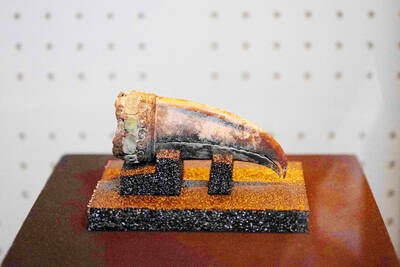
Archeologists in Peru on Thursday said they found the 5,000-year-old remains of a noblewoman at the sacred city of Caral, revealing the important role played by women in the oldest center of civilization in the Americas. “What has been discovered corresponds to a woman who apparently had elevated status, an elite woman,” archeologist David Palomino said. The mummy was found in Aspero, a sacred site within the city of Caral that was a garbage dump for more than 30 years until becoming an archeological site in the 1990s. Palomino said the carefully preserved remains, dating to 3,000BC, contained skin, part of the
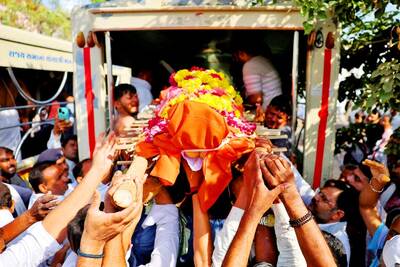
‘WATER WARFARE’: A Pakistani official called India’s suspension of a 65-year-old treaty on the sharing of waters from the Indus River ‘a cowardly, illegal move’ Pakistan yesterday canceled visas for Indian nationals, closed its airspace for all Indian-owned or operated airlines, and suspended all trade with India, including to and from any third country. The retaliatory measures follow India’s decision to suspend visas for Pakistani nationals in the aftermath of a deadly attack by shooters in Kashmir that killed 26 people, mostly tourists. The rare attack on civilians shocked and outraged India and prompted calls for action against their country’s archenemy, Pakistan. New Delhi did not publicly produce evidence connecting the attack to its neighbor, but said it had “cross-border” links to Pakistan. Pakistan denied any connection to

TRUMP EFFECT: The win capped one of the most dramatic turnarounds in Canadian political history after the Conservatives had led the Liberals by more than 20 points Canadian Prime Minister Mark Carney yesterday pledged to win US President Donald Trump’s trade war after winning Canada’s election and leading his Liberal Party to another term in power. Following a campaign dominated by Trump’s tariffs and annexation threats, Carney promised to chart “a new path forward” in a world “fundamentally changed” by a US that is newly hostile to free trade. “We are over the shock of the American betrayal, but we should never forget the lessons,” said Carney, who led the central banks of Canada and the UK before entering politics earlier this year. “We will win this trade war and
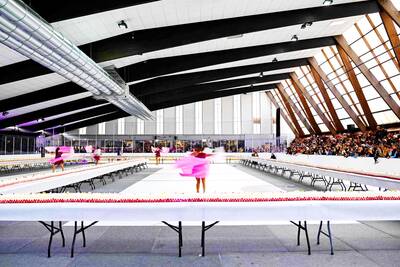
Armed with 4,000 eggs and a truckload of sugar and cream, French pastry chefs on Wednesday completed a 121.8m-long strawberry cake that they have claimed is the world’s longest ever made. Youssef El Gatou brought together 20 chefs to make the 1.2 tonne masterpiece that took a week to complete and was set out on tables in an ice rink in the Paris suburb town of Argenteuil for residents to inspect. The effort overtook a 100.48m-long strawberry cake made in the Italian town of San Mauro Torinese in 2019. El Gatou’s cake also used 350kg of strawberries, 150kg of sugar and 415kg of


 RSS
RSS