


US-backed Iraqi forces stormed the Health Ministry and arrested the No. 2 official, accusing him of diverting millions of dollars to the biggest Shiite militia and allowing death squads to use ambulances and government hospitals to carry out kidnappings and killings.
Shiite politicians allied with anti-US cleric Moqtada al-Sadr denounced the arrest of Deputy Health Minister Hakim al-Zamili on Thursday as a violation of Iraqi sovereignty and demanded that the prime minister intervene.
But Prime Minister Nouri al-Maliki and his senior advisers remained silent. Al-Maliki, a Shiite, is under strong US pressure to crack down on Shiite militias and has pledged not to interfere in the security operation to rid Baghdad's streets of gunmen from both Islamic sects.
The arrest took place at 9am, an hour after Iraqi government offices generally open. Iraqi troops pushed through the iron gates of the Health Ministry building in northern Baghdad, ordered people to drop to the ground and rushed to al-Zamili's ground-floor office, witnesses said.
One of al-Zamili's bodyguards said US soldiers accompanying the force asked everyone to step aside and approached the deputy minister, who introduced himself. A US soldier handcuffed al-Zamili and led him away, the guard said on condition of anonymity because he feared reprisal.
A US military statement did not mention al-Zamili by name but said Iraqi special troops had captured a "senior official" suspected of alleged corruption and links to al-Sadr's Mahdi Army militia.
The Health Ministry is among six Cabinet posts controlled by al-Sadr, an ally of the prime minister.
The statement also alleged the senior official played a role in the deaths of several ministry officials, including the Sunni director of health in Diyala Province. The director, Ali al-Mahdawi, vanished last June after coming to Baghdad for a meeting at the ministry.
According to the statement, the official was believed to have siphoned millions of dollars from the ministry to the Mahdi Army "to support sectarian attacks and violence targeting Iraqi citizens."
US military spokesman Lieutenant Colonel Christopher Garver said militiamen were also allowed to use government hospitals and clinics to gather information on Iraqis seeking treatment and "those Iraqis that were discovered to be Sunnis would later be targeted for attacks."
US officials had long complained that al-Sadr's followers were transforming hospitals into bases for the Mahdi militia and were diverting medicine from state clinics to health care facilities run by the cleric's movement.
The arrest is likely to add new strains to al-Maliki's fragile coalition as it embarks on a high-risk campaign to curb violence in Baghdad. Shiite politicians persuaded al-Sadr to pull his militiamen back from the streets in the run-up to the security campaign.
Nasr al-Rubaie, leader of the Sadrist bloc in parliament, called al-Zamili's arrest a "kidnapping."
Health Minister Ali al-Shemari also denounced the raid.
US officials have insisted that al-Maliki rein in al-Sadr's forces, and the prime minister told the cleric last month that he could no longer provide him with political protection in the face of pressure, al-Maliki's aides said.
Curbing the militias is considered key to halting the wave of Sunni-Shiite reprisal killings that surged after last year's bombing of a Shiite shrine in the mostly Sunni city of Samarra.
Despite recent efforts, the violence showed little signs of receding any time soon.
At least 104 people were killed or found dead on Thursday in Iraq, including at least 10 Sunni men gunned down in the village of Rufayaat, just east of Balad. Balad is a majority Shiite town 80km northeast of the Iraqi capital, but it is surrounded by territory that is mainly populated by Sunnis.
In the day's deadliest attack, a parked car bomb exploded at a food market in the predominantly Shiite town of Aziziyah, southeast of Baghdad, killing 20 people and wounding 45, police said.
Another parked car bomb tore through a minibus in the mainly Shiite Amin neighborhood of southeastern Baghdad, killing seven passengers and wounding 10, police said.
In Anbar Province west of Baghdad, a US airstrike killed 13 insurgents in a raid on two safe houses where intelligence showed foreign fighters were assembled near Amiriyah, the military said.
Five militants were detained and a weapons cache was found in an initial raid on a target near the safe houses.
Police and hospital officials in the area offered a conflicting account, saying the airstrike hit the village of Zaidan south of Abu Ghraib and flattened four houses, leaving 45 people dead, including women, children and old people.
Also on Thursday, the US announced that four US Marines were killed the day before in fighting in Anbar, an insurgent stronghold.
At least 3,114 members of the US military have died since the Iraq war started in March 2003.
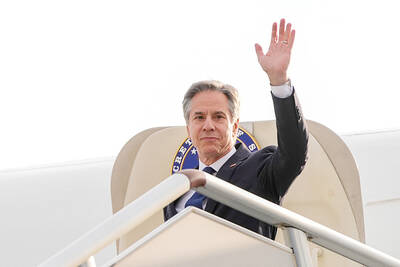
‘IN A DIFFERENT PLACE’: The envoy first visited Shanghai, where he attended a Chinese basketball playoff match, and is to meet top officials in Beijing tomorrow US Secretary of State Antony Blinken yesterday arrived in China on his second visit in a year as the US ramps up pressure on its rival over its support for Russia while also seeking to manage tensions with Beijing. The US diplomat tomorrow is to meet China’s top brass in Beijing, where he is also expected to plead for restraint as Taiwan inaugurates president-elect William Lai (賴清德), and to raise US concerns on Chinese trade practices. However, Blinken is also seeking to stabilize ties, with tensions between the world’s two largest economies easing since his previous visit in June last year. At the
Nearly half of China’s major cities are suffering “moderate to severe” levels of subsidence, putting millions of people at risk of flooding, especially as sea levels rise, according to a study of nationwide satellite data released yesterday. The authors of the paper, published by the journal Science, found that 45 percent of China’s urban land was sinking faster than 3mm per year, with 16 percent at more than 10mm per year, driven not only by declining water tables, but also the sheer weight of the built environment. With China’s urban population already in excess of 900 million people, “even a small portion

UNSETTLING IMAGES: The scene took place in front of TV crews covering the Trump trial, with a CNN anchor calling it an ‘emotional and unbelievably disturbing moment’ A man who doused himself in an accelerant and set himself on fire outside the courthouse where former US president Donald Trump is on trial has died, police said yesterday. The New York City Police Department (NYPD) said the man was declared dead by staff at an area hospital. The man was in Collect Pond Park at about 1:30pm on Friday when he took out pamphlets espousing conspiracy theories, tossed them around, then doused himself in an accelerant and set himself on fire, officials and witnesses said. A large number of police officers were nearby when it happened. Some officers and bystanders rushed
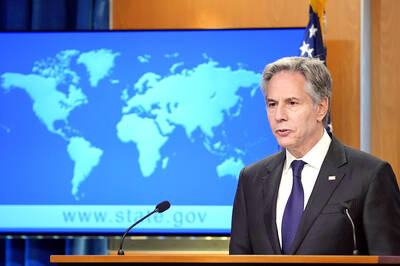
Beijing is continuing to commit genocide and crimes against humanity against Uyghurs and other Muslim minorities in its western Xinjiang province, U.S. Secretary of State Antony Blinken said in a report published on Monday, ahead of his planned visit to China this week. The State Department’s annual human rights report, which documents abuses recorded all over the world during the previous calendar year, repeated language from previous years on the treatment of Muslims in Xinjiang, but the publication raises the issue ahead of delicate talks, including on the war in Ukraine and global trade, between the top U.S. diplomat and Chinese


 RSS
RSS