


Iran stepped up its warnings to the US, with the nation's supreme leader saying Tehran will strike US interests around the world if his country is attacked.
Ayatollah Ali Khamenei's words on Thursday were also likely meant as a show of toughness to rally Iranians, who are increasingly worried about the possibility of US military action as the two countries' standoff has grown more tense.
Days earlier, an Iranian diplomat was detained in Iraq in an incident that Iran blamed on the US. The US denied any role and says it has no plans to strike Iran militarily, but has sent a second aircraft carrier to the Gulf to show strength in the face of rising Iranian regional influence.
But many in Iran say they fear attack. Iranian media and Web sites have almost daily commentaries on a possible US attack -- some of them blaming Iranian President Mahmoud Ahmadinejad for the deterioration in the already sour US-Iranian relations by his provocative rhetoric against the US and Israel.
Speaking to Iranian air force commanders, Khamenei said: ``The enemy knows well that any invasion would be followed by a comprehensive reaction to the invaders and their interests all over the world.'' His words were carried on state-run TV.
In Washington, US State Department spokesman Tom Casey, asked about the comments, said Washington's efforts on Iran focus on diplomacy. The two are in dispute over Iran's nuclear program and its role in Iraq.
``Our efforts to respond to Iran's nuclear program are focused on diplomacy. ... I think we've made it clear that what our intentions are, is to pursue this issue through diplomatic channels,'' Casey said.
Even as Iran's rhetoric has escalated, it has insisted it is open to a diplomatic solution to its standoff with the West. Iran's top nuclear negotiator, Ali Larijani, said on Wednesday he would meet European officials for talks on Iran's nuclear program during a security conference this weekend in Germany.
Tehran's ambassador to the UN, Javad Zarif, complained in a column published Thursday in the New York Times that the US was trying to make Iran a ``scapegoat'' for Washington's failures in the Mideast, particularly Iraq. He warned that efforts to isolate Iran would backfire on the US, increasing sectarian tensions in the region.
The US is reaping ``the expected bitter fruits of its ill-conceived adventurism'' in Iraq, he said.
``But rather than face these unpleasant facts, the United States administration is trying to sell an escalated version of the same failed policy. It does this by trying to make Iran its scapegoat and fabricating evidence of Iranian activities in Iraq,'' he said.
Zarif also made clear, however, that Iran wants to be part of a regional and international solution to calm Iraq, despite US rejection of the idea of seeking Iran's help.
Solving Iraq's problems requires ``prudence, dialogue and a genuine search for solutions,'' he wrote. ``Only through such regional cooperation, with the necessary international support, can we contain the current crisis and prevent future ones.''
Also on Thursday, Iran's intelligence minister said the government had detected a network of US and Israeli spies operating on its borders and had detained a group of Iranians who planned to go abroad for espionage training, state television reported.
But the minister, Gholam Hossein Mohseni Ejehi, did not say whether any members of the US-Israeli network had been arrested nor provide any details on the Iranians.
Khamenei's words are not that unusual -- Iranian leaders often speak of a crushing response to any attack as a way to drum up domestic support.
But the rhetoric overall has escalated: two weeks ago, the official publication of the country's elite Revolutionary Guards,
Sobh-e-Sadegh, noted it would be easy to kidnap US citizens and transfer them to ``any location of choice'' in retaliation for any attack.
Many Iranians have said they fear an attack despite US denials of such a plan. US President George W. Bush has ordered US troops to act against Iranians suspected of being involved in the Iraqi insurgency, in addition to sending the second carrier to the region.
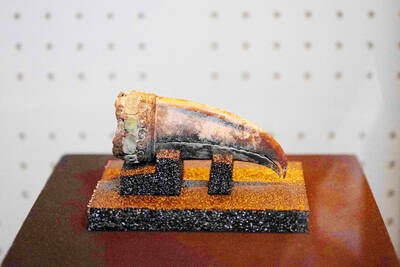
Archeologists in Peru on Thursday said they found the 5,000-year-old remains of a noblewoman at the sacred city of Caral, revealing the important role played by women in the oldest center of civilization in the Americas. “What has been discovered corresponds to a woman who apparently had elevated status, an elite woman,” archeologist David Palomino said. The mummy was found in Aspero, a sacred site within the city of Caral that was a garbage dump for more than 30 years until becoming an archeological site in the 1990s. Palomino said the carefully preserved remains, dating to 3,000BC, contained skin, part of the
‘WATER WARFARE’: A Pakistani official called India’s suspension of a 65-year-old treaty on the sharing of waters from the Indus River ‘a cowardly, illegal move’ Pakistan yesterday canceled visas for Indian nationals, closed its airspace for all Indian-owned or operated airlines, and suspended all trade with India, including to and from any third country. The retaliatory measures follow India’s decision to suspend visas for Pakistani nationals in the aftermath of a deadly attack by shooters in Kashmir that killed 26 people, mostly tourists. The rare attack on civilians shocked and outraged India and prompted calls for action against their country’s archenemy, Pakistan. New Delhi did not publicly produce evidence connecting the attack to its neighbor, but said it had “cross-border” links to Pakistan. Pakistan denied any connection to

TRUMP EFFECT: The win capped one of the most dramatic turnarounds in Canadian political history after the Conservatives had led the Liberals by more than 20 points Canadian Prime Minister Mark Carney yesterday pledged to win US President Donald Trump’s trade war after winning Canada’s election and leading his Liberal Party to another term in power. Following a campaign dominated by Trump’s tariffs and annexation threats, Carney promised to chart “a new path forward” in a world “fundamentally changed” by a US that is newly hostile to free trade. “We are over the shock of the American betrayal, but we should never forget the lessons,” said Carney, who led the central banks of Canada and the UK before entering politics earlier this year. “We will win this trade war and

Armed with 4,000 eggs and a truckload of sugar and cream, French pastry chefs on Wednesday completed a 121.8m-long strawberry cake that they have claimed is the world’s longest ever made. Youssef El Gatou brought together 20 chefs to make the 1.2 tonne masterpiece that took a week to complete and was set out on tables in an ice rink in the Paris suburb town of Argenteuil for residents to inspect. The effort overtook a 100.48m-long strawberry cake made in the Italian town of San Mauro Torinese in 2019. El Gatou’s cake also used 350kg of strawberries, 150kg of sugar and 415kg of


 RSS
RSS