


Envoys to international talks on ending North Korea's nuclear weapons hit a stumbling block yesterday when they failed to back a Chinese proposal for initial disarmament, the main US delegate said.
US Assistant Secretary of State Christopher Hill said the Chinese draft proposal, put forward after the talks' first day on Thursday, was discussed at a meeting of the delegation heads from the six countries involved.
"Opinions were expressed around the room, sometimes divergent opinions on the Chinese draft," Hill said.
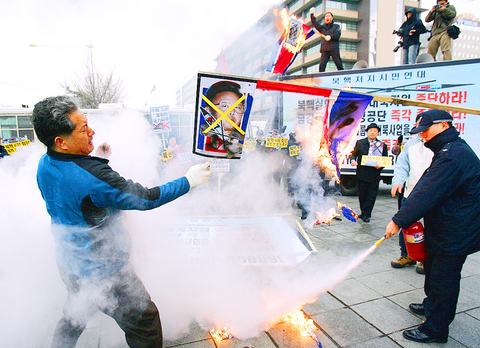
PHOTO: AP
"There are some differences of views among the various delegations," he said.
The one-page plan -- presented after North Korea agreed in principle to take initial steps to disarm -- would grant the communist nation unspecified energy aid for shutting down its main nuclear facilities, South Korea's Yonhap news agency reported.
Officials declined to confirm details of the draft.
The US and North Korean envoys held a one-on-one meeting on the proposal later yesterday at a Beijing hotel away from the main negotiating venue.
"We discussed ways to move the talks forward," the North's Kim Kye-gwan told reporters afterward.
"We agreed on some issues, but overall there are still some points of confrontation, and we are going to make more efforts to resolve them," he said.
Hill said he was "cautiously optimistic, but I don't want to count chickens before they hatch."
"There is a realization that the first step that we are looking at is the big first step ... So I think they want to be sure they understand what is expected of them," Hill said.
The US diplomat said some negotiators' concerns focused on which elements would be implemented under the current proposal, and which would be put off until future negotiations. He declined to give specifics.
Any agreement on an initial set of reciprocal moves to implement a September 2005 accord -- in which North Korea pledged to disarm in exchange for aid and security guarantees -- would set the stage for the first tangible steps in the often-delayed six-nation process.
The 2005 deal, a broad statement of principles that did not outline any concrete steps for dismantling North Korea's nuclear program, was the only agreement since the negotiations began in 2003.
Later yesterday North Korea accused Japan of jeopardizing progress at the talks, calling Tokyo's insistence on discussing the North's past abduction of its nationals "disgusting" and saying it had no right to be at the talks.
"It is ridiculous and disgusting that Japan, which is not even qualified to attend the talks, keeps saying that the abduction issue is a basic agenda," said a commentary published yesterday by the North's official news agency.
"The international community will never tolerate Japanese politicians' behavior if the nuclear talks become complicated and fail to produce substantial fruit due to Japan's wrong maneuver," the commentary said.
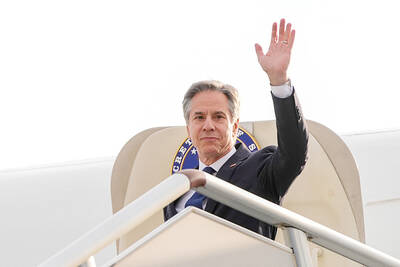
‘IN A DIFFERENT PLACE’: The envoy first visited Shanghai, where he attended a Chinese basketball playoff match, and is to meet top officials in Beijing tomorrow US Secretary of State Antony Blinken yesterday arrived in China on his second visit in a year as the US ramps up pressure on its rival over its support for Russia while also seeking to manage tensions with Beijing. The US diplomat tomorrow is to meet China’s top brass in Beijing, where he is also expected to plead for restraint as Taiwan inaugurates president-elect William Lai (賴清德), and to raise US concerns on Chinese trade practices. However, Blinken is also seeking to stabilize ties, with tensions between the world’s two largest economies easing since his previous visit in June last year. At the

UNSETTLING IMAGES: The scene took place in front of TV crews covering the Trump trial, with a CNN anchor calling it an ‘emotional and unbelievably disturbing moment’ A man who doused himself in an accelerant and set himself on fire outside the courthouse where former US president Donald Trump is on trial has died, police said yesterday. The New York City Police Department (NYPD) said the man was declared dead by staff at an area hospital. The man was in Collect Pond Park at about 1:30pm on Friday when he took out pamphlets espousing conspiracy theories, tossed them around, then doused himself in an accelerant and set himself on fire, officials and witnesses said. A large number of police officers were nearby when it happened. Some officers and bystanders rushed

Beijing is continuing to commit genocide and crimes against humanity against Uyghurs and other Muslim minorities in its western Xinjiang province, U.S. Secretary of State Antony Blinken said in a report published on Monday, ahead of his planned visit to China this week. The State Department’s annual human rights report, which documents abuses recorded all over the world during the previous calendar year, repeated language from previous years on the treatment of Muslims in Xinjiang, but the publication raises the issue ahead of delicate talks, including on the war in Ukraine and global trade, between the top U.S. diplomat and Chinese

RIVER TRAGEDY: Local fishers and residents helped rescue people after the vessel capsized, while motorbike taxis evacuated some of the injured At least 58 people going to a funeral died after their overloaded river boat capsized in the Central African Republic’s (CAR) capital, Bangui, the head of civil protection said on Saturday. “We were able to extract 58 lifeless bodies,” Thomas Djimasse told Radio Guira. “We don’t know the total number of people who are underwater. According to witnesses and videos on social media, the wooden boat was carrying more than 300 people — some standing and others perched on wooden structures — when it sank on the Mpoko River on Friday. The vessel was heading to the funeral of a village chief in


 RSS
RSS