


Nearly 60 countries have signed a treaty banning forced disappearances, capping a quarter-century of efforts by families of people who have vanished at the hands of governments.
The US was notably absent among the signatories on Tuesday. US President George W. Bush's administration opposed an early draft of the treaty, which bars governments from holding people in secret detention.
"Our American friends were naturally invited to this ceremony; unfortunately, they weren't able to join us," French Foreign Minister Philippe Douste-Blazy told reporters after 57 states signed the treaty at his ministry in Paris.

PHOTO: AFP
"That won't prevent them from one day signing on in New York at UN headquarters -- and I hope they will," he said.
In Washington, US State Department spokesman Sean McCormack declined comment except to say that the US had helped draft the treaty but that the final text "did not meet our expectations."
McCormack declined to comment on whether the US stance was influenced by the administration's policy of sending terrorism suspects to CIA-run prisons overseas, which Bush acknowledged last September.
Many other Western countries, including Germany, Spain, Britain and Italy, did not sign the treaty. France introduced the convention at the UN General Assembly in November and it was adopted in December.
The treaty was officially opened for signature at the ceremony in Paris on Tuesday. It will enter into force after 20 countries ratify it, usually by a parliamentary vote.
Many delegates expressed hope that other countries would sign on by year-end. Some European states have expressed support for the treaty but face constitutional hurdles or require a full Cabinet debate before signing, French and UN officials said.
UN High Commissioner for Human Rights (UNHCHR) Louise Arbour called the treaty an important step both in preventing injustices common years ago and barring newer tactics that often fall through regulatory loopholes.
Arbour said the US had expressed "reservations" about parts of the text, but declined to elaborate and urged US officials to sign and ratify it. She noted that the US often backs activities of the UNHCHR without formally signing on to them.
She called the treaty "a message to all modern-day authorities committed to the fight against terrorism" -- that some methods applied in the past are now "not acceptable, in a very explicit way."
The convention defines forced disappearances as the arrest, detention, kidnapping or "any other form of deprivation of freedom" by state agents or affiliates, followed by denials or cover-ups about the detention and location of the person gone missing.
States that go on to ratify the text would enshrine victims' rights, and would require states to penalize any forced disappearances in their countries and enact preventive and monitoring measures.
Latin America, is now owning up to much of the violence that left hundreds of thousands dead or "disappeared" during wars and under dictatorships in the 1970s and 1980s.
Many Latin American dignitaries joined the signing, including Argentina's first lady, lawmaker Cristina Kirchner.
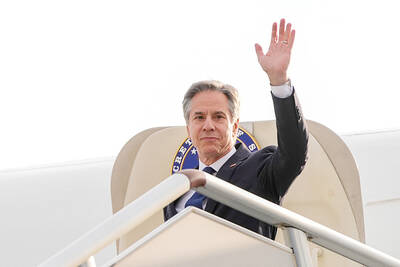
‘IN A DIFFERENT PLACE’: The envoy first visited Shanghai, where he attended a Chinese basketball playoff match, and is to meet top officials in Beijing tomorrow US Secretary of State Antony Blinken yesterday arrived in China on his second visit in a year as the US ramps up pressure on its rival over its support for Russia while also seeking to manage tensions with Beijing. The US diplomat tomorrow is to meet China’s top brass in Beijing, where he is also expected to plead for restraint as Taiwan inaugurates president-elect William Lai (賴清德), and to raise US concerns on Chinese trade practices. However, Blinken is also seeking to stabilize ties, with tensions between the world’s two largest economies easing since his previous visit in June last year. At the
Nearly half of China’s major cities are suffering “moderate to severe” levels of subsidence, putting millions of people at risk of flooding, especially as sea levels rise, according to a study of nationwide satellite data released yesterday. The authors of the paper, published by the journal Science, found that 45 percent of China’s urban land was sinking faster than 3mm per year, with 16 percent at more than 10mm per year, driven not only by declining water tables, but also the sheer weight of the built environment. With China’s urban population already in excess of 900 million people, “even a small portion

UNSETTLING IMAGES: The scene took place in front of TV crews covering the Trump trial, with a CNN anchor calling it an ‘emotional and unbelievably disturbing moment’ A man who doused himself in an accelerant and set himself on fire outside the courthouse where former US president Donald Trump is on trial has died, police said yesterday. The New York City Police Department (NYPD) said the man was declared dead by staff at an area hospital. The man was in Collect Pond Park at about 1:30pm on Friday when he took out pamphlets espousing conspiracy theories, tossed them around, then doused himself in an accelerant and set himself on fire, officials and witnesses said. A large number of police officers were nearby when it happened. Some officers and bystanders rushed

Beijing is continuing to commit genocide and crimes against humanity against Uyghurs and other Muslim minorities in its western Xinjiang province, U.S. Secretary of State Antony Blinken said in a report published on Monday, ahead of his planned visit to China this week. The State Department’s annual human rights report, which documents abuses recorded all over the world during the previous calendar year, repeated language from previous years on the treatment of Muslims in Xinjiang, but the publication raises the issue ahead of delicate talks, including on the war in Ukraine and global trade, between the top U.S. diplomat and Chinese


 RSS
RSS