


South Korean President Roh Moo-hyun said yesterday he would leave the ruling party if members ask him, amid recent moves by politicians seeking to distance themselves from his unpopular administration.
At least three members of the Uri Party -- whose around 10 percent popularity rating is only a little lower than Roh's -- have left in the past few days as the race to December's presidential election starts to heat up.
Roh's leaving the party wouldn't directly affect his ability to govern.
"Some people say the party is becoming ruined because of the president," he told a nationally televised news conference. "If you say, `if it weren't for the president, we'd stay,' then I will leave."
Opinion polls currently show the conservative opposition as the clear frontrunner to provide South Korea's next president with the Uri, or "our," Party looked increasingly divided over whether the best chance would be to cut links with Roh.
Roh, increasingly labeled a lame duck in his final year in office by a largely hostile domestic media, said the break-up of Uri would mean sliding back to the regionalism that has long dominated South Korean politics and which he has tried to end.
But top Uri member and one-time close ally of Roh, Chung Dong-young, told reporters late last week that the the party's MPs should join forces with other liberal parties to have any hope of contesting the presidential election.
He said that the party faced a crisis of trust.
The plummeting popularity of the Uri Party has meant heavy losses in by-elections and wiped out its thin majority in parliament.
That, along with internal factionalism and relentless attacks by the main opposition Grand National Party, have largely blocked new legislation by Roh.
The president took a swipe at the repeated opposition to his attempts to resolve key issues, saying some political maneuvring looked to be simply designed to block his reforms rather than because of a genuine difference of view.
Roh's latest policy initiative, to change the constitution so future presidents can hold two terms in office instead of one, has faced an icy response from the main opposition party even though some of its leaders have previously backed the idea in principle.
"I want to ask the [Uri] members cordially: `Let's try to work with Uri in a way that will achieve your political goal that you are setting for the new party,'" Roh said.
He said they could continue to push what he called middle-of-the-road political policies by staying with his party.
"So let's not break it up but instead go together."
A high-ranking Uri MP, speaking to Reuters last month but asking not to be named, echoed Roh's position.
"The only thing we have going for us is our numbers in parliament. If we break up, we lose that," he said.
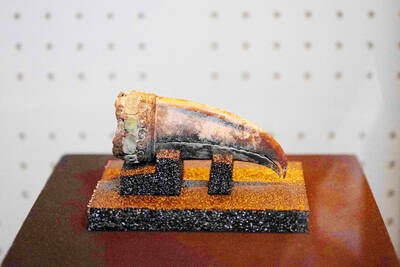
Archeologists in Peru on Thursday said they found the 5,000-year-old remains of a noblewoman at the sacred city of Caral, revealing the important role played by women in the oldest center of civilization in the Americas. “What has been discovered corresponds to a woman who apparently had elevated status, an elite woman,” archeologist David Palomino said. The mummy was found in Aspero, a sacred site within the city of Caral that was a garbage dump for more than 30 years until becoming an archeological site in the 1990s. Palomino said the carefully preserved remains, dating to 3,000BC, contained skin, part of the

TRUMP EFFECT: The win capped one of the most dramatic turnarounds in Canadian political history after the Conservatives had led the Liberals by more than 20 points Canadian Prime Minister Mark Carney yesterday pledged to win US President Donald Trump’s trade war after winning Canada’s election and leading his Liberal Party to another term in power. Following a campaign dominated by Trump’s tariffs and annexation threats, Carney promised to chart “a new path forward” in a world “fundamentally changed” by a US that is newly hostile to free trade. “We are over the shock of the American betrayal, but we should never forget the lessons,” said Carney, who led the central banks of Canada and the UK before entering politics earlier this year. “We will win this trade war and

‘BODIES EVERYWHERE’: The incident occurred at a Filipino festival celebrating an anti-colonial leader, with the driver described as a ‘lone suspect’ known to police Canadian police arrested a man on Saturday after a car plowed into a street party in the western Canadian city of Vancouver, killing a number of people. Authorities said the incident happened shortly after 8pm in Vancouver’s Sunset on Fraser neighborhood as members of the Filipino community gathered to celebrate Lapu Lapu Day. The festival, which commemorates a Filipino anti-colonial leader from the 16th century, falls this year on the weekend before Canada’s election. A 30-year-old local man was arrested at the scene, Vancouver police wrote on X. The driver was a “lone suspect” known to police, a police spokesperson told journalists at the
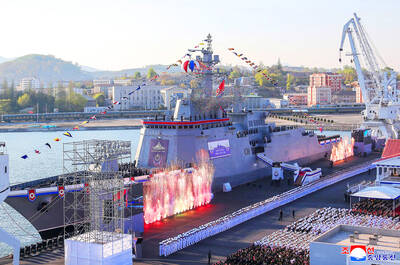
North Korean leader Kim Jong-un has unveiled a new naval destroyer, claiming it as a significant advancement toward his goal of expanding the operational range and preemptive strike capabilities of his nuclear-armed military, state media said yesterday. North Korea’s state-run Korean Central News Agency (KCNA) said Kim attended the launching ceremony for the 5,000-tonne warship on Friday at the western port of Nampo. Kim framed the arms buildup as a response to perceived threats from the US and its allies in Asia, who have been expanding joint military exercises amid rising tensions over the North’s nuclear program. He added that the acquisition


 RSS
RSS