


Howard Hunt, the veteran CIA spy who helped plan the break-in at Washington's Watergate complex which brought down president Richard Nixon in the most notorious political scandal in US history, has died at 88, his church said.
Hunt, who reportedly had battled pneumonia, plotted the nighttime burglary on June 17, 1972, at the Watergate offices of the Democratic National Committee, together with fellow White House conspirator G. Gordon Liddy.
The accidental discovery of the break-in snowballed into the scandal which embroiled the White House and led to Nixon's stepping down.
"He passed away today, in Miami," said a source who did not wish to be identified at Hunt's Miami Shores Presbyterian church, where he was a regular worshipper. "He died from natural causes."
Hunt served 33 months in jail for conspiracy, wiretapping and burglary for his part in Watergate, which revealed the existence of a secret White House slush fund, sparked a cover-up and eventually saw Nixon become the only US president to resign in August 1974.
Fellow operative Liddy went to prison for four-and-a-half years for the break-in, which aimed to plant listening devices to spy on the Democrats during the Republican president's re-election campaign.
Hunt's phone number was famously found in address books belonging to the Watergate burglars and helped investigators and famed Washington Post reporters Bob Woodward and Carl Bernstein link the break-in to Nixon's campaign.
During World War II, Hunt was part of the Office of Strategic Services, the shadowy wartime US intelligence service which eventually evolved into the CIA and other US espionage agencies. As a CIA officer, he had a hand in the botched 1961 US-backed Bay of Pigs invasion of Cuba.
He also churned out a string of spy novels under his own name and pseudonyms.
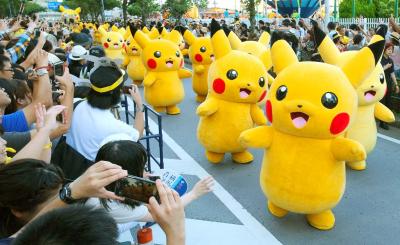
China’s military news agency yesterday warned that Japanese militarism is infiltrating society through series such as Pokemon and Detective Conan, after recent controversies involving events at sensitive sites. In recent days, anime conventions throughout China have reportedly banned participants from dressing as characters from Pokemon or Detective Conan and prohibited sales of related products. China Military Online yesterday posted an article titled “Their schemes — beware the infiltration of Japanese militarism in culture and sports.” The article referenced recent controversies around the popular anime series Pokemon, Detective Conan and My Hero Academia, saying that “the evil influence of Japanese militarism lives on in

DIPLOMATIC THAW: The Canadian prime minister’s China visit and improved Beijing-Ottawa ties raised lawyer Zhang Dongshuo’s hopes for a positive outcome in the retrial China has overturned the death sentence of Canadian Robert Schellenberg, a Canadian official said on Friday, in a possible sign of a diplomatic thaw as Canadian Prime Minister Mark Carney seeks to boost trade ties with Beijing. Schellenberg’s lawyer, Zhang Dongshuo (張東碩), yesterday confirmed China’s Supreme People’s Court struck down the sentence. Schellenberg was detained on drug charges in 2014 before China-Canada ties nosedived following the 2018 arrest in Vancouver of Huawei chief financial officer Meng Wanzhou (孟晚舟). That arrest infuriated Beijing, which detained two Canadians — Michael Spavor and Michael Kovrig — on espionage charges that Ottawa condemned as retaliatory. In January

A sign hanging from a rusty ice-green shipping container installed by Thai forces on what they say is the border with Cambodia reads: “Cambodian citizens are strictly prohibited from entering this area.” On opposite sides of the makeshift barricade, fronted by coils of barbed wire, Cambodians lamented their lost homes and livelihoods as Thailand’s military showed off its gains. Thai forces took control of several patches of disputed land along the border during fighting last year, which could amount to several square kilometers in total. Cambodian Kim Ren said her house in Chouk Chey used to stand on what is now the Thai
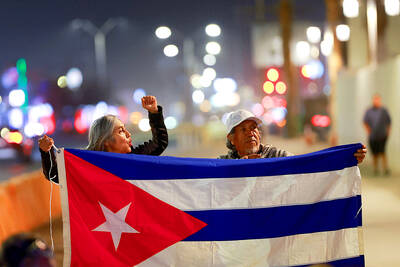
NEW RULES: There would be fewer school days, four-day workweeks, and a reduction in transportation services as the country battles a crisis exacerbated by US pressure The Cuban government on Friday announced emergency measures to address a crippling energy crisis worsened by US sanctions, including the adoption of a four-day work week for state-owned companies and fuel sale restrictions. Cuban Deputy Prime Minister Oscar Perez-Oliva Fraga blamed Washington for the crisis, telling Cuban television the government would “implement a series of decisions, first and foremost to guarantee the vitality of our country and essential services, without giving up on development.” “Fuel will be used to protect essential services for the population and indispensable economic activities,” he said. Among the new measures are the reduction of the working week in


 RSS
RSS