


The rising demand for live reef fish by seafood-hungry diners in China and Taiwan has for the first time been shown to have severely depleted numbers of endangered species around Asia, a study released yesterday said.
Researchers studying the trade in Malaysia, formerly home to some of Asia's most abundant coastal reefs, found that catches of some grouper species and the Napoleon wrasse fell by as much as 99 percent between 1995 and 2003, a period coinciding with the rapid economic growth of countries where such exotic fish are a delicacy.
"The removal of these large, predatory fish might upset the delicate balance of the coral reef ecosystem," said Helen Scales, who co-authored the study for the Swiss-based World Conservation Union (WCU), appearing in the online edition of Proceedings of The Royal Societies, a respected scientific journal.
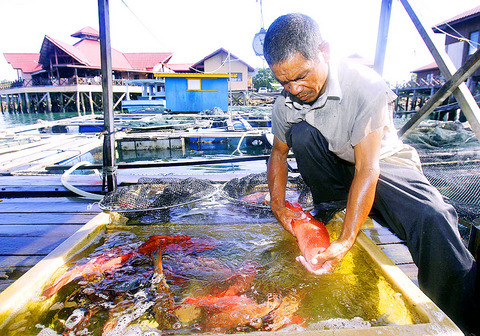
PHOTO: AP
"With all the threats the reefs already face, these fishing practices take us one step closer to losing these reefs," Scales said.
The study of daily fish catches and sales quantifies what many conservationists have said for a decade -- that hunger for live reef fish in Hong Kong, Taiwan and China is causing populations of wrasse, grouper and coral trout on coastal reefs to plummet in Malaysia, Indonesia, the Philippines and Papua New Guinea.
The UN and the WCU released a report last year warning that human exploitation of the high seas was putting many of its resources on the verge of extinction.
It noted that 52 percent of global fish stocks are over harvested and that populations of the largest fish such as tuna, cod and swordfish declined as much as 90 percent in the past century.
It also said destructive fishing practices -- including bottom trawling, illegal longline fishing and a rise in large industrial vessels -- have led to the deaths of tens of thousands of seabirds, turtles and other marine life.
"Well over 60 percent of the marine world and its rich diversity found beyond the limits of national jurisdiction is vulnerable and at increasing risk," Ibrahim Thaiw of the WCU said in a statement last year.
Reef fish -- which are caught mostly by small fishermen who sometimes use cyanide to stun their catch -- are prized mostly because they are cooked live. Traders are careful to ensure they arrive that way, packaging them in bags of water and placing them in white coolers for a trip that often takes them thousands of kilometers to seafood restaurants that resemble aquariums.
Diners stroll past bubbling tanks stuffed full of fish that can cost as much as US$100 a kilogram.
"Most Hong Kong people now choose to eat grouper because of the firm flesh. It's tastier," said Ng Wai Lun, a restaurant owner in Hong Kong, which consumes the most reef fish of any city.
"Farmed fish is less tasty and fresh," he said.
Some go closer to the source. Kerry To, a Hong Kong resident, flew to Malaysia for a holiday to enjoy a meal of steamed grouper in Kota Kinabalu, a few hours away from key reef fishing grounds.
"These fish are so big and taste so good. I'll be telling my friends," said To, 45, tucking into a meal of steamed fish with a dozen other Hong Kong tourists.
Annadel Cabanban of the World Wide Fund for Nature, who studies the trade in Malaysia, agreed with the study's finding that the numbers of reef fish were on the decline due to increasing human demand within Asia.
She said destructive fishing practices -- namely explosives and the use of cyanide over the past 10 years -- were as much to blame for the decline as overfishing because they destroy crucial reef habitats, affecting reproduction.
"There are no predators to check the fish that eat the plants and the shellfish," Cabanban said.
"There is a cascading effect on the reef. With so many herbivores, the plant population declines and fish run out of food and they die," she said.
Scales, the study's co-author, said it was impossible to quantify how many fish were taken by explosives or cyanide because fishermen refuse to discuss it.
Conservationists fear that the growing demand for live fish -- an industry worth more than US$1 billion a year -- is adding pressure to coral reefs already threatened by warming oceans, development and pollution.
Some 88 percent of Southeast Asia's coral reefs face destruction from overfishing and pollution, the US-based World Resources Institute estimates. Most under threat were the Philippines and Indonesia, home to 77 percent of the region's nearly 100,000km2 of reefs.
Fishermen in Kudat -- a sleepy South China Sea port in Malaysia that depends almost entirely on fishing -- acknowledged that catches have declined. Their boats now travel to the neighboring Philippines to find prized reef fish.
The fishermen argue that there are plenty of fish and that they have few options.
"This is our livelihood," said Ismail Noor, 45, adding that he sometimes spends three days at sea in search of the fish.
"If we stop, we would have no income," he said.
Noor and his fellow fishermen insist they use only hooks and lines or nets. But the local fisheries department said the use of explosives remains widespread, despite campaigns that warn of the dangers of losing arms, legs and hands.
"Most villagers are stubborn and have always done bombing since they were children," said fisheries official A. Hamid Maulana.
"It is difficult to change attitudes," he said.
Conservationists say the answer is to establish international standards for managing the import and export of reef fish, and consumers must be educated about the need to avoid certain endangered fish.

‘IN A DIFFERENT PLACE’: The envoy first visited Shanghai, where he attended a Chinese basketball playoff match, and is to meet top officials in Beijing tomorrow US Secretary of State Antony Blinken yesterday arrived in China on his second visit in a year as the US ramps up pressure on its rival over its support for Russia while also seeking to manage tensions with Beijing. The US diplomat tomorrow is to meet China’s top brass in Beijing, where he is also expected to plead for restraint as Taiwan inaugurates president-elect William Lai (賴清德), and to raise US concerns on Chinese trade practices. However, Blinken is also seeking to stabilize ties, with tensions between the world’s two largest economies easing since his previous visit in June last year. At the

UNSETTLING IMAGES: The scene took place in front of TV crews covering the Trump trial, with a CNN anchor calling it an ‘emotional and unbelievably disturbing moment’ A man who doused himself in an accelerant and set himself on fire outside the courthouse where former US president Donald Trump is on trial has died, police said yesterday. The New York City Police Department (NYPD) said the man was declared dead by staff at an area hospital. The man was in Collect Pond Park at about 1:30pm on Friday when he took out pamphlets espousing conspiracy theories, tossed them around, then doused himself in an accelerant and set himself on fire, officials and witnesses said. A large number of police officers were nearby when it happened. Some officers and bystanders rushed

Beijing is continuing to commit genocide and crimes against humanity against Uyghurs and other Muslim minorities in its western Xinjiang province, U.S. Secretary of State Antony Blinken said in a report published on Monday, ahead of his planned visit to China this week. The State Department’s annual human rights report, which documents abuses recorded all over the world during the previous calendar year, repeated language from previous years on the treatment of Muslims in Xinjiang, but the publication raises the issue ahead of delicate talks, including on the war in Ukraine and global trade, between the top U.S. diplomat and Chinese
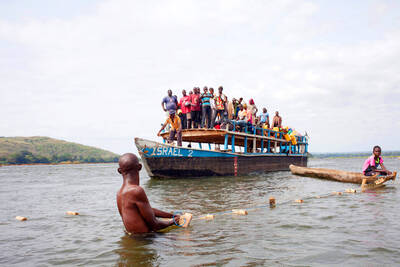
RIVER TRAGEDY: Local fishers and residents helped rescue people after the vessel capsized, while motorbike taxis evacuated some of the injured At least 58 people going to a funeral died after their overloaded river boat capsized in the Central African Republic’s (CAR) capital, Bangui, the head of civil protection said on Saturday. “We were able to extract 58 lifeless bodies,” Thomas Djimasse told Radio Guira. “We don’t know the total number of people who are underwater. According to witnesses and videos on social media, the wooden boat was carrying more than 300 people — some standing and others perched on wooden structures — when it sank on the Mpoko River on Friday. The vessel was heading to the funeral of a village chief in


 RSS
RSS