


Police shot dead 23 protesters across Guinea on Monday, raising to 33 the death toll in almost two weeks of a general strike and demonstrations against Guinean President Lansana Conte's rule, medical and union officials said.
At least 169 have been recorded injured across the country.
The death toll made Monday the bloodiest day in the strike that started on Jan. 10 at the call of labor unions.
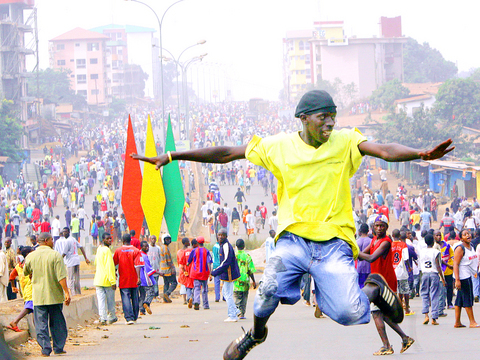
PHOTO: AFP
With 18 dead and 140 wounded, Conakry recorded the largest number of deaths.
"About 10 of the wounded are in a critical condition and could die soon considering our lack of resources," said a source at one of the capital's two largest hospitals.
In Kankan town east of the country, three demonstrators were killed and 22 wounded, among them seven seriously.
In neighboring Siguiri, two protesters were also shot dead while seven were injured, said Mamadi Conde, Kankan regional secretary general of the National Confederation of the Workers of Guinea.
Several labour union leaders behind the open-ended strike that has paralyzed Guinea, were arrested on Monday evening by members of the presidential guard, a union official said.
The crackdown by authorities has left UN Secretary-General Ban Ki-moon "gravely concerned at the excessive use of force" by government troops in the former French colony.
Several opposition parties have called for the release of the unionists in the third mass strike in 12 months in this poverty-stricken west African country.
The protest, organized by powerful labor unions and backed by 14 opposition parties, began on Jan. 10 over endemic corruption and interference in the judiciary by Conte after he freed two associates facing trial for embezzlement.
Strike leaders then demanded that Conte, who has been in power for the past 23 years, be constitutionally removed by the Supreme Court on the grounds that he is too unwell to hold office.
Michele Montas, spokeswoman for the UN secretary general, said Ki-moon wanted an official probe of the deadly clashes with opponents of Conte's rule.
Several thousand people also took to streets in the central towns of Pita and Dabola and at Telemele in the north, demanding an end to the rule of the 72-year-old head of state, who is suffering from chronic diabetes, witnesses said.
Protesters want a new broad-based government to take over, demanding the naming of a prime minister to fill a post left empty since April and form a government of national unity as a condition for lifting the strike call, labor leader Mamadou Alpha Barry said.
Conte on Saturday dismissed union demands calling on the military to back his government, a day after sacking his number two, minister for presidential affairs Fode Bangoura, and giving Planning Minister Eugene Camara more responsibility.
Sekou Konate, the secretary general of Conte's ruling party, on Sunday described the strike as "a political insurrection"
The UN chief urged the Conakry administration and parties concerned "to engage in dialogue" to seek "a peaceful solution to the dispute."
A meeting planned for Monday between the unions and authorities failed to take off due to the violence.
Mediation by the presidents of Senegal and Nigeria, Abdoulaye Wade and Olusegun Obasanjo, acting for the 15-nation Economic Community of West African States, was postponed by a few days at the request of Conakry.
Obasanjo has not yet decided if and when to embark on the mediation mission to Guinea, his spokesman said.
Guinea has in recent years been mired in a social, economic and political crisis with Conte's failing health raising fears of a power vacuum in the event of his death.
Conte has run the west African country since a bloodless military coup in 1984. He was twice hospitalized last year in Switzerland.
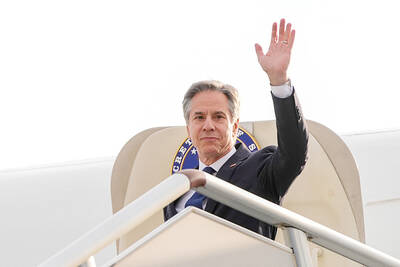
‘IN A DIFFERENT PLACE’: The envoy first visited Shanghai, where he attended a Chinese basketball playoff match, and is to meet top officials in Beijing tomorrow US Secretary of State Antony Blinken yesterday arrived in China on his second visit in a year as the US ramps up pressure on its rival over its support for Russia while also seeking to manage tensions with Beijing. The US diplomat tomorrow is to meet China’s top brass in Beijing, where he is also expected to plead for restraint as Taiwan inaugurates president-elect William Lai (賴清德), and to raise US concerns on Chinese trade practices. However, Blinken is also seeking to stabilize ties, with tensions between the world’s two largest economies easing since his previous visit in June last year. At the
Nearly half of China’s major cities are suffering “moderate to severe” levels of subsidence, putting millions of people at risk of flooding, especially as sea levels rise, according to a study of nationwide satellite data released yesterday. The authors of the paper, published by the journal Science, found that 45 percent of China’s urban land was sinking faster than 3mm per year, with 16 percent at more than 10mm per year, driven not only by declining water tables, but also the sheer weight of the built environment. With China’s urban population already in excess of 900 million people, “even a small portion

UNSETTLING IMAGES: The scene took place in front of TV crews covering the Trump trial, with a CNN anchor calling it an ‘emotional and unbelievably disturbing moment’ A man who doused himself in an accelerant and set himself on fire outside the courthouse where former US president Donald Trump is on trial has died, police said yesterday. The New York City Police Department (NYPD) said the man was declared dead by staff at an area hospital. The man was in Collect Pond Park at about 1:30pm on Friday when he took out pamphlets espousing conspiracy theories, tossed them around, then doused himself in an accelerant and set himself on fire, officials and witnesses said. A large number of police officers were nearby when it happened. Some officers and bystanders rushed
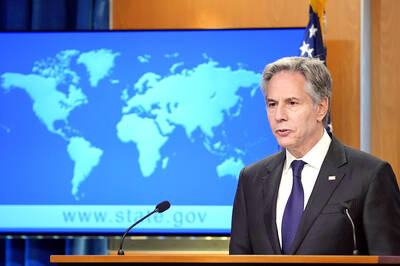
Beijing is continuing to commit genocide and crimes against humanity against Uyghurs and other Muslim minorities in its western Xinjiang province, U.S. Secretary of State Antony Blinken said in a report published on Monday, ahead of his planned visit to China this week. The State Department’s annual human rights report, which documents abuses recorded all over the world during the previous calendar year, repeated language from previous years on the treatment of Muslims in Xinjiang, but the publication raises the issue ahead of delicate talks, including on the war in Ukraine and global trade, between the top U.S. diplomat and Chinese


 RSS
RSS