


Argentines refusing to be cowed by death threats against the witnesses, judges and lawyers involved in "dirty war" trials were marching in the capital on Thursday, marking four months since the disappearance of a witness who testified against his torturers.
Jorge Julio Lopez vanished on Sept. 18 after he described being jolted with electric prods by a former police chief and others during two years in a secret prison. Thanks in part to Lopez's willingness to speak up and even show his scars in court, the defendant was convicted and given a life sentence for six disappearances two decades ago.
Argentina's leftist government is intent on trying as many as 900 lower-ranking former police and military officers for their roles in state-sponsored terrorism against dissidents during the 1970s and 1980s, now that the Supreme Court has struck down amnesty laws that kept all but the top ranking military leaders from being prosecuted.
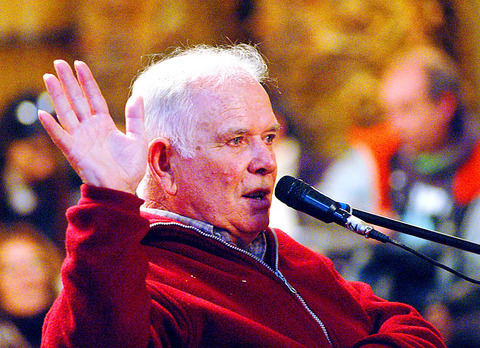
PHOTO: AP
Key to these trials are as many as 2,000 witnesses, and their safety was at the heart of Thursday's protests. With anonymous death threats raining down on those involved and Lopez still missing despite President Nestor Kirchner's declaration that finding him alive is a top priority, many worry they'll refuse to testify.
"The witnesses are at risk, a lot of risk," said Maria Adela Antokoletz, whose brother Daniel disappeared for months at the outset of the 1976-1983 dictatorship.
The march grew to more than 2,000 people as it reached the president's offices at Government House, snarling rush-hour traffic for blocks around. Demonstrators, who banged drums as they marched and carried banners with Lopez's picture, said they were delivering a petition supported by more than 100 human rights groups demanding a "full clarification" of Lopez's disappearance.
Monica Vina, a leftist leader, said his disappearance would not stop justice.
"This has been a 30-year struggle to bring the assassins to trial," she said. "We had some steps forward and some steps back, but the trials will continue."
Kirchner and top police officials blame shadowy "para-police" groups for trying to sow fear as momentum grows for human rights trials. The backlash is expected to intensify as courts prepare cases involving the junta's largest torture camp at the Navy Mechanic's School, where some 5,000 dissidents were held.
"We will not submit to extortion. We will not allow the trials to be halted," Kirchner vowed in a recent national address. "To the contrary, we are demanding speedy justice so that, once and for all, a just sentence is meted out and the assassins are put where they belong: ordinary prisons."
The government has offered to provide security for the torture survivors and even to relocate their families through witness protection programs. But many of them fear accepting protection from security forces once used in state repression.
Lopez, 77, a former laborer who provided investigators with names of victims and the police officers who ran a torture center in La Plata during the dictatorship, shrugged off police protection. So did a second witness, Luis Gerez, even after unidentified assailants seized him for two days last month.
Gerez, a 51-year-old construction worker, accused Luis Abelardo Patti of torturing him in 1972 and thus derailed the retired police officer's political career. He then disappeared on Dec. 27.
Kirchner ordered an intense manhunt and publicly blamed both disappearances on "former police and military agents who want to intimidate, pursuing their goal of maintaining impunity."
Hours later, Gerez's captors threw him from a car, alive but beaten and burned with cigarettes.
The dictatorship officially killed nearly 13,000 people, but some human rights groups put the toll closer to 30,000, including deaths that predated military rule. Now even these early atrocities are being scrutinized -- two federal judges want former president Isabel Peron extradited from Spain for questioning about right-wing death squads she allegedly approved before being ousted in the coup.
Justice Ministry officials would not comment on their witness protection program, but authorities have reportedly been discussing increased security and free psychological support for torture survivors willing to relive their ordeals in court.
Meanwhile, the marchers hope witnesses will see that Argentines stand with them.
"They must have Lopez hidden somewhere. They want to instill fear in us," said Juanita Paracament, a 92-year-old member of the human rights group Mothers of the Plaza de Mayo. "They don't want the witnesses to speak out. But the witnesses will continue to speak out."

‘IN A DIFFERENT PLACE’: The envoy first visited Shanghai, where he attended a Chinese basketball playoff match, and is to meet top officials in Beijing tomorrow US Secretary of State Antony Blinken yesterday arrived in China on his second visit in a year as the US ramps up pressure on its rival over its support for Russia while also seeking to manage tensions with Beijing. The US diplomat tomorrow is to meet China’s top brass in Beijing, where he is also expected to plead for restraint as Taiwan inaugurates president-elect William Lai (賴清德), and to raise US concerns on Chinese trade practices. However, Blinken is also seeking to stabilize ties, with tensions between the world’s two largest economies easing since his previous visit in June last year. At the
Nearly half of China’s major cities are suffering “moderate to severe” levels of subsidence, putting millions of people at risk of flooding, especially as sea levels rise, according to a study of nationwide satellite data released yesterday. The authors of the paper, published by the journal Science, found that 45 percent of China’s urban land was sinking faster than 3mm per year, with 16 percent at more than 10mm per year, driven not only by declining water tables, but also the sheer weight of the built environment. With China’s urban population already in excess of 900 million people, “even a small portion

UNSETTLING IMAGES: The scene took place in front of TV crews covering the Trump trial, with a CNN anchor calling it an ‘emotional and unbelievably disturbing moment’ A man who doused himself in an accelerant and set himself on fire outside the courthouse where former US president Donald Trump is on trial has died, police said yesterday. The New York City Police Department (NYPD) said the man was declared dead by staff at an area hospital. The man was in Collect Pond Park at about 1:30pm on Friday when he took out pamphlets espousing conspiracy theories, tossed them around, then doused himself in an accelerant and set himself on fire, officials and witnesses said. A large number of police officers were nearby when it happened. Some officers and bystanders rushed
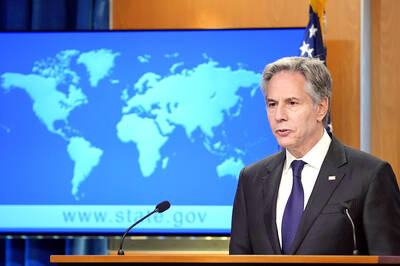
Beijing is continuing to commit genocide and crimes against humanity against Uyghurs and other Muslim minorities in its western Xinjiang province, U.S. Secretary of State Antony Blinken said in a report published on Monday, ahead of his planned visit to China this week. The State Department’s annual human rights report, which documents abuses recorded all over the world during the previous calendar year, repeated language from previous years on the treatment of Muslims in Xinjiang, but the publication raises the issue ahead of delicate talks, including on the war in Ukraine and global trade, between the top U.S. diplomat and Chinese


 RSS
RSS