


US operations in Somalia will go on until key al-Qaeda targets are eliminated, a Pentagon official said on Wednesday, as debate sharpened over Washington's next move in the stricken nation.
The remarks followed last week's assault in Somalia using a fearsome AC-130 aircraft which US officials say killed at least eight people, described in Washington as radicals sheltering al-Qaeda's top Africa leadership.
The fact that the top members of Osama bin Laden's network are still presumed at large in the country is sparking speculation of possible follow-up operations and questions on whether Somalia will become the latest hot battlefront in the "war on terror."
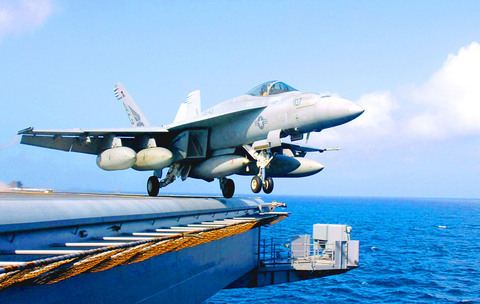
PHOTO: AFP
Theresa Whelan, US deputy assistant secretary of defense for African affairs, said on Wednesday US forces were working to ensure "international terrorists who were seeking refuge in Somalia are brought to justice."
"When that is done, our operations will cease," she said, at a half-day conference on Somalia sponsored by US think tanks, without specifying how long operations might continue or offering details on future US troop deployments.
Some observers saw the strike as presaging an attempt to snuff out any resurgence of the fundamentalist Islamic Courts movement, which took control of most of Somalia last year before being ousted in a US-backed Ethiopian offensive.
Al-Qaeda
The strike also fits into a long-term US goal of ensuring East Africa does not succeed Afghanistan as an al-Qaeda terror base.
Speculation over possible future US action is also being spurred by the mighty firepower of a US aircraft carrier battlegroup prowling off the African coast.
"It's a good question, and it's easier to pose it than answer it," said John Pike, an analyst with GlobalSecurity.org.
"It would appear that the Islamic Courts envisioned a Taliban-like enterprise -- just because we have run them out of downtown Mogadishu, doesn't mean we have heard the end of it," he said.
Exaggerated?
Critics of US policy say Washington exaggerated al-Qaeda's sway on the movement, in pursuit of their own geopolitical ends in the strategically sensitive Horn of Africa region.
"I think the US and Ethiopia overstated the case in order to justify the military intervention and ongoing air strikes," said John Prendergast, of the International Crisis Group.
"There is certainly a dangerous al-Qaeda cell on the Indian Ocean coast that used Somalia as a safe haven and transshipment point [but] this kind of short-term military tactic devoid of any political strategy will backfire in the long run," he said.
Senior US officials argue however that security operations in Somalia co-exist with vigorous US diplomatic and political attempts to stabilize the fragile state after its latest political earthquake.
As well as chasing terrorists, Washington was also trying to mobilize global support for Somalia's weak transitional government, and to speed the deployment of an African peacekeeping force, Jendayi Frazer, assistant US secretary of state for African affairs, said at the conference.
Clan elders and residents in the area targeted by the US operation close to the Kenyan border claimed 100 people were killed in numerous air strikes on Monday, Tuesday and Wednesday of last week.
Washington has said however that no civilians were killed and that US forces carried out only a single air strike.
"High value" al-Qaeda militants the US believes are in Somalia include Comoran Fazul Abdullah Mohammed and Kenyan Saleh Ali Saleh Nabhan, blamed for the 1998 bombings of US embassies in Kenya and Tanzania that killed 224 people. Materials used in the blasts were smuggled through Somalia.
The other is Abu Taha al-Sudani, a Sudanese alleged to be close to al-Qaeda leader Osama bin Laden.
Stephen Morrison, of the Center for Strategic and International Studies which hosted the conference, said a US program that simply prioritized hunting alleged terrorists was insufficient.
"We know [the US] approach has been very concentrated on the counter-terror side that is highly controversial," he said at the conference. "We need to be thinking about how we move beyond that."
Archeologists in Peru on Thursday said they found the 5,000-year-old remains of a noblewoman at the sacred city of Caral, revealing the important role played by women in the oldest center of civilization in the Americas. “What has been discovered corresponds to a woman who apparently had elevated status, an elite woman,” archeologist David Palomino said. The mummy was found in Aspero, a sacred site within the city of Caral that was a garbage dump for more than 30 years until becoming an archeological site in the 1990s. Palomino said the carefully preserved remains, dating to 3,000BC, contained skin, part of the

‘WATER WARFARE’: A Pakistani official called India’s suspension of a 65-year-old treaty on the sharing of waters from the Indus River ‘a cowardly, illegal move’ Pakistan yesterday canceled visas for Indian nationals, closed its airspace for all Indian-owned or operated airlines, and suspended all trade with India, including to and from any third country. The retaliatory measures follow India’s decision to suspend visas for Pakistani nationals in the aftermath of a deadly attack by shooters in Kashmir that killed 26 people, mostly tourists. The rare attack on civilians shocked and outraged India and prompted calls for action against their country’s archenemy, Pakistan. New Delhi did not publicly produce evidence connecting the attack to its neighbor, but said it had “cross-border” links to Pakistan. Pakistan denied any connection to

TRUMP EFFECT: The win capped one of the most dramatic turnarounds in Canadian political history after the Conservatives had led the Liberals by more than 20 points Canadian Prime Minister Mark Carney yesterday pledged to win US President Donald Trump’s trade war after winning Canada’s election and leading his Liberal Party to another term in power. Following a campaign dominated by Trump’s tariffs and annexation threats, Carney promised to chart “a new path forward” in a world “fundamentally changed” by a US that is newly hostile to free trade. “We are over the shock of the American betrayal, but we should never forget the lessons,” said Carney, who led the central banks of Canada and the UK before entering politics earlier this year. “We will win this trade war and

Armed with 4,000 eggs and a truckload of sugar and cream, French pastry chefs on Wednesday completed a 121.8m-long strawberry cake that they have claimed is the world’s longest ever made. Youssef El Gatou brought together 20 chefs to make the 1.2 tonne masterpiece that took a week to complete and was set out on tables in an ice rink in the Paris suburb town of Argenteuil for residents to inspect. The effort overtook a 100.48m-long strawberry cake made in the Italian town of San Mauro Torinese in 2019. El Gatou’s cake also used 350kg of strawberries, 150kg of sugar and 415kg of


 RSS
RSS