


Political squabbling, rookie wanderlust and Israel's arrest of dozens of lawmakers have effectively shut down the Palestinian parliament.
A session planned for Tuesday was to have been the first in four months. It was canceled because a dozen Hamas legislators preferred to go on a junket to Indonesia instead, and the deputy speaker believed he wouldn't get a quorum of at least 67 out of 132 lawmakers.
The extended break has largely gone unnoticed by a jaded public. Polls indicate that after years of inaction by the lawmakers, Palestinians don't have much faith in parliament.
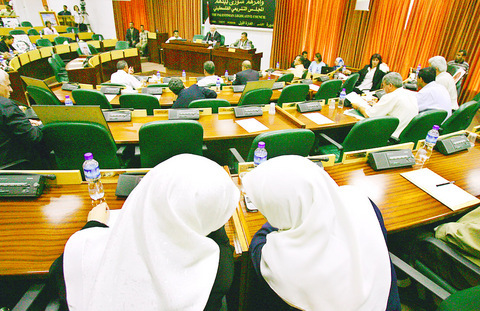
PHOTO: AP
"The public doesn't feel the absence of the legislative council because ... it didn't do its job," political scientist Ali Jerbawi said.
Parliament was formed in 1996 as part of the interim peace deals with Israel. For the first 10 years it was controlled by the Fatah movement founded by the late Yasser Arafat, predecessor of moderate Palestinian President Mahmoud Abbas.
A year ago, the Islamic militant Hamas swept parliament elections, winning 74 seats, compared to 45 for Fatah, and enabling Hamas to form a government without relying on a coalition partner.
Today, 41 legislators are in Israeli lockups, including 37 from Hamas. Israel has rounded up dozens of Hamas officials in recent months on charges of membership of an outlawed organization.
The detentions have weakened Hamas' control of parliament, since those in prison cannot cast a vote.
Initially, Fatah promised Hamas it wouldn't exploit the sudden advantage. However, with the power struggle between the rival movements intensifying -- 35 people were killed in Hamas-Fatah fighting in the past month -- such promises no longer hold.
"At the beginning, ... we said we will not play into the hand of the occupation," said Fatah lawmaker Abdullah Abdullah, referring to the Israeli arrests. "But if something comes up for a vote, we will vote. If something bad is affecting our nation, we will do our duty."
Abdullah said he believes his party's numerical advantage is the main reason behind what he portrayed as Hamas' reluctance to convene parliament. The legislature hasn't passed any laws since Hamas' election.
The last full session was held in September, though Fatah derailed one of the sessions because the agenda didn't include appearances by Prime Minister Ismail Haniyeh and Interior Minister Said Siyam, both of Hamas.
Hamas accused Fatah of playing into Israel's hands, saying the arrests of the lawmakers were meant to weaken parliament.
"They [Fatah lawmakers] want to help the Zionists remove Hamas from power," Hamas legislator Mushir al-Masri said .
Deputy Speaker Ahmed Bahar of Hamas, filling in for the imprisoned speaker, denied politics played a part in his decision to call off the last two sessions, including Tuesday's.
He said legislators were either sick or abroad, and that the technician who operates the video hookup between simultaneous parliament sessions in the West Bank and Gaza -- a device to get around Israeli travel restrictions -- didn't show up for work because of alleged threats.
The main reason, he said, was the trip to Indonesia, according to Hamas. The trip is being funded in part by the Indonesian hosts.
"This time, there is a big delegation that has to leave," Bahar said. "They've been planning this trip for more than two months, and it just so happened that they had to leave at the same time that the session was called."
Pollster Nader Said of the West Bank's Bir Zeit University said most Palestinians did not have high expectations of the legislature to begin with, and that the long recess didn't change that view.
In a September survey by Said, 55 percent said they had a negative opinion of parliament, making it one the least regarded institutions, on par only with the Cabinet. The error margin was 3 percentage points.
"It's not one of the priorities to activate the legislative council," Said said of the public's concerns. "They are more concerned about internal fighting. People didn't have high expectations of the legislative council, they had high expectations of the government."
The previous, Fatah-controlled legislature, was widely seen as a rubber stamp for Arafat, the autocratic ruler who died two years ago. However, lawmakers did pass a forerunner to a constitution and were able exercise some oversight over the government.
Archeologists in Peru on Thursday said they found the 5,000-year-old remains of a noblewoman at the sacred city of Caral, revealing the important role played by women in the oldest center of civilization in the Americas. “What has been discovered corresponds to a woman who apparently had elevated status, an elite woman,” archeologist David Palomino said. The mummy was found in Aspero, a sacred site within the city of Caral that was a garbage dump for more than 30 years until becoming an archeological site in the 1990s. Palomino said the carefully preserved remains, dating to 3,000BC, contained skin, part of the

‘WATER WARFARE’: A Pakistani official called India’s suspension of a 65-year-old treaty on the sharing of waters from the Indus River ‘a cowardly, illegal move’ Pakistan yesterday canceled visas for Indian nationals, closed its airspace for all Indian-owned or operated airlines, and suspended all trade with India, including to and from any third country. The retaliatory measures follow India’s decision to suspend visas for Pakistani nationals in the aftermath of a deadly attack by shooters in Kashmir that killed 26 people, mostly tourists. The rare attack on civilians shocked and outraged India and prompted calls for action against their country’s archenemy, Pakistan. New Delhi did not publicly produce evidence connecting the attack to its neighbor, but said it had “cross-border” links to Pakistan. Pakistan denied any connection to

TRUMP EFFECT: The win capped one of the most dramatic turnarounds in Canadian political history after the Conservatives had led the Liberals by more than 20 points Canadian Prime Minister Mark Carney yesterday pledged to win US President Donald Trump’s trade war after winning Canada’s election and leading his Liberal Party to another term in power. Following a campaign dominated by Trump’s tariffs and annexation threats, Carney promised to chart “a new path forward” in a world “fundamentally changed” by a US that is newly hostile to free trade. “We are over the shock of the American betrayal, but we should never forget the lessons,” said Carney, who led the central banks of Canada and the UK before entering politics earlier this year. “We will win this trade war and

Armed with 4,000 eggs and a truckload of sugar and cream, French pastry chefs on Wednesday completed a 121.8m-long strawberry cake that they have claimed is the world’s longest ever made. Youssef El Gatou brought together 20 chefs to make the 1.2 tonne masterpiece that took a week to complete and was set out on tables in an ice rink in the Paris suburb town of Argenteuil for residents to inspect. The effort overtook a 100.48m-long strawberry cake made in the Italian town of San Mauro Torinese in 2019. El Gatou’s cake also used 350kg of strawberries, 150kg of sugar and 415kg of


 RSS
RSS