


Hundreds of thousands of people took part in peace rallies on Saturday in Madrid and in the Basque city of Bilbao to protest a deadly attack two weeks ago by the armed Basque separatist group ETA.
Nearly 175,000 people staged a march through the Spanish capital under the banner "For peace, against terrorism," according to the city council. A further 80,000 gathered in Bilbao, police said.
Both demonstrations were to protest at an ETA bombing in a carpark at Madrid airport on Dec. 30 that killed two Ecuadorans and blew a hole in efforts by Socialist Prime Minister Jose Luis Rodriguez Zapatero to negotiate a lasting peace in the Basque region.
The Madrid event had drawn 174,800 people onto the streets by 6:25pm, the city council said in a statement.
Members of the Socialist government joined the marchers, as did hundreds of Ecuadorans wishing to honor their dead compatriots, Diego Armando Estacio and Carlos Alonso Palate.
But the main opposition party, the conservative Popular Party (PP), refused to attend the demonstration because it did not include a clear call "to defeat ETA" by police and legal means.
"The saddest thing is that the political parties are incapable of agreeing to demonstrate for something as simple as peace," lamented 43-year-old shop worker Miguel Melgar.
The powerful pro-PP Association of the Victims of Terrorism also shunned the marches.
The silent march in Bilbao began around 5pm, with police estimating the crowd at 80,000.
"It is important to say to ETA that Basque society is against violence. Once peace is established we can begin a dialogue but we have had enough of attacks and violence," said protester Aritz, who works in real estate.
Unrest continued in the Basque region in the run-up to the protests, according to Vasco Press news agency, which reported several acts of violence and arrests overnight.
The head of the moderate Basque nationalist party that leads the Basque regional government, Juan Jose Ibarretxe, was among the Bilbao marchers, who called for peace and dialogue with the Spanish government.
But ETA's banned political wing, Batasuna, was absent from the rally. The Basque branch of the Socialist Party had threatened not to participate if Batasuna, which has not condemned the ETA attack last month, took part.
For nearly four decades ETA waged a struggle for an independent Basque homeland comprising parts of northern Spain and southwestern France that has claimed more than 800 lives.
In March last year it declared a unilateral and "permanent" ceasefire, prompting Zapatero's government to launch efforts to negotiate a lasting peace in the Basque region.
But the peace process was beset with difficulties. It was opposed outright by the PP, no formal direct talks took place and the Madrid airport bomb last month scuppered the efforts.
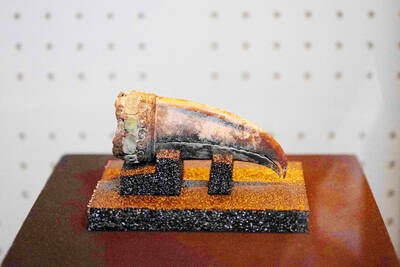
Archeologists in Peru on Thursday said they found the 5,000-year-old remains of a noblewoman at the sacred city of Caral, revealing the important role played by women in the oldest center of civilization in the Americas. “What has been discovered corresponds to a woman who apparently had elevated status, an elite woman,” archeologist David Palomino said. The mummy was found in Aspero, a sacred site within the city of Caral that was a garbage dump for more than 30 years until becoming an archeological site in the 1990s. Palomino said the carefully preserved remains, dating to 3,000BC, contained skin, part of the

TRUMP EFFECT: The win capped one of the most dramatic turnarounds in Canadian political history after the Conservatives had led the Liberals by more than 20 points Canadian Prime Minister Mark Carney yesterday pledged to win US President Donald Trump’s trade war after winning Canada’s election and leading his Liberal Party to another term in power. Following a campaign dominated by Trump’s tariffs and annexation threats, Carney promised to chart “a new path forward” in a world “fundamentally changed” by a US that is newly hostile to free trade. “We are over the shock of the American betrayal, but we should never forget the lessons,” said Carney, who led the central banks of Canada and the UK before entering politics earlier this year. “We will win this trade war and
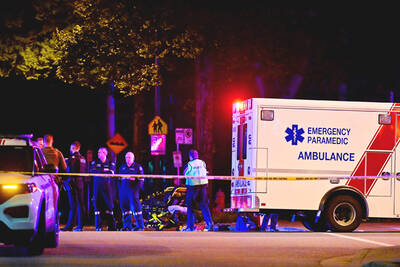
‘BODIES EVERYWHERE’: The incident occurred at a Filipino festival celebrating an anti-colonial leader, with the driver described as a ‘lone suspect’ known to police Canadian police arrested a man on Saturday after a car plowed into a street party in the western Canadian city of Vancouver, killing a number of people. Authorities said the incident happened shortly after 8pm in Vancouver’s Sunset on Fraser neighborhood as members of the Filipino community gathered to celebrate Lapu Lapu Day. The festival, which commemorates a Filipino anti-colonial leader from the 16th century, falls this year on the weekend before Canada’s election. A 30-year-old local man was arrested at the scene, Vancouver police wrote on X. The driver was a “lone suspect” known to police, a police spokesperson told journalists at the

North Korean leader Kim Jong-un has unveiled a new naval destroyer, claiming it as a significant advancement toward his goal of expanding the operational range and preemptive strike capabilities of his nuclear-armed military, state media said yesterday. North Korea’s state-run Korean Central News Agency (KCNA) said Kim attended the launching ceremony for the 5,000-tonne warship on Friday at the western port of Nampo. Kim framed the arms buildup as a response to perceived threats from the US and its allies in Asia, who have been expanding joint military exercises amid rising tensions over the North’s nuclear program. He added that the acquisition


 RSS
RSS