


Canada unveiled a major border security and prosperity initiative, saying it would spend more than C$432 million (US$368 million) over the next five years to protect its border from terrorist, economic and environmental threats.
Public Safety Minister Stockwell Day made the announcement on Friday at the Canada-US border crossing between Windsor and Detroit, Michigan, where one-third of the US$1.6 billion in daily trade between the North American neighbors crosses over the Ambassador Bridge or in tunnels beneath the Detroit River.
"I even sometimes surprise my American friends when I remind them that the trade that comes across the Ambassador Bridge in total is greater than all of the trade that exists between the United States and Japan,'' Day told a news conference.
Security experts have long criticized the lack of security measures along Canada's side of the 6,435km border with the US, particularly since the Sept. 11, 2001, terrorist attacks.
The Canadian prime minister, Stephen Harper, pledged when he was elected nearly a year ago to strengthen the frontier between the world's largest trading partners, including the security measures just unveiled, and eventually arming Canada's border guards.
The bulk of the money -- US$337 million -- is for the eManifest program, which allows for computer-automated risk assessments of cargo shipments before they reach Canada.
The 18,000 trucks that cross the US-Canada border each day, as well as all railroad, air and marine cargo carriers, will eventually be required to file electronic manifests before their shipments arrive.
This will help border service agents to determine in advance whether the cargo, or those who are delivering it, should be further screened.
The eManifest program will ensure that background checks on crew and risk assessments of cargo are in the hands of the Canada Border Services Agency 24 hours in advance of the arrival of shipments by sea and several hours ahead of railroad, highway and air cargo.
The program was developed in cooperation with the US Department of Homeland Security.
It is part of the Security and Prosperity Partnership of North America, launched in 2005 by then prime minister Paul Martin, US President George W. Bush and then-Mexican president Vicente Fox.
Day would not give a precise date as to when the electronic manifests would become mandatory at the 119 border crossings.
"There's still going to be that human element at the border, to look at material and talk to the driver, but the amount of time that's going to be saved is going to be significant," he said of the requirement to file electronic manifests in advance of cargo shipments.
Another US$20 million has been earmarked for business leaders and emergency responders to plan for the immediate resumption of trade across the border in the event of a terrorist attack, medical pandemic or natural disaster.
Perrin Beatty, president of the Canadian Manufacturers & Exporters, said that his and other associations would work with governments and emergency response teams on both sides of the border to stage exercises and develop protocols that would get trade moving within hours of an emergency.
"If al-Qaeda can damage us, either physically or economically, they win," Beatty said during the news conference.
"It would be foolish for us to assume that there will not be any further incidents along the border," Beatty added.
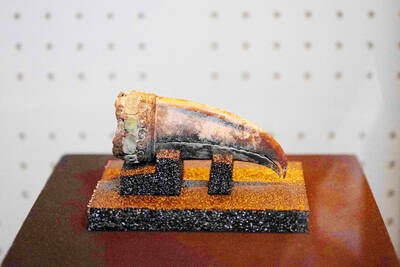
Archeologists in Peru on Thursday said they found the 5,000-year-old remains of a noblewoman at the sacred city of Caral, revealing the important role played by women in the oldest center of civilization in the Americas. “What has been discovered corresponds to a woman who apparently had elevated status, an elite woman,” archeologist David Palomino said. The mummy was found in Aspero, a sacred site within the city of Caral that was a garbage dump for more than 30 years until becoming an archeological site in the 1990s. Palomino said the carefully preserved remains, dating to 3,000BC, contained skin, part of the

‘WATER WARFARE’: A Pakistani official called India’s suspension of a 65-year-old treaty on the sharing of waters from the Indus River ‘a cowardly, illegal move’ Pakistan yesterday canceled visas for Indian nationals, closed its airspace for all Indian-owned or operated airlines, and suspended all trade with India, including to and from any third country. The retaliatory measures follow India’s decision to suspend visas for Pakistani nationals in the aftermath of a deadly attack by shooters in Kashmir that killed 26 people, mostly tourists. The rare attack on civilians shocked and outraged India and prompted calls for action against their country’s archenemy, Pakistan. New Delhi did not publicly produce evidence connecting the attack to its neighbor, but said it had “cross-border” links to Pakistan. Pakistan denied any connection to

TRUMP EFFECT: The win capped one of the most dramatic turnarounds in Canadian political history after the Conservatives had led the Liberals by more than 20 points Canadian Prime Minister Mark Carney yesterday pledged to win US President Donald Trump’s trade war after winning Canada’s election and leading his Liberal Party to another term in power. Following a campaign dominated by Trump’s tariffs and annexation threats, Carney promised to chart “a new path forward” in a world “fundamentally changed” by a US that is newly hostile to free trade. “We are over the shock of the American betrayal, but we should never forget the lessons,” said Carney, who led the central banks of Canada and the UK before entering politics earlier this year. “We will win this trade war and

Armed with 4,000 eggs and a truckload of sugar and cream, French pastry chefs on Wednesday completed a 121.8m-long strawberry cake that they have claimed is the world’s longest ever made. Youssef El Gatou brought together 20 chefs to make the 1.2 tonne masterpiece that took a week to complete and was set out on tables in an ice rink in the Paris suburb town of Argenteuil for residents to inspect. The effort overtook a 100.48m-long strawberry cake made in the Italian town of San Mauro Torinese in 2019. El Gatou’s cake also used 350kg of strawberries, 150kg of sugar and 415kg of


 RSS
RSS