


The execution of Saddam Hussein has sparked a wave of support for the former Iraqi president around the Arab world, with some proclaiming him a martyr and comparing him to heroes of Arab nationalism -- raising resentment against the US and the Shiite-led Iraqi government.
Praise for Saddam has only grown since his Dec. 30 hanging, eclipsing what had been a greater acknowledgement in recent years of the atrocities committed by his regime.
On Monday, the independent Egyptian paper, Al-Karama, splashed Saddam's photo over a full page, with an Iraqi flag behind him, declaring him an "Arab martyr."
"He lived as hero, died as a man," another Egyptian opposition newspaper, Al-Osboa, proclaimed in a headline, showing a photo of Saddam at the gallows.
The praise has angered the Iraqi government and Kuwait, which Saddam invaded in 1990. On Monday, Kuwaiti lawmakers slammed Arab countries that described the former Iraqi leader as a hero and demanded the government reconsider ties and financial aid to them.
Anger over the execution could fuel support for Iraq's Sunni Muslim insurgency. It could also complicate the US' efforts to rally Arab nations' help in reconciling Iraq's warring Sunni and Shiite communities and ease the nation's bloodshed.
In large part, it was the unruly scene at the gallows that catapulted Saddam to hero's status. In video footage smuggled out of the execution room, Saddam's Shiite executioners were seen taunting and cursing him, while the former leader -- his head unbowed -- retorted: "Is this manly?"
For many, the scene came to symbolize dignified Arab resistance in the face of humiliation at the hands of a Shiite government seen by some in the region as illegitimate, backed by the US military presence and closely allied to predominantly Shiite Iran.
Some media compared Saddam to another hero of Arab nationalism against Western domination: Omar al-Mokhtar, the leader of resistance against Italy's military occupation of Libya, who was executed by hanging in 1931.
Egypt's nationalist weekly newspaper Al-Arabi published a cartoon on Sunday showing an open book with pictures of Saddam and al-Mokhtar on facing pages.
The reaction was in contrast to the shock that followed Saddam's capture by US troops in December 2003. At the time, Saddam was humiliated, shown bearded and bedraggled in photos as he was pulled out of a hole by US troops.
The images sparked a debate across the region over his dictatorship. Many pointed out his weakness in the face of US forces and over the following years, Arab media dealt more frankly with the mass killings carried out by Saddam's regime. Languishing in US custody, Saddam faded in relevance and coverage of his trial waned in Arab media.
But after the execution, even some Arab critics of Saddam said his new heroic status was more significant now than his record of crimes and atrocities.
"Five sublime minutes at the hanging rope created the myth," columnist Abdel-Halim Qandil wrote in Al-Karama. "The story of Saddam the bloody dictator was over, replaced by Saddam's image similar to Omar al-Mokhtar."
Egyptian President Hosni Mubarak suggested the execution could worsen the situation in Iraq.
"It was disgraceful and very painful," Mubarak said of the execution in an interview with the Israeli daily Yediot Ahronot on Thursday. "They [the Iraqi government] have made him into a martyr, while the problems within Iraq remain."
On Saturday, Iraqi Prime Minister Nouri al-Maliki denounced government for criticizing the execution, accusing them of meddling in Iraqi affairs.
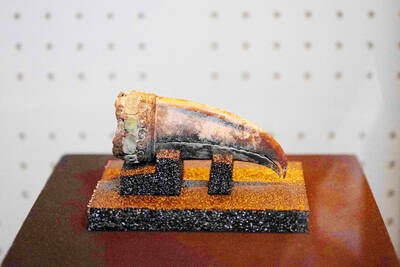
Archeologists in Peru on Thursday said they found the 5,000-year-old remains of a noblewoman at the sacred city of Caral, revealing the important role played by women in the oldest center of civilization in the Americas. “What has been discovered corresponds to a woman who apparently had elevated status, an elite woman,” archeologist David Palomino said. The mummy was found in Aspero, a sacred site within the city of Caral that was a garbage dump for more than 30 years until becoming an archeological site in the 1990s. Palomino said the carefully preserved remains, dating to 3,000BC, contained skin, part of the
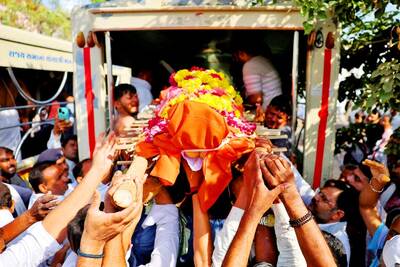
‘WATER WARFARE’: A Pakistani official called India’s suspension of a 65-year-old treaty on the sharing of waters from the Indus River ‘a cowardly, illegal move’ Pakistan yesterday canceled visas for Indian nationals, closed its airspace for all Indian-owned or operated airlines, and suspended all trade with India, including to and from any third country. The retaliatory measures follow India’s decision to suspend visas for Pakistani nationals in the aftermath of a deadly attack by shooters in Kashmir that killed 26 people, mostly tourists. The rare attack on civilians shocked and outraged India and prompted calls for action against their country’s archenemy, Pakistan. New Delhi did not publicly produce evidence connecting the attack to its neighbor, but said it had “cross-border” links to Pakistan. Pakistan denied any connection to

TRUMP EFFECT: The win capped one of the most dramatic turnarounds in Canadian political history after the Conservatives had led the Liberals by more than 20 points Canadian Prime Minister Mark Carney yesterday pledged to win US President Donald Trump’s trade war after winning Canada’s election and leading his Liberal Party to another term in power. Following a campaign dominated by Trump’s tariffs and annexation threats, Carney promised to chart “a new path forward” in a world “fundamentally changed” by a US that is newly hostile to free trade. “We are over the shock of the American betrayal, but we should never forget the lessons,” said Carney, who led the central banks of Canada and the UK before entering politics earlier this year. “We will win this trade war and

Armed with 4,000 eggs and a truckload of sugar and cream, French pastry chefs on Wednesday completed a 121.8m-long strawberry cake that they have claimed is the world’s longest ever made. Youssef El Gatou brought together 20 chefs to make the 1.2 tonne masterpiece that took a week to complete and was set out on tables in an ice rink in the Paris suburb town of Argenteuil for residents to inspect. The effort overtook a 100.48m-long strawberry cake made in the Italian town of San Mauro Torinese in 2019. El Gatou’s cake also used 350kg of strawberries, 150kg of sugar and 415kg of


 RSS
RSS