


Hamas accepts the existence of the state of Israel but will not officially recognize it until the establishment of a Palestinian state in the West Bank and Gaza, according to Khaled Meshal, a Hamas leader in Damascus.
In comments to reporters, Meshal softened his anti-Israel rhetoric, suggesting that Hamas does not seek the destruction of Israel as written in its charter.
He said that Israel is a "reality" and "there will remain a state called Israel -- this is a matter of fact."
"The problem is not that there is an entity called Israel. The problem is that the Palestinian state is non-existent," he said.
Israel and the international community have demanded that Hamas recognize Israel as a prerequisite to receiving tax revenues and international funding. Hamas' refusal has led to Palestinian Authority employees receiving little or no wages for almost a year and has severely depressed the Palestinian economy.
Meshal, who Israel tried to assassinate in 1997, is seen as a hardliner who has used his influence in the last year to move Hamas towards greater confrontation with Israel.
He was seen as the driving force behind the attack on Israeli positions near Gaza in June that led to the capture of the Israeli soldier Gilad Shalit and a full-scale confrontation with Israel.
Because Meshal is the conduit for much of the finance for Hamas, he was able to influence the group's armed wing, which diverged from the political wing led by Palestinian Authority Prime Minister Ismail Haniya.
Palestinian observers have long suspected that Meshal, who has never set foot in Gaza or the West Bank, is a pragmatist whose ultimate aim is to lead the Palestine Liberation Organization.
Hamas is not a member of the PLO, but as the dominant political force in the Palestinian territories, it is only a matter of time and negotiation before it takes its place.
The PLO, currently led by Palestinian President Mahmoud Abbas, is dominated by Fatah and leftist groups whose influence has waned since the 1960s and 1970s.
Hamas and Fatah are locked in an occasionally violent power struggle that some fear will lead to a civil war. Meshal called for renewed dialogue between the groups to try to form a national unity government.
Meshal's comments are far from the rhetoric of the Hamas charter, which was published in 1988.
In its preamble, the charter notes: "Israel will rise and will remain erect until Islam eliminates it as it had eliminated its predecessors."
The charter insists that the whole of Palestine is an Islamic trust which cannot be given away to non-Muslims.
"As a Palestinian today I speak of a Palestinian and Arab demand for a state on 1967 borders. It is true that in reality there will be an entity or state called Israel on the rest of Palestinian land. This is a reality but I won't deal with it in terms of recognizing or admitting it," Meshal said. "The distant future will have its own circumstances, and positions could be determined then."
Changing the Hamas charter was also a matter for the future, he said.
Past concessions by Palestinian negotiators went unrewarded, he argued, and Hamas would drive hard bargains over issues such as recognition.
"For Israel to suck us into bargains in stages and in packages -- this road constitutes an attempt to weaken the Palestinian position," he said.
Meshal's comments caused surprise among Hamas officials in Gaza, although they were quick to point out there was little substantial divergence from other Hamas statements.
Ahmed Yusuf, an adviser to Haniya, said that Hamas recognized Israel's de facto existence but was not going to recognize it officially.
"Israel is there, it is part of the United Nations and we do not deny its existence. But we still have rights and land there which have been usurped and until these matters are dealt with we will withhold our recognition," he said.

An American scientist convicted of lying to US authorities about payments from China while he was at Harvard University has rebuilt his research lab in Shenzhen, China, to pursue technology the Chinese government has identified as a national priority: embedding electronics into the human brain. Charles Lieber, 67, is among the world’s leading researchers in brain-computer interfaces. The technology has shown promise in treating conditions such as amyotrophic lateral sclerosis and restoring movement in paralyzed people. It also has potential military applications: Scientists at the Chinese People’s Liberation Army have investigated brain interfaces as a way to engineer super soldiers by boosting
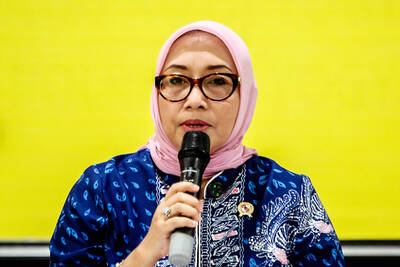
Indonesian police have arrested 13 people after shocking images of alleged abuse against small children at a daycare center went viral, sparking outrage across the nation, officials said on Monday. Police on Friday last week raided Little Aresha, a daycare center in Yogyakarta on Java island, following a report from a former employee. CCTV footage circulating on social media showed children, most younger than two, lying on the floor wearing only diapers, their hands and feet bound with rags. The police have confirmed that the footage is authentic. Police said they also found 20 children crammed into a room just 3m by 3m. “So

Jailed media entrepreneur Jimmy Lai (黎智英) has been awarded Deutsche Welle’s (DW) freedom of speech award for his contribution to Hong Kong’s pro-democracy movement. The German public broadcaster on Thursday said Lai would be presented in absentia with the 12th iteration of the award on June 23 at the DW Global Media Forum in Bonn. Deutsche Welle director-general Barbara Massing praised the 78-year-old founder of the now-shuttered news outlet Apple Daily for standing “unwaveringly for press freedom in Hong Kong at great personal risk.” “With Apple Daily, he gave journalists a platform for free reporting and a voice to the democracy movement in

PHILIPPINE COMMITTEE: The head of the committee that made the decision said: ‘If there is nothing to hide, there is no reason to hide, there is no reason to obstruct’ A Philippine congressional committee on Wednesday ruled that there was “probable cause” to impeach Philippine Vice President Sara Duterte after hearing allegations of unexplained wealth, misuse of state funds and threats to have the president assassinated. The unanimous decision of the 53-member committee in the Philippine House of Representatives sends the two impeachment complaints to deliberations and voting by the entire lower chamber, which has more than 300 lawmakers. The complaints centered on Duterte’s alleged illegal use and mishandling of intelligence funds from the vice president’s office, and from her time as education secretary under Philippine President Ferdinand Marcos Jr. Duterte and the


 RSS
RSS