


The abrupt resignation of Warsaw's new archbishop over his ties to the communist-era secret police has left Poland facing a "national crisis," the prime minister said on Monday, as the Polish Church struggles with the long-suppressed issue of priests compromised under communism.
Speaking on state Radio 1, Prime Minister Jaroslaw Kaczynski praised Pope Benedict XVI for accepting Archbishop Stanislaw Wielgus' resignation, calling it "the right decision."
Wielgus stunned worshippers gathered at St. John's Cathedral on Sunday by stepping down moments before his official installation Mass -- a move that has rattled the nation and Poland's powerful Roman Catholic Church.
Kaczynski, whose conservative Law and Justice party has sought both to purge Poland of the vestiges of communist influence and to strengthen traditional Catholic values, also warned of the scandal's damage to the Church in the deeply Catholic country.
He called the Church a "national institution" in Poland.
"That's why this crisis is a national crisis, a very difficult crisis," he said.
While the government has passed new laws widening the number of public officials that must be screened for possible ties to the communist-era intelligence service, many say the Church has fallen behind the rest of society in dealing with penetration of its ranks.
One reason could be that General Czeslaw Kiszczak told Church officials in 1990 that the secret police had destroyed all documents on clergy in their files, Polish media have reported.
It now turns out, however, that microfilm of some of those files survived. It was microfilm copies that confirmed Wielgus' cooperation with the secret police.
Asked on Tuesday about the alleged burning of the files on TVN24 television, Kiszczak declined to comment.
Historians from the state-run Institute of National Remembrance, which holds the secret police archives, estimate that about 15 percent of Polish priests cooperated with the communist-era intelligence services.
Wielgus' case highlights the problem, but may also mark a turning point, says Marek Zajac, a commentator for the Catholic weekly Tygodnik Powszechny.
"I have the impression that the Wielgus affair was for a lot of Church leaders, not all, but for many of them a mental Rubicon, a mental breakthrough, although a very painful one, that you can't stop" the outing of past agents, said Zajac.
Another prominent clergyman, the rector of Krakow's Wawel Cathedral, also left his post for very similar reasons on Monday amid warnings that more such revelations may be on the way for the Church.
Reverend Janusz Bielanski denied the allegations on Tuesday, saying: "I was never an informer, I never signed any documents, I never received any money."
Kaczynski stressed that the Church played an "unambiguously positive and heroic role" in opposing the communist regime that ruled Poland until 1989, and warned that due to the current crisis the Church is "almost accused of participation in the [communist] system."
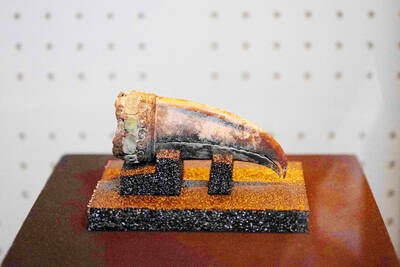
Archeologists in Peru on Thursday said they found the 5,000-year-old remains of a noblewoman at the sacred city of Caral, revealing the important role played by women in the oldest center of civilization in the Americas. “What has been discovered corresponds to a woman who apparently had elevated status, an elite woman,” archeologist David Palomino said. The mummy was found in Aspero, a sacred site within the city of Caral that was a garbage dump for more than 30 years until becoming an archeological site in the 1990s. Palomino said the carefully preserved remains, dating to 3,000BC, contained skin, part of the

TRUMP EFFECT: The win capped one of the most dramatic turnarounds in Canadian political history after the Conservatives had led the Liberals by more than 20 points Canadian Prime Minister Mark Carney yesterday pledged to win US President Donald Trump’s trade war after winning Canada’s election and leading his Liberal Party to another term in power. Following a campaign dominated by Trump’s tariffs and annexation threats, Carney promised to chart “a new path forward” in a world “fundamentally changed” by a US that is newly hostile to free trade. “We are over the shock of the American betrayal, but we should never forget the lessons,” said Carney, who led the central banks of Canada and the UK before entering politics earlier this year. “We will win this trade war and
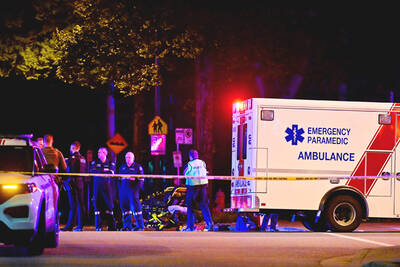
‘BODIES EVERYWHERE’: The incident occurred at a Filipino festival celebrating an anti-colonial leader, with the driver described as a ‘lone suspect’ known to police Canadian police arrested a man on Saturday after a car plowed into a street party in the western Canadian city of Vancouver, killing a number of people. Authorities said the incident happened shortly after 8pm in Vancouver’s Sunset on Fraser neighborhood as members of the Filipino community gathered to celebrate Lapu Lapu Day. The festival, which commemorates a Filipino anti-colonial leader from the 16th century, falls this year on the weekend before Canada’s election. A 30-year-old local man was arrested at the scene, Vancouver police wrote on X. The driver was a “lone suspect” known to police, a police spokesperson told journalists at the
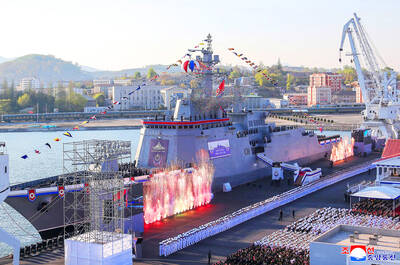
North Korean leader Kim Jong-un has unveiled a new naval destroyer, claiming it as a significant advancement toward his goal of expanding the operational range and preemptive strike capabilities of his nuclear-armed military, state media said yesterday. North Korea’s state-run Korean Central News Agency (KCNA) said Kim attended the launching ceremony for the 5,000-tonne warship on Friday at the western port of Nampo. Kim framed the arms buildup as a response to perceived threats from the US and its allies in Asia, who have been expanding joint military exercises amid rising tensions over the North’s nuclear program. He added that the acquisition


 RSS
RSS