


European countries faced continued disruption to their oil supplies yesterday after talks failed to end an oil transit row between Russia and Belarus that threatens relations between Moscow and the EU.
Russian President Vladimir Putin said on Tuesday that Western consumers must be spared the effects of disrupted supplies after German Chancellor Angela Merkel warned the crisis was destroying confidence in Moscow.
Russia confirmed that it had cut oil shipments through the Druzhba (Friendship) pipeline to western Europe, but Putin urged government ministers to "do everything to secure the interests of Western consumers."
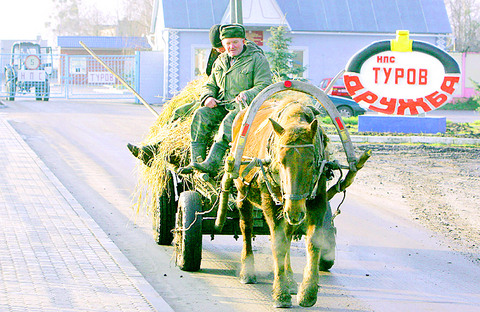
PHOTO: AFP
He added, however, that Russia might nonetheless have to reduce oil output owing to the crisis.
Despite the gravity of the situation, talks between Russia and Belarus ended in Moscow on Tuesday with no agreement in a dispute that was quickly spreading well beyond the two countries' borders.
Russian news agencies quoted Economic Development Minister German Gref as saying that "we are ready to begin talks on all questions as soon as illegal and unprecedented measures such as the transit tax and shutting down of petrol shipments have been lifted."
"This is our demand and we will not negotiate as long as these conditions have not been fulfilled," Gref said after a long meeting with Belarusian Deputy Prime Minister Andrei Kobyakov, adding that Russia would seek alternative delivery routes if Belarus refused.
"That means that part of the oil would not be shipped out of Russia, and we will have to work on slashing the volume of oil production," which would be "a very negative scenario for both Russia and Belarus," Gref warned.
The row blew up on Monday when Russia cut oil supplies via Belarus in response to what Moscow said was the former Soviet republic's illegal demand for a transit fee and siphoning of oil. The cut-off impacted oil supplies to EU members Czech Republic, Germany, Hungary, Poland and Slovakia.
In Berlin, Merkel criticized the row between Moscow and Minsk and the fact that European countries had not been kept informed.
"It is not acceptable when there are no consultations about such moves," Merkel said when asked about Russia's reliability as an energy partner.
"You cannot build cooperation based on true mutual trust in this way," said Merkel, whose country has in recent years been considered Russia's closest EU partner.
About 12.5 percent of the oil consumed by the EU transits through the Druzhba pipeline from Russia, which provides half of the 27-nation bloc's oil imports.
The pipeline supplies about 20 percent of Germany's annual oil imports, or 23.4 million tonnes in 2005, according to the German oil industry federation.
Belarus and its giant neighbor Russia each accuse the other for the disruption. Khristenko acknowledged Russia's role in cutting off the oil, but said it had been forced to act after Minsk's "non-Slavic foul play" in blocking oil transit on its end.
"Since the morning of Jan. 8, Russia has not been supplying oil through the pipeline in the direction of Belarus," Khristenko told reporters.
"If the valve is closed to you on the other end of the pipeline, then you have nowhere to ship that oil" without causing a "technical failure" or re-routing the oil in Russia "not knowing where or to whom," he said.
The row was sparked when Belarus imposed a US$45 per tonne tariff from New Year's day on Russian oil transiting through its territory. Minsk's move was in retaliation for a separate Russian tariff as well as a more than doubling of gas prices for Belarus imposed at the New Year.
Khristenko said Russia would seek to compensate for the cuts with increased shipments to Europe by rail and river transport.
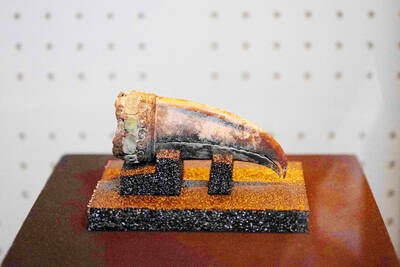
Archeologists in Peru on Thursday said they found the 5,000-year-old remains of a noblewoman at the sacred city of Caral, revealing the important role played by women in the oldest center of civilization in the Americas. “What has been discovered corresponds to a woman who apparently had elevated status, an elite woman,” archeologist David Palomino said. The mummy was found in Aspero, a sacred site within the city of Caral that was a garbage dump for more than 30 years until becoming an archeological site in the 1990s. Palomino said the carefully preserved remains, dating to 3,000BC, contained skin, part of the

TRUMP EFFECT: The win capped one of the most dramatic turnarounds in Canadian political history after the Conservatives had led the Liberals by more than 20 points Canadian Prime Minister Mark Carney yesterday pledged to win US President Donald Trump’s trade war after winning Canada’s election and leading his Liberal Party to another term in power. Following a campaign dominated by Trump’s tariffs and annexation threats, Carney promised to chart “a new path forward” in a world “fundamentally changed” by a US that is newly hostile to free trade. “We are over the shock of the American betrayal, but we should never forget the lessons,” said Carney, who led the central banks of Canada and the UK before entering politics earlier this year. “We will win this trade war and

‘BODIES EVERYWHERE’: The incident occurred at a Filipino festival celebrating an anti-colonial leader, with the driver described as a ‘lone suspect’ known to police Canadian police arrested a man on Saturday after a car plowed into a street party in the western Canadian city of Vancouver, killing a number of people. Authorities said the incident happened shortly after 8pm in Vancouver’s Sunset on Fraser neighborhood as members of the Filipino community gathered to celebrate Lapu Lapu Day. The festival, which commemorates a Filipino anti-colonial leader from the 16th century, falls this year on the weekend before Canada’s election. A 30-year-old local man was arrested at the scene, Vancouver police wrote on X. The driver was a “lone suspect” known to police, a police spokesperson told journalists at the
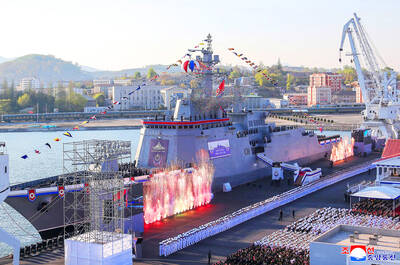
North Korean leader Kim Jong-un has unveiled a new naval destroyer, claiming it as a significant advancement toward his goal of expanding the operational range and preemptive strike capabilities of his nuclear-armed military, state media said yesterday. North Korea’s state-run Korean Central News Agency (KCNA) said Kim attended the launching ceremony for the 5,000-tonne warship on Friday at the western port of Nampo. Kim framed the arms buildup as a response to perceived threats from the US and its allies in Asia, who have been expanding joint military exercises amid rising tensions over the North’s nuclear program. He added that the acquisition


 RSS
RSS