


The editor of a popular Chinese publication yesterday said that he was fired after reporting widely on corruption, driving home the fact that new relaxed rules on foreign journalists do not apply to locals.
Huang Liangtian (黃良天), 50, was sacked after transforming Baixing (Popular Masses) into a widely read magazine with a fearless reputation for investigative reporting into corruption.
"I was really sorry to hear that I had been sacked -- I've been working in the media industry for more than 20 years," Huang said by telephone.
"I don't dare guess why the [Chinese Communist] Party sacked me, because I fear that they will accuse me of leaking state secrets," he said, referring to a method used in China to quiet journalists.
Huang was formally sacked on Dec. 30. Yesterday was his final day in the office.
Huang said he had focused his three-year tenure at Baixing on advancing press freedom in China and expressed doubts that the state-run media would ever be allowed to openly criticize the government.
"I made my greatest effort [for press freedom] while here at Baixing," Huang said.
"Now I am not so sure that press freedom is going to improve for the government media."
The Paris-based Reporters With-out Borders condemned Huang's sacking, saying it was part of a media purge that began last year in an attempt to stop growing criticism of officials belonging to the Chinese Communist Party.
"After starting 2006 with [media] purges ... the Propaganda Department ended the year by unceremoniously removing the courageous editor of a magazine that did not hesitate to condemn corruption," it said in a statement.
"The authorities are allowing foreign journalists more freedom, but at the same time the Chinese media are still being kept under strict surveillance by the Propaganda Department and by local authorities," it added.
Huang's sacking comes after restrictions on foreign reporters were lifted on Jan. 1, ahead of the 2008 Beijing Olympics, allowing overseas reporters the freedom to interview Chinese without first getting government approval.

Crowds in Bangladesh are flocking to snap photographs with an unlikely social media star — an albino buffalo with flowing blond hair nicknamed “Donald Trump” that is due to be sacrificed within days. Owner Zia Uddin Mridha, 38, said his brother named the 700kg bull over its flowing helmet of hair resembling the signature look of the US president. “My younger brother picked this name because of the buffalo’s extraordinary hair,” he said at his farm in Narayanganj, just outside the capital, Dhaka. Mridha said that a constant stream of curious visitors — social media fans, onlookers and children — have come throughout

The Bolivian government on Friday struck a deal with protesting miners, but was still grappling with blockades and demonstrations by other workers across La Paz. Other groups are still blocking access roads into the city, which is also the seat of the government. Police on Thursday prevented the miners from entering the main square by using tear gas, while the demonstrators hurled stones and explosives with slingshots. Protests against the policies of Bolivian President Rodrigo Paz have convulsed the Andean nation since early this month, and roadblocks were choking routes into La Paz throughout Friday, the national road authority said. Miners demanded that Paz
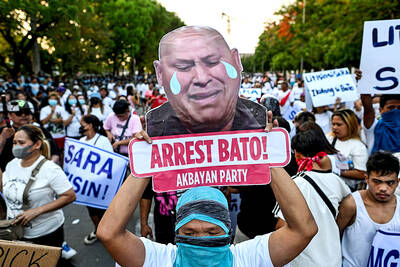
The Philippines said it has asked the country’s Supreme Court to allow it to arrest former Philippine president Rodrigo Duterte’s chief drug war enforcer to stand trial in an international tribunal. The International Criminal Court (ICC) last week unsealed an arrest warrant against Philippine Senator Ronald dela Rosa, accusing him along with Duterte and other “coperpetrators” of the “crime against humanity of murder.” Dela Rosa briefly sought refuge in the Philippine Senate last week while asking the Philippine Supreme Court to stop an ongoing attempt by government agents to arrest him. “By his own conduct, he has placed himself outside the protection of

The researchers in Ireland looked at their computer screen, marveling at a medieval book tracked down in a Roman library. They flipped through its digitized pages and found their sought-after treasure: the oldest surviving English poem. “We were extremely surprised. We were speechless. We couldn’t believe our eyes when we first saw that,” said Elisabetta Magnanti, a visiting research fellow at Trinity College Dublin’s school of English. The poem was also within the main body of Latin text, she said, calling it “extraordinary.” Composed in Old English by a Northumbrian agricultural worker in the 7th century, Caedmon’s Hymn appears within some copies of


 RSS
RSS