


Some journalists who made careers out of questioning government officials and bearing witness to history may soon find themselves answering questions from prosecutors as key witnesses in a CIA leak case.
Ten or more reporters from some of the most prominent news organizations could be called to testify in the perjury and obstruction case of former White House aide Lewis "Scooter" Libby.
It is rare enough for reporters to become witnesses.
But the Libby case is even more unusual because journalists will be dueling witnesses -- some called by the defense team, some by prosecutors.
"It will be unprecedented and, as far as I'm concerned, horrifying," Lucy Dalglish, executive director of the Reporters' Committee for Freedom of the Press, said of the case, for which jury selection begins in two weeks.
Prosecutors want to show that Libby lied to investigators about his conversations with journalists regarding outed CIA officer Valerie Plame. They are expected to rely on former New York Times reporter Judith Miller, Time magazine reporter Matthew Cooper and NBC Washington bureau chief Tim Russert to make their case.
Libby, the former top aide to US Vice President Dick Cheney, has said he had no reason to lie and simply did not remember those conversations.
His attorneys have said they will call as many as seven unidentified journalists to testify about their conversations with Libby to bolster his case.
The Libby case has rankled news agencies for nearly three years, since special prosecutor Patrick Fitzgerald began subpoenaing journalists to testify before a grand jury.
Fitzgerald said it was the only way he could thoroughly investigate whether any laws were broken.
After a lengthy court fight that included an 85-day jail term for Miller, Fitzgerald won cooperation from journalists.
When Libby was indicted, it was clear reporters would be key witnesses. That puts them in the awkward position of aiding a criminal investigation, something journalism groups say erodes the wall between the government and an independent press.
Plame's identity was first revealed by syndicated columnist Robert Novak.
She believes she was outed as retribution for her husband's criticism of the Bush administration's prewar intelligence on Iraq.
Jurors likely will not hear much about the leak itself because the original source, former deputy secretary of state Richard Armitage, has already confirmed his role and Libby is not charged with the leak.
But the trial is certain to renew questions about whether the administration used reporters to drum up support for the war.
Roy Peter Clark of the Poynter Institute said he worries about the fallout of the trial.
If it is perceived that reporters grant anonymity to officials engaged in political gamesmanship, prosecutors are more likely to subpoena them in cases where anonymity was granted in serious issues of public importance.
"This case, it's magnified by the fact that it's in Washington and the status of the players," Clark said. "It's a bizarre and I'd say dangerous case."

Kouri Richins, a Utah mother who published a children’s book about grief after the death of her husband is to serve a life sentence for his murder without the possibility of parole, a judge ruled on Wednesday. Richins was convicted in March of aggravated murder for lacing a cocktail given to her husband, Eric Richins, with five times the lethal dose of fentanyl at their home near Park City in 2022. A jury also found her guilty of four other felonies, including insurance fraud, forgery and attempted murder for trying to poison her husband weeks earlier on Feb. 14, 2022, with a
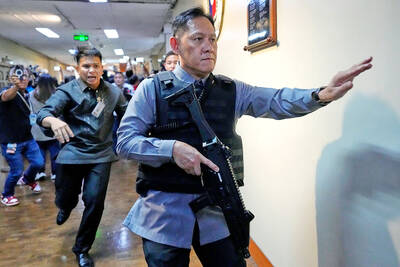
DELA ROSA CASE: The whereabouts of the senator, who is wanted by the ICC, was unclear, while President Marcos faces a political test over the senate situation Philippine authorities yesterday were seeking confirmation of reports that a top politician wanted by the International Criminal Court (ICC) had fled, a day after gunfire rang out at the Philippine Senate where he had taken refuge fearing his arrest. Senator Ronald “Bato” dela Rosa, the former national police chief and top enforcer of former Philippine president Rodrigo Duterte’s “war on drugs,” has been under Senate protection and is wanted for crimes against humanity, the same charges Duterte is accused of. “Several sources confirmed that the senator, Senator Bato, is no longer in the Senate premises, but we are still getting confirmation,” Presidential

HELP DENIED? The US Department of State said that the Cuban leadership refuses to allow the US to provide aid to Cubans, ‘who are in desperate need of assistance’ US Secretary of State Marco Rubio on Wednesday said that Cuba’s leadership must change, as Washington renewed an offer of US$100 million in aid if the communist nation agrees to cooperate. Cuba has been suffering severe economic tumult led by an energy shortage that plunged 65 percent of the country into darkness on Tuesday. Cuba’s leaders have blamed US sanctions, but Rubio, a Cuban American and critic of the government established by Fidel Castro, said the system was to blame, including corruption by the military. “It’s a broken, nonfunctional economy, and it’s impossible to change it. I wish it were different,” he told

Myanmar yesterday published a parliamentary bill proposing the death sentence for those who detain or violently coerce people into working in online scam centers. Internet fraud factories have flourished in Myanmar, part of Southeast Asia’s scam economy, targeting Internet users worldwide with romance and cryptocurrency investment cons. The multibillion-dollar black market attracts many willing employees, but repatriated foreigners have also reported being trafficked to sites in Myanmar and tortured by scam center operators. The draft legislation would allow capital punishment for “violence, torture, unlawful arrest and detention, or cruel treatment against another person for the purpose of forcing them to commit online scams.” The


 RSS
RSS