


Thousands of Spaniards marched to protest the Madrid airport bombing by Basque separatists as the Ecuadorean community fretted over the fate of two missing men who if confirmed dead would be the first fatalities ascribed to armed group ETA since 2003.
Saturday's blast, which spectacularly ended a nine-month ceasefire by the armed separatist group and led the government to suspend efforts to broker a negotiated solution to four decades of conflict, slightly injured 19 people and left two young Ecuadoreans missing.
Trained rescue dogs could find no trace of them on Sunday but the search in the rubble was to continue through the night.
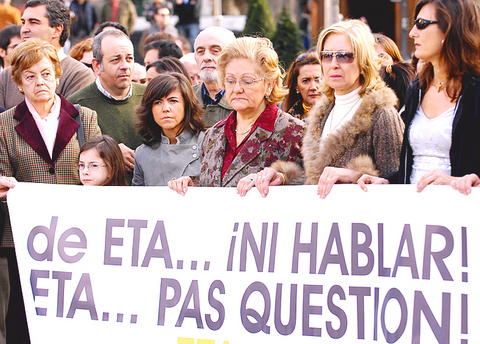
PHOTO: AFP
The explosion was probably caused by a bomb packing more than 500kg -- and possibly up to 800kg -- of explosives, city hall experts said. A first police estimate spoke about 200kg of explosives.
The Madrid city government also called off a planned light and sound extravaganza at the central Puerta del Sol square where Spaniards and tourists traditionally converge to welcome the new year.
Reports from Quito said the government had given the Ecuadoreans up for dead, as did the national federation representing the more than half a million Ecuadoreans who live in Spain.
ETA gave three telephone warnings in the hour before the blast but rescuers on Sunday night still had no trace of either Diego Armando Estacio Civizapa, 19, and Carlos Alonso Palate, 33.
Both were believed to have been dozing in their cars waiting for flights from their homeland to arrive.
Diego's father, Winston, told Spanish television he could only pray for good news.
"We're just waiting to see if they find anything, if they find him alive. I just pray to God they find him and that he is alright. That's all we can do, just hope," he said.
As Spanish Prime Minister Jose Luis Rodriguez Zapatero pondered the apparent end of his attempts to kickstart long stalled peace negotiations, the mood was grim as several thousand people marched on Madrid's Sol Square to condemn the bombing.
Zapatero found himself in the line of fire as some protesters yelled out for him to resign.
Other smaller rallies took place in a swathe of other towns.
Just one day before the bombing, Zapatero had forecast that "the situation [with regards to ETA] will be better in a year."
But after the bombing the leader of the main conservative opposition Popular Party Mariano Rajoy urged a tougher stance.
"The response cannot be `I am suspending a negotiation,'" Rajoy said.
"It should be: `I am breaking with ETA, I am applying the law with all parties and all Spaniards and I am going to take the battle to them,'" he said.
Feelings still run high across the left and right divide after Zapatero came to power unexpectedly in the wake of the March 2004 Madrid train bombings, which left 191 people dead and which the former Conservative government mistakenly blamed on ETA.
The trial of 29 accused of carrying out those attacks should begin within weeks.
The separatist organization is blamed for some 850 deaths in a four-decade independence campaign, and the organization's banned political wing Batasuna has failed to condemn Saturday's attack.
Josu Jon Imaz, chairman of the Basque Nationalist Party, in power in the autonomous Basque regional government, pinned the blame firmly on ETA for the crisis.
"The rupture of the truce and yesterday's attack are solely the responsibility of ETA," Imaz told Cadena Ser radio.
He noted that after the "terrible attack" of the August 1998 bombings in Omagh, Northern Ireland, carried out by a splinter group of the Irish Republican Army, peace had eventually been reached.
"That could have happened [in Spain] if Batasuna had shown a clear attitude of rejecting violence," he said.
Earlier, the Interior Ministry said the owner of the van blown up in the blast was abducted by an ETA commando after driving across the French border.
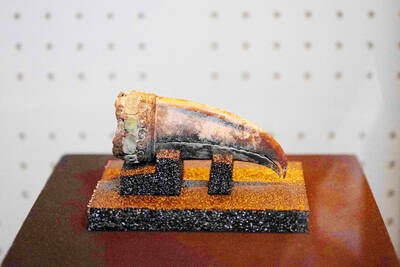
Archeologists in Peru on Thursday said they found the 5,000-year-old remains of a noblewoman at the sacred city of Caral, revealing the important role played by women in the oldest center of civilization in the Americas. “What has been discovered corresponds to a woman who apparently had elevated status, an elite woman,” archeologist David Palomino said. The mummy was found in Aspero, a sacred site within the city of Caral that was a garbage dump for more than 30 years until becoming an archeological site in the 1990s. Palomino said the carefully preserved remains, dating to 3,000BC, contained skin, part of the

TRUMP EFFECT: The win capped one of the most dramatic turnarounds in Canadian political history after the Conservatives had led the Liberals by more than 20 points Canadian Prime Minister Mark Carney yesterday pledged to win US President Donald Trump’s trade war after winning Canada’s election and leading his Liberal Party to another term in power. Following a campaign dominated by Trump’s tariffs and annexation threats, Carney promised to chart “a new path forward” in a world “fundamentally changed” by a US that is newly hostile to free trade. “We are over the shock of the American betrayal, but we should never forget the lessons,” said Carney, who led the central banks of Canada and the UK before entering politics earlier this year. “We will win this trade war and
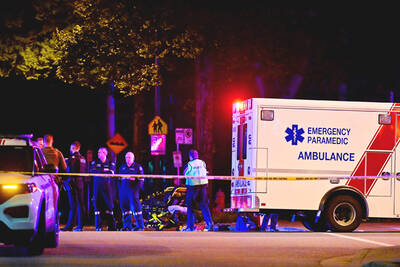
‘BODIES EVERYWHERE’: The incident occurred at a Filipino festival celebrating an anti-colonial leader, with the driver described as a ‘lone suspect’ known to police Canadian police arrested a man on Saturday after a car plowed into a street party in the western Canadian city of Vancouver, killing a number of people. Authorities said the incident happened shortly after 8pm in Vancouver’s Sunset on Fraser neighborhood as members of the Filipino community gathered to celebrate Lapu Lapu Day. The festival, which commemorates a Filipino anti-colonial leader from the 16th century, falls this year on the weekend before Canada’s election. A 30-year-old local man was arrested at the scene, Vancouver police wrote on X. The driver was a “lone suspect” known to police, a police spokesperson told journalists at the
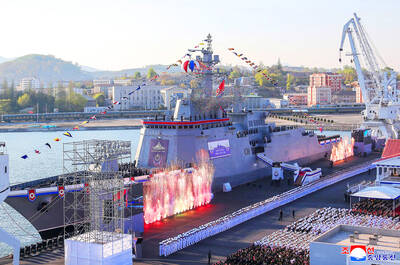
North Korean leader Kim Jong-un has unveiled a new naval destroyer, claiming it as a significant advancement toward his goal of expanding the operational range and preemptive strike capabilities of his nuclear-armed military, state media said yesterday. North Korea’s state-run Korean Central News Agency (KCNA) said Kim attended the launching ceremony for the 5,000-tonne warship on Friday at the western port of Nampo. Kim framed the arms buildup as a response to perceived threats from the US and its allies in Asia, who have been expanding joint military exercises amid rising tensions over the North’s nuclear program. He added that the acquisition


 RSS
RSS