


Of all the old saws about the Eternal City, at least one remains simply true: dig a deep hole almost anywhere here, and you'll unearth an archeological artifact or two.
Yet a wave of public and private building projects is suddenly focusing unusual attention on Rome's rich subterranean world as one treasure after another emerges at a steady clip.
"We're walking on the world's largest untapped underground museum," said Maria Antonietta Tomei, a government official responsible for coordinating archaeological digs in Rome.
During the last week reports surfaced that 800 coins from the fourth and fifth centuries BC had been unearthed during the reconstruction of a movie theater near the Trevi Fountain.
Earlier this month a temple from the second century AD dedicated to Matidia, mother-in-law of the Emperor Hadrian, was discovered when a former orphanage was rebuilt to create offices for the Italian Senate. La Repubblica, the daily newspaper, hailed that find as "the most important archaeological discovery in Rome in recent years."
And on a trip to New York last month Italian Culture Minister, Francesco Rutelli, revealed that some rare fourth-century regalia belonging to Emperor Maxentius, including spears and javelins, had been found wrapped in linen and silk and buried in wooden cases on the Palatine Hill, near the Colosseum.
Archeologists view the fervent media interest as a reflection of Italy's rising concern for its cultural patrimony.
"In the last 10 or 15 years there's been enormous attention on the part of the public" regarding Rome's ancient past, said Silvana Rizzo, an archeologist and top aide to Rutelli.
In what may seem like a paradox, globalization has also deepened the resolve of many countries to protect artifacts that reflect national cultures, said Angelo Bottini, the chief archeology official for Rome.
"There's greater desire to establish an identity, and archeology is identity," he said.
The increased interest is also an offshoot of growing vigilance among government-appointed archaeologists, who supervise all major private and public building projects in Italy.
"Today you can't move a shovelful of dirt without it being examined, so more archaeological finds come to light," Bottini said.
As a major subway project begins in downtown Rome, discoveries are likely to accelerate. Experts entrusted with protecting Italy's ancient heritage expect to be busy.
Several artifacts that surfaced during the preliminary digging for the subway line -- a Roman-era bronze compass and a bronze-and-copper spatula once used to mix makeup, for example -- are on view in the show at Olearie Papali, "Memories From the Underground: Archeological Finds From 1980 to 2006."
Archeologists organized the show to take stock of the recent finds, Bottini said.
"It is the prelude to a larger reflection on the enormous transformation of Rome through the centuries," he said.

An American scientist convicted of lying to US authorities about payments from China while he was at Harvard University has rebuilt his research lab in Shenzhen, China, to pursue technology the Chinese government has identified as a national priority: embedding electronics into the human brain. Charles Lieber, 67, is among the world’s leading researchers in brain-computer interfaces. The technology has shown promise in treating conditions such as amyotrophic lateral sclerosis and restoring movement in paralyzed people. It also has potential military applications: Scientists at the Chinese People’s Liberation Army have investigated brain interfaces as a way to engineer super soldiers by boosting
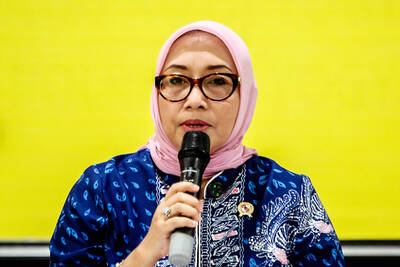
Indonesian police have arrested 13 people after shocking images of alleged abuse against small children at a daycare center went viral, sparking outrage across the nation, officials said on Monday. Police on Friday last week raided Little Aresha, a daycare center in Yogyakarta on Java island, following a report from a former employee. CCTV footage circulating on social media showed children, most younger than two, lying on the floor wearing only diapers, their hands and feet bound with rags. The police have confirmed that the footage is authentic. Police said they also found 20 children crammed into a room just 3m by 3m. “So
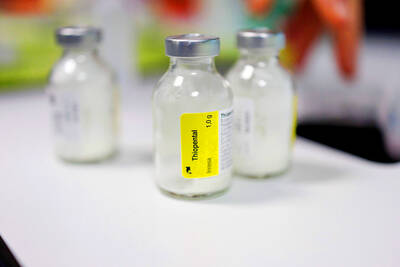
A grieving mother has ended her life at a clinic in Switzerland four years after the death of her only child. Wendy Duffy, 56, a physically healthy woman, died at the Pegasos clinic in Basel after struggling to cope with the death of her 23-year-old son, Marcus. The former care worker, from the West Midlands, England, had previously attempted to take her own life. The case comes as assisted dying would not become law in England and Wales after proposed legislation, branded “hopelessly flawed” by opponents, ran out of time. Ruedi Habegger, the founder of Pegasos, described Duffy’s death as
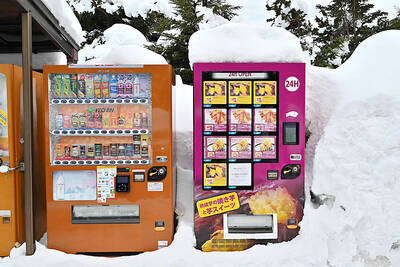
From post offices and parks to stations and even the summit of Mount Fuji, Japan’s vending machines are ubiquitous, but with the rapid pace of inflation cooling demand for their drinks, operators are being forced to rethink the business. Last month beverage giant DyDo Group Holdings announced it would remove about 20,000 vending machines — about 7 percent of their stock nationwide — by January next year, to “reconstruct a profitable network.” Pokka Sapporo Food & Beverage, based in Nagoya, also said last month it would sell its 40,000-machine operation to Osaka-based Lifedrink Co. “The strength of the vending machine


 RSS
RSS