


Radical Shiite cleric Moqtada al-Sadr, who heads a militia feared by Iraq's Sunnis, is considering a one-month unilateral ceasefire and may push his followers to rejoin the political process after a three-week boycott, officials close to him said.
The issue was expected to come up at a meeting yesterday in the holy city of Najaf between al-Sadr and a delegation representing the seven Shiite groups that form the largest bloc in Iraq's parliament, the Shiite officials said on Wednesday on condition of anonymity because of the secrecy of the talks.
Half the delegates traveled to Najaf on Wednesday night, and were gathered yesterday morning at the home of the country's top Shiite cleric, Grand Ayatollah Ali al-Sistani, an official in al-Sistani's office said on condition of anonymity because of political sensitivities. The others were traveling to Najaf yesterday, he said.
The visit is intended to allow the Shiite bloc, the United Iraqi Alliance, to work out some of Iraq's biggest political obstacles in front of al-Sistani, and to pressure al-Sadr to rein in his fighters and rejoin politics -- or face isolation, participants said.
Joint army-police checkpoints were erected at all entrances to Najaf yesterdau morning, a top police official and a representative from al-Sistani's office said.
Until the walkout, al-Sadr's faction had been an integral part of Prime Minister Nouri al-Maliki's governing coalition. Cabinet ministers and legislators who belong to al-Sadr's movement called the boycott after al-Maliki met with US President George W. Bush in Jordan three weeks ago. Al-Sadr's militia and its offshoots have been increasingly blamed for sectarian attacks.
As violence rages across Baghdad and much of Iraq, a new coalition taking shape among Shiites, Kurds and one Sunni Party is seen as a last-ditch effort to form a government across sectarian divisions that have split the country. While al-Sadr's movement would not be part of this coalition, such an alliance -- which reportedly is supported by the Bush administration -- might pressure the radical cleric to soften his stance.
In yesterday's meeting, the group was to assure al-Sistani that the new coalition would not break apart the Shiite bloc, said officials from several Shiite parties. Potential members of the coalition said they have been negotiating for two weeks, and now want the blessing of al-Sistani, whose word many Shiites consider binding.
The movement is backed by the US government, said Sami al-Askari, a member of the Dawa Party and an adviser to al-Maliki.
"I met the American ambassador in Baghdad and he named this front the `front of the moderates,' and they [the US] support it," al-Askari said.
However, two prominent figures in the proposed coalition went to Washington to meet Bush separately in the past three weeks: Tarek al-Hashemi of the Sunni Iraqi Islamic Party and Abdul-Aziz al-Hakim of the Supreme Council for the Islamic Revolution in Iraq, known as SCIRI. The US supports two other potential members, the Kurdish Democratic Party and President Jalal Talabani's Patriotic Union of Kurdistan.
``The US wants to see an Iraq that is united, stable, democratic and prosperous. We will continue to work with the democratically elected government of Iraq to reach this goal by improving security, promoting national reconciliation and the rule of law and helping the Iraqis deliver essential services,'' US embassy spokesman Lou Fintor said.
Meanwhile, a suicide bomber blew up among a group of police volunteers yesterday, killing at least 14 people and wounded 21 others, police said.
The attack occurred at 7:15am at a police academy in eastern Baghdad, authorities said. The attacker was wearing a belt laden with explosives, and at least two of the dead were policemen.
The area around the facility remained cordoned off hours after the attack. Outside a nearby hospital, at least five bodies lay on gurneys and on the ground, covered in blue tarps as onlookers passed by.
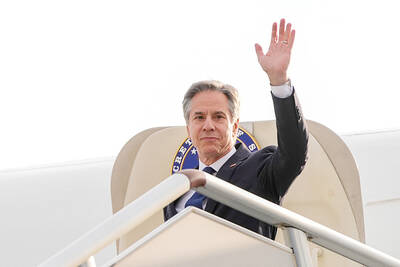
‘IN A DIFFERENT PLACE’: The envoy first visited Shanghai, where he attended a Chinese basketball playoff match, and is to meet top officials in Beijing tomorrow US Secretary of State Antony Blinken yesterday arrived in China on his second visit in a year as the US ramps up pressure on its rival over its support for Russia while also seeking to manage tensions with Beijing. The US diplomat tomorrow is to meet China’s top brass in Beijing, where he is also expected to plead for restraint as Taiwan inaugurates president-elect William Lai (賴清德), and to raise US concerns on Chinese trade practices. However, Blinken is also seeking to stabilize ties, with tensions between the world’s two largest economies easing since his previous visit in June last year. At the

UNSETTLING IMAGES: The scene took place in front of TV crews covering the Trump trial, with a CNN anchor calling it an ‘emotional and unbelievably disturbing moment’ A man who doused himself in an accelerant and set himself on fire outside the courthouse where former US president Donald Trump is on trial has died, police said yesterday. The New York City Police Department (NYPD) said the man was declared dead by staff at an area hospital. The man was in Collect Pond Park at about 1:30pm on Friday when he took out pamphlets espousing conspiracy theories, tossed them around, then doused himself in an accelerant and set himself on fire, officials and witnesses said. A large number of police officers were nearby when it happened. Some officers and bystanders rushed

Beijing is continuing to commit genocide and crimes against humanity against Uyghurs and other Muslim minorities in its western Xinjiang province, U.S. Secretary of State Antony Blinken said in a report published on Monday, ahead of his planned visit to China this week. The State Department’s annual human rights report, which documents abuses recorded all over the world during the previous calendar year, repeated language from previous years on the treatment of Muslims in Xinjiang, but the publication raises the issue ahead of delicate talks, including on the war in Ukraine and global trade, between the top U.S. diplomat and Chinese
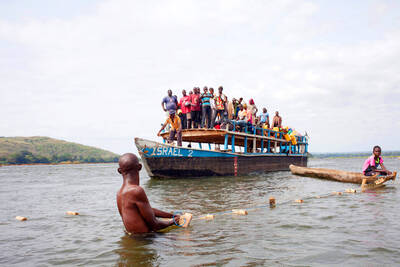
RIVER TRAGEDY: Local fishers and residents helped rescue people after the vessel capsized, while motorbike taxis evacuated some of the injured At least 58 people going to a funeral died after their overloaded river boat capsized in the Central African Republic’s (CAR) capital, Bangui, the head of civil protection said on Saturday. “We were able to extract 58 lifeless bodies,” Thomas Djimasse told Radio Guira. “We don’t know the total number of people who are underwater. According to witnesses and videos on social media, the wooden boat was carrying more than 300 people — some standing and others perched on wooden structures — when it sank on the Mpoko River on Friday. The vessel was heading to the funeral of a village chief in


 RSS
RSS