


Some 300kg of uranium from a long-closed reactor in the former East Germany was airlifted to Russia yesterday for processing.
A convoy of around 40 police vehicles escorted the silver armored truck carrying 18 containers of uranium during the 10km, pre-dawn trip from the former Rossendorf nuclear research center to Dresden airport.
Police spokesman Thomas Herbst said the operation involved between 300 and 500 police and more undercover officers. Security officials had dispatched a second decoy convoy.
The containers were loaded aboard a waiting Russian plane, which took off early yesterday, Herbst said.
The uranium -- 200kg of it highly enriched, and the remaining 100kg enriched to a lower degree -- was headed for a processing center at Podolsk, outside Moscow.
Nuclear waste shipments in Germany have frequently met with protests, but the journey to the Dresden airport passed without major incident.
The convoy ran into a group of 20 to 30 anti-nuclear protesters along the way, forcing the vehicles to stop briefly before changing routes and proceeding to the airport, officials said.
Experts from the UN's Vienna-based International Atomic Energy Agency (IAEA) and the US National Nuclear Security Administration were on site assisting the Russians handling the transport.
The transfer of the uranium is part of a joint US-Russian program in cooperation with the IAEA called the Global Threat Reduction Initiative (GTRI).
Its aim is to find, secure and recover dangerous nuclear materials around the world to prevent them from falling into the hands of terrorists.
In a recent fact sheet, the US Department of Energy said the GTRI program had secured more than 400 sites around the world containing enough radioactive material for 6,000 "dirty bombs," conventional explosives laced with nuclear material.
Once back in Russia, the highly enriched uranium will be mixed with low-grade uranium so that it becomes low-enriched reactor fuel that will no longer represent a proliferation risk.
Over recent years, smaller quantities of uranium have been returned to Russia from several countries including Romania, Serbia and Bulgaria.
The Rossendorf reactor was shut down in 1991, the year after German reunification.

‘IN A DIFFERENT PLACE’: The envoy first visited Shanghai, where he attended a Chinese basketball playoff match, and is to meet top officials in Beijing tomorrow US Secretary of State Antony Blinken yesterday arrived in China on his second visit in a year as the US ramps up pressure on its rival over its support for Russia while also seeking to manage tensions with Beijing. The US diplomat tomorrow is to meet China’s top brass in Beijing, where he is also expected to plead for restraint as Taiwan inaugurates president-elect William Lai (賴清德), and to raise US concerns on Chinese trade practices. However, Blinken is also seeking to stabilize ties, with tensions between the world’s two largest economies easing since his previous visit in June last year. At the
Nearly half of China’s major cities are suffering “moderate to severe” levels of subsidence, putting millions of people at risk of flooding, especially as sea levels rise, according to a study of nationwide satellite data released yesterday. The authors of the paper, published by the journal Science, found that 45 percent of China’s urban land was sinking faster than 3mm per year, with 16 percent at more than 10mm per year, driven not only by declining water tables, but also the sheer weight of the built environment. With China’s urban population already in excess of 900 million people, “even a small portion

UNSETTLING IMAGES: The scene took place in front of TV crews covering the Trump trial, with a CNN anchor calling it an ‘emotional and unbelievably disturbing moment’ A man who doused himself in an accelerant and set himself on fire outside the courthouse where former US president Donald Trump is on trial has died, police said yesterday. The New York City Police Department (NYPD) said the man was declared dead by staff at an area hospital. The man was in Collect Pond Park at about 1:30pm on Friday when he took out pamphlets espousing conspiracy theories, tossed them around, then doused himself in an accelerant and set himself on fire, officials and witnesses said. A large number of police officers were nearby when it happened. Some officers and bystanders rushed
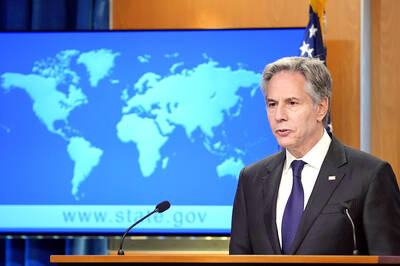
Beijing is continuing to commit genocide and crimes against humanity against Uyghurs and other Muslim minorities in its western Xinjiang province, U.S. Secretary of State Antony Blinken said in a report published on Monday, ahead of his planned visit to China this week. The State Department’s annual human rights report, which documents abuses recorded all over the world during the previous calendar year, repeated language from previous years on the treatment of Muslims in Xinjiang, but the publication raises the issue ahead of delicate talks, including on the war in Ukraine and global trade, between the top U.S. diplomat and Chinese


 RSS
RSS