


The six largest automakers in the US asked a federal judge to toss out a lawsuit by the state of California that accuses them of harming human health and the environment by producing vehicles that contribute to global warming.
The US and Japanese auto companies filed a motion on Friday in US District Court in Oakland to dismiss the state's suit and an attorney for the carmakers said on Saturday that state officials who want to reduce auto emissions should do it through regulation, not litigation.
"It's the classic kind of case that the Supreme Court has said doesn't belong in federal court," said Theodore Boutrous, who represents Chrysler Motors Corp, General Motors Corp, Ford Motor Co, Toyota Motor North America Inc, American Honda Motor Co and Nissan North America Inc.
State Attorney General Bill Lockyer, who filed the suit in September, claims that automakers are violating public nuisance laws by making high-emission vehicles and should pay damages for polluting.
"The thrust of what we're saying is the technology to make vehicles that emit far less greenhouse gases exists," Lockyer's spokeswoman Teresa Schilling said. "They fight any attempt to get them to cut back on their pollution."
The lawsuit contends the state is already dealing with the harmful effects of global warming caused by rising emissions of carbon dioxide and other heat-trapping gases. Vehicles are the state's largest single source of greenhouse gas emissions.
The complaint cites reports that show rising temperatures will melt snowpack in the Sierra Nevada Mountains earlier each year, which will flood California's Central Valley and threaten the state's water supply.
Automakers are also wrangling with California over a 2002 law requiring them to cut emissions. Under the law, the California Air Resources Board has adopted standards designed to cut carbon dioxide emissions by cars and light trucks by 25 percent and from sport utility vehicles by 18 percent starting in 2009.
That law has since been copied by 10 other states.
The auto industry is challenging those regulations, arguing that such reductions can only come from stricter fuel-economy standards, which are the province of the federal government.

Former Nicaraguan president Violeta Chamorro, who brought peace to Nicaragua after years of war and was the first woman elected president in the Americas, died on Saturday at the age of 95, her family said. Chamorro, who ruled the poor Central American country from 1990 to 1997, “died in peace, surrounded by the affection and love of her children,” said a statement issued by her four children. As president, Chamorro ended a civil war that had raged for much of the 1980s as US-backed rebels known as the “Contras” fought the leftist Sandinista government. That conflict made Nicaragua one of
COMPETITION: The US and Russia make up about 90 percent of the world stockpile and are adding new versions, while China’s nuclear force is steadily rising, SIPRI said Most of the world’s nuclear-armed states continued to modernize their arsenals last year, setting the stage for a new nuclear arms race, the Stockholm International Peace Research Institute (SIPRI) said yesterday. Nuclear powers including the US and Russia — which account for about 90 percent of the world’s stockpile — had spent time last year “upgrading existing weapons and adding newer versions,” researchers said. Since the end of the Cold War, old warheads have generally been dismantled quicker than new ones have been deployed, resulting in a decrease in the overall number of warheads. However, SIPRI said that the trend was likely
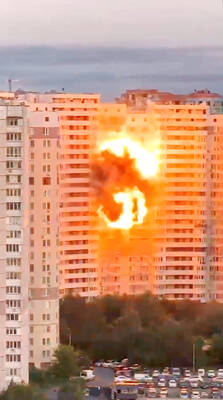
BOMBARDMENT: Moscow sent more than 440 drones and 32 missiles, Volodymyr Zelenskiy said, in ‘one of the most terrifying strikes’ on the capital in recent months A nighttime Russian missile and drone bombardment of Ukraine killed at least 15 people and injured 116 while they slept in their homes, local officials said yesterday, with the main barrage centering on the capital, Kyiv. Kyiv City Military Administration head Tymur Tkachenko said 14 people were killed and 99 were injured as explosions echoed across the city for hours during the night. The bombardment demolished a nine-story residential building, destroying dozens of apartments. Emergency workers were at the scene to rescue people from under the rubble. Russia flung more than 440 drones and 32 missiles at Ukraine, Ukrainian President Volodymyr Zelenskiy
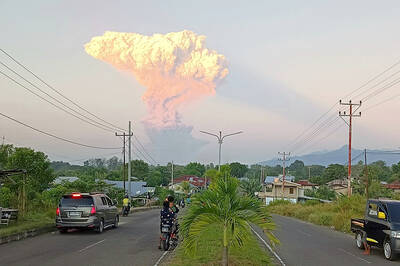
Indonesia’s Mount Lewotobi Laki-Laki yesterday erupted again with giant ash and smoke plumes after forcing evacuations of villages and flight cancelations, including to and from the resort island of Bali. Several eruptions sent ash up to 5km into the sky on Tuesday evening to yesterday afternoon. An eruption on Tuesday afternoon sent thick, gray clouds 10km into the sky that expanded into a mushroom-shaped ash cloud visible as much as 150km kilometers away. The eruption alert was raised on Tuesday to the highest level and the danger zone where people are recommended to leave was expanded to 8km from the crater. Officers also


 RSS
RSS