


Saudi Arabia threatened to stop sharing vital intelligence -- particularly intercepted communications between al-Qaeda members active there -- unless Britain suspended its investigation into a controversial arms deal.
Senior British government sources said the Saudis warned they would also kick out British military and intelligence personnel based in the country.
"They were threatening everything, intelligence, everything. The US and the UK have got their bases in Saudi; that is their `in' to the Middle East," one source said.
"Essentially, the line was that British lives could be lost if this relationship broke down. It would have been them freezing everybody out and speaking to nobody about anything," the source said.
The investigation into allegations that BAE Systems paid bribes to senior Saudis was dropped on Thursday following a detailed report from the security services.
Saudi sources insisted yesterday the real reason was that the firm -- which had said it risked losing a large deal for the Saudis to buy 72 Typhoon jets -- could have gone bust if it lost contracts.
Nevertheless, the intelligence threats appear to have been made after several months of commercial threats failed to get the desired result. One senior intelligence expert said the Saudis' contribution to the battle against al-Qaeda could not be underestimated.
"The Saudis are very, very important. Mucking up that relationship is something you do not do," the expert said.
Serious Fraud Office (SFO) Director Robert Wardle confirmed on Saturday in an interview with the Financial Times that he was convinced to drop the case by national security considerations.
However, government sources said the attorney-general, Lord Goldsmith, had gone further by concluding there was little chance of bringing charges.
Goldsmith believed the main evidence gathered so far dated back to before the introduction of Britain's current anti-corruption laws, which meant it might not be prosecutable.
Goldsmith also thought the SFO would be obstructed by the constitutional position of the Saudi royal family in their country's government -- they are only held liable under law when acting in a government capacity, rather than as royals.
Members of parliament, however, are reluctant to let the issue drop. Members of the powerful Commons public accounts select committee are now pushing to be allowed to see the findings of the National Audit Office report -- suppressed by the then Conservative government -- into the original Al-Yamamah deal.
That contract was signed in 1988, agreeing that BAE would supply the Saudis with fighters, jet trainers, air bases and personnel. The present Typhoon contract forms part of its third and most recent phase.
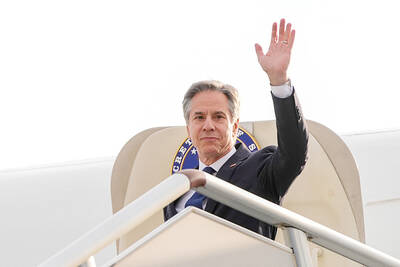
‘IN A DIFFERENT PLACE’: The envoy first visited Shanghai, where he attended a Chinese basketball playoff match, and is to meet top officials in Beijing tomorrow US Secretary of State Antony Blinken yesterday arrived in China on his second visit in a year as the US ramps up pressure on its rival over its support for Russia while also seeking to manage tensions with Beijing. The US diplomat tomorrow is to meet China’s top brass in Beijing, where he is also expected to plead for restraint as Taiwan inaugurates president-elect William Lai (賴清德), and to raise US concerns on Chinese trade practices. However, Blinken is also seeking to stabilize ties, with tensions between the world’s two largest economies easing since his previous visit in June last year. At the
Nearly half of China’s major cities are suffering “moderate to severe” levels of subsidence, putting millions of people at risk of flooding, especially as sea levels rise, according to a study of nationwide satellite data released yesterday. The authors of the paper, published by the journal Science, found that 45 percent of China’s urban land was sinking faster than 3mm per year, with 16 percent at more than 10mm per year, driven not only by declining water tables, but also the sheer weight of the built environment. With China’s urban population already in excess of 900 million people, “even a small portion

UNSETTLING IMAGES: The scene took place in front of TV crews covering the Trump trial, with a CNN anchor calling it an ‘emotional and unbelievably disturbing moment’ A man who doused himself in an accelerant and set himself on fire outside the courthouse where former US president Donald Trump is on trial has died, police said yesterday. The New York City Police Department (NYPD) said the man was declared dead by staff at an area hospital. The man was in Collect Pond Park at about 1:30pm on Friday when he took out pamphlets espousing conspiracy theories, tossed them around, then doused himself in an accelerant and set himself on fire, officials and witnesses said. A large number of police officers were nearby when it happened. Some officers and bystanders rushed

Beijing is continuing to commit genocide and crimes against humanity against Uyghurs and other Muslim minorities in its western Xinjiang province, U.S. Secretary of State Antony Blinken said in a report published on Monday, ahead of his planned visit to China this week. The State Department’s annual human rights report, which documents abuses recorded all over the world during the previous calendar year, repeated language from previous years on the treatment of Muslims in Xinjiang, but the publication raises the issue ahead of delicate talks, including on the war in Ukraine and global trade, between the top U.S. diplomat and Chinese


 RSS
RSS