


European leaders are set to put the brakes on EU enlargement at a two-day summit in Brussels that opened yesterday, to allow time to get the bloc's constitutional house in order.
The European Parliament on Wednesday voted overwhelmingly in favor of reforming the EU's institutions before admitting any more member states, a call endorsed by the EU's executive arm, the European Commission, on the eve of a summit where enlargement tops the agenda.
The buzzwords are "integration capacity" or "absorption capacity," putting the emphasis on the EU's ability to handle new members rather than the readiness of candidate states to join up.
"A new institutional settlement should have been reached by the time the next new member is likely to be ready to join the Union," Enlargement Commissioner Olli Rehn told members of parliament during their enlargement debate in Strasbourg.
"We need it to strengthen the legitimacy of the Union. We need it to strengthen Europe's role in the world," he said, adding that the steps to achieve that settlement should be taken before 2009.
Bulgaria and Romania will become the 26th and 27th members of the European club on Jan. 1, but under the strictest conditions ever imposed on new members amid continued concerns over corruption and their judicial systems.
After that there is general agreement that the doors must be closed while serious EU housekeeping is done. Bad news for Croatia and the other, mainly Balkan, nations behind it in the queue.
A new method of introducing the institutional reform is needed after French and Dutch voters last year rejected a draft EU constitution that was meant to do the job.
The heads of government and state will stress that the EU should "maintain and deepen its own development while pursuing the enlargement agenda," according to draft conclusions for the summit.
Mindful of the enlargement fatigue, or plain hostility, which set in after the big bang of 2004 when 10 mainly ex-Soviet members joined, the European leaders will also put the accent on communication.
"The European Council recognizes the necessity to ensure public support to the enlargement process and agrees to increase the communication transparency of the enlargement process," they are expected to say.
The issue of Turkey will also be brought up at the summit, though this should entail little more than endorsing this week's decision by EU foreign ministers to partially freeze talks with Ankara as punishment for its refusal to open its ports and airports to EU member Cyprus.
British Prime Minister Tony Blair, a staunch advocate of Turkey's bid to join the EU, is expected to pay a brief consolatory visit to Turkey immediately after the summit today.
Elsewhere on the agenda the heads of state and government will discuss such thorny issues as Sudan, the Middle East and migration -- of particular concern presently to Italy, Spain and Malta.
There will also be a discussion, though no firm conclusions, on the increasingly high-profile issue of sustainable energy supply. The real initiatives on that subject are expected in the first half of next year when the Germans assume the rotating EU presidency from the Finns, for whom this is the final EU summit in charge.
With Turkey tucked away for the time being and nobody ready to wade too far into the issue of institutional reform, two issues were looming as possible bones of contention, in what diplomats said was not expected to be a fiery summit.
The other potentially lively issue, which some diplomats said was creeping towards the summit agenda, is the question of where to base the authority that will oversee the Galileo satellite navigation network.
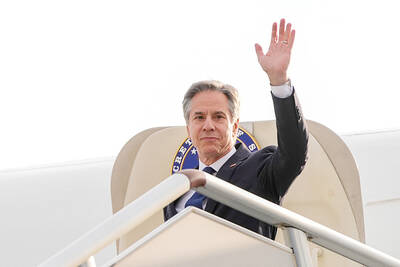
‘IN A DIFFERENT PLACE’: The envoy first visited Shanghai, where he attended a Chinese basketball playoff match, and is to meet top officials in Beijing tomorrow US Secretary of State Antony Blinken yesterday arrived in China on his second visit in a year as the US ramps up pressure on its rival over its support for Russia while also seeking to manage tensions with Beijing. The US diplomat tomorrow is to meet China’s top brass in Beijing, where he is also expected to plead for restraint as Taiwan inaugurates president-elect William Lai (賴清德), and to raise US concerns on Chinese trade practices. However, Blinken is also seeking to stabilize ties, with tensions between the world’s two largest economies easing since his previous visit in June last year. At the

UNSETTLING IMAGES: The scene took place in front of TV crews covering the Trump trial, with a CNN anchor calling it an ‘emotional and unbelievably disturbing moment’ A man who doused himself in an accelerant and set himself on fire outside the courthouse where former US president Donald Trump is on trial has died, police said yesterday. The New York City Police Department (NYPD) said the man was declared dead by staff at an area hospital. The man was in Collect Pond Park at about 1:30pm on Friday when he took out pamphlets espousing conspiracy theories, tossed them around, then doused himself in an accelerant and set himself on fire, officials and witnesses said. A large number of police officers were nearby when it happened. Some officers and bystanders rushed
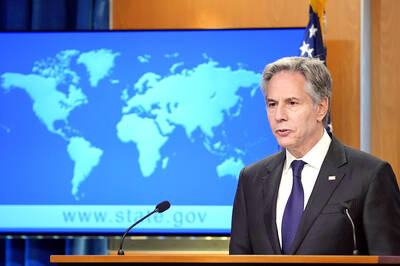
Beijing is continuing to commit genocide and crimes against humanity against Uyghurs and other Muslim minorities in its western Xinjiang province, U.S. Secretary of State Antony Blinken said in a report published on Monday, ahead of his planned visit to China this week. The State Department’s annual human rights report, which documents abuses recorded all over the world during the previous calendar year, repeated language from previous years on the treatment of Muslims in Xinjiang, but the publication raises the issue ahead of delicate talks, including on the war in Ukraine and global trade, between the top U.S. diplomat and Chinese
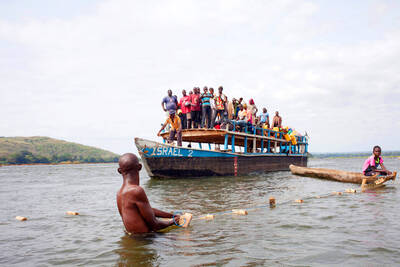
RIVER TRAGEDY: Local fishers and residents helped rescue people after the vessel capsized, while motorbike taxis evacuated some of the injured At least 58 people going to a funeral died after their overloaded river boat capsized in the Central African Republic’s (CAR) capital, Bangui, the head of civil protection said on Saturday. “We were able to extract 58 lifeless bodies,” Thomas Djimasse told Radio Guira. “We don’t know the total number of people who are underwater. According to witnesses and videos on social media, the wooden boat was carrying more than 300 people — some standing and others perched on wooden structures — when it sank on the Mpoko River on Friday. The vessel was heading to the funeral of a village chief in


 RSS
RSS