


Medical aid was rushed to squalid Philippine evacuation sites yesterday amid dire warnings that poor sanitation could trigger an outbreak of disease among hundreds of mudslide survivors.
Babies and children sleep on the damp wooden floors of the elementary school turned into a temporary shelter for nearly 100 families in the township of Guinobatan in the eastern Bicol region, where entire villages were swept away by volcanic debris last week.
Yet these unfortunates are relatively lucky. When Supertyphoon Durian hit last week, it created avalanches of volcanic mud that left more than 1,300 people dead or missing.
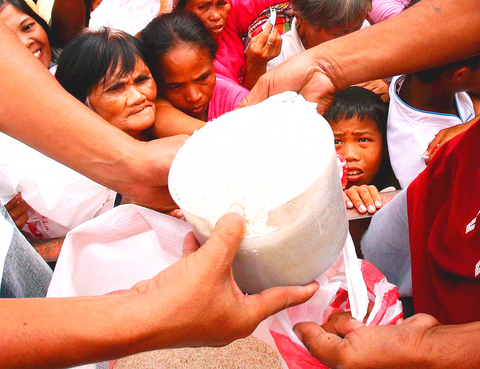
PHOTO: EPA
Sixteen-year-old mother Jennifer Pamplona is struggling to breastfeed her two-week-old baby, Sofia Jane, swaddled in a soiled canvass doubling as a diaper.
"She is not eating. She has been crying and has been feverish," Pamplona said, as husband, Radji, 20, sat dazed in a corner. "She was a week old when the mudslide struck and our house was instantly gone."
Nearby, children walk in their bare feet, their faces full of grime as they await daily rations of boiled noodles and fish.
An elderly man who is visibly sick sits in one corner, just meters away from another mother and her children huddled over a piece of bread.
"Water is a huge problem, the toilets are filled to capacity and we don't have portable ones. There are so many children that are sickly now, and we can't continue to live like this," said Jun Espinas, 35, an engineer.
"The government must now start looking for relocation sites because we can't return to our village. It is gone," he said. "We are desperate for medicines and infant formula."
A disease surveillance team from the Department of Health was dispatched here to assess the situation and try to prevent an outbreak that could be fatal in these crowded communities.
They administered anti-measles and polio vaccines to children as well as gave them boosters to counter the common cold.
"There have also been rising incidences of acute respiratory infections and loose bowel movements," team leader Nancy Pastrana said. "The condition here is congested, this is a common breeding ground for diseases."

‘IN A DIFFERENT PLACE’: The envoy first visited Shanghai, where he attended a Chinese basketball playoff match, and is to meet top officials in Beijing tomorrow US Secretary of State Antony Blinken yesterday arrived in China on his second visit in a year as the US ramps up pressure on its rival over its support for Russia while also seeking to manage tensions with Beijing. The US diplomat tomorrow is to meet China’s top brass in Beijing, where he is also expected to plead for restraint as Taiwan inaugurates president-elect William Lai (賴清德), and to raise US concerns on Chinese trade practices. However, Blinken is also seeking to stabilize ties, with tensions between the world’s two largest economies easing since his previous visit in June last year. At the

UNSETTLING IMAGES: The scene took place in front of TV crews covering the Trump trial, with a CNN anchor calling it an ‘emotional and unbelievably disturbing moment’ A man who doused himself in an accelerant and set himself on fire outside the courthouse where former US president Donald Trump is on trial has died, police said yesterday. The New York City Police Department (NYPD) said the man was declared dead by staff at an area hospital. The man was in Collect Pond Park at about 1:30pm on Friday when he took out pamphlets espousing conspiracy theories, tossed them around, then doused himself in an accelerant and set himself on fire, officials and witnesses said. A large number of police officers were nearby when it happened. Some officers and bystanders rushed

Beijing is continuing to commit genocide and crimes against humanity against Uyghurs and other Muslim minorities in its western Xinjiang province, U.S. Secretary of State Antony Blinken said in a report published on Monday, ahead of his planned visit to China this week. The State Department’s annual human rights report, which documents abuses recorded all over the world during the previous calendar year, repeated language from previous years on the treatment of Muslims in Xinjiang, but the publication raises the issue ahead of delicate talks, including on the war in Ukraine and global trade, between the top U.S. diplomat and Chinese
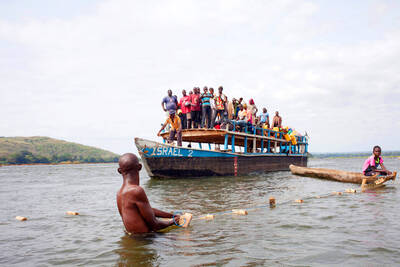
RIVER TRAGEDY: Local fishers and residents helped rescue people after the vessel capsized, while motorbike taxis evacuated some of the injured At least 58 people going to a funeral died after their overloaded river boat capsized in the Central African Republic’s (CAR) capital, Bangui, the head of civil protection said on Saturday. “We were able to extract 58 lifeless bodies,” Thomas Djimasse told Radio Guira. “We don’t know the total number of people who are underwater. According to witnesses and videos on social media, the wooden boat was carrying more than 300 people — some standing and others perched on wooden structures — when it sank on the Mpoko River on Friday. The vessel was heading to the funeral of a village chief in


 RSS
RSS