


Anti-government protests entered their fourth day yesterday after a crowd of 100,000 demonstrated within earshot of the government offices in Beirut, urging the ouster of Prime Minister Fouad Siniora and his anti-Syrian government.
The Lebanese army deployed more soldiers in Beirut after the killing of a pro-Syrian Shiite Muslim demonstrator raised fears anti-government protests could turn into sectarian violence.
Security sources said the military increased its forces in the Sunni districts that Shiite protesters drive through to get to central Beirut where the Hezbollah-led opposition is holding a sit-in to topple the Western-backed government.
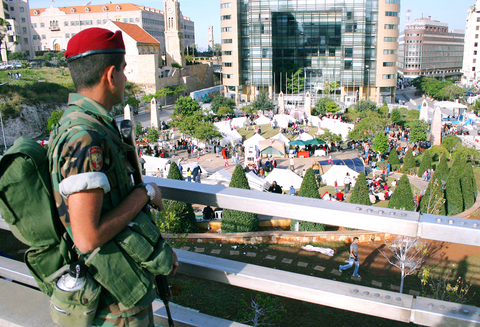
PHOTO: AP
These districts witnessed several clashes between residents and protesters on Sunday -- from stone-throwing incidents to fights with sticks and knives.
In the most serious incident, gunmen fired from assault rifles at a group of protesters in the Sunni Qasqas neighborhood, a stronghold for the anti-Syrian majority coalition, killing one young man and wounding others.
The clash took place on the outskirts of the central Beirut rally, which has been peaceful.
The opposition said the incidents would not drive it to abandon plans for toppling the government.
The Shiite group Hezbollah, which is backed by Syria and Iran, and its allies in the opposition had taken to the streets and were holding an indefinite sit-in to force Siniora's resignation.
Many politicians and observers warned the crisis could spill over into sectarian strife in a country that has gone through two civil wars in the last century.
Thousands of protesters spent a third night in a newly built tent city in central Beirut outside the main government complex where Siniora was spending his days and nights.
Many banks and businesses were again closed yesterday in the downtown area, Lebanon's banking and commercial center. Business owners in the area have said that lengthy closures could devastate several businesses and force employers to cut jobs.
The opposition, which includes some Christians, has been demanding effective veto power in the government, which has a majority comprising anti-Syrian politicians from Christian, Sunni and Druze parties.
But these politicians say the opposition only wants to weaken the government and derail a UN tribunal that would try suspects in last year's murder of former prime minister Rafik Hariri.
A preliminary UN inquiry has implicated Syrian and Lebanese security officials in the killing, which led to Syrian forces being forced to withdraw from Lebanon last year.
Arab League Secretary General Amr Moussa met Lebanese leaders in Beirut, including Hezbollah officials, to try to find a compromise, political sources said.
Moussa expressed concern at the situation and said Arab countries could not afford to be bystanders in a crisis that developed after Hezbollah's summer war with Israel.
German Foreign Minister Frank-Walter Steinmeier arrived in Syria yesterday on a brief visit to urge President Bashir al-Assad to play an active role in helping stabilize the Middle East.
Speaking from inside government headquarters where Siniora and a number of ministers have been holed up for days, Druze chief and anti-Syrian MP Walid Jumblatt reiterated the government's call for fresh talks.

‘IN A DIFFERENT PLACE’: The envoy first visited Shanghai, where he attended a Chinese basketball playoff match, and is to meet top officials in Beijing tomorrow US Secretary of State Antony Blinken yesterday arrived in China on his second visit in a year as the US ramps up pressure on its rival over its support for Russia while also seeking to manage tensions with Beijing. The US diplomat tomorrow is to meet China’s top brass in Beijing, where he is also expected to plead for restraint as Taiwan inaugurates president-elect William Lai (賴清德), and to raise US concerns on Chinese trade practices. However, Blinken is also seeking to stabilize ties, with tensions between the world’s two largest economies easing since his previous visit in June last year. At the

UNSETTLING IMAGES: The scene took place in front of TV crews covering the Trump trial, with a CNN anchor calling it an ‘emotional and unbelievably disturbing moment’ A man who doused himself in an accelerant and set himself on fire outside the courthouse where former US president Donald Trump is on trial has died, police said yesterday. The New York City Police Department (NYPD) said the man was declared dead by staff at an area hospital. The man was in Collect Pond Park at about 1:30pm on Friday when he took out pamphlets espousing conspiracy theories, tossed them around, then doused himself in an accelerant and set himself on fire, officials and witnesses said. A large number of police officers were nearby when it happened. Some officers and bystanders rushed

Beijing is continuing to commit genocide and crimes against humanity against Uyghurs and other Muslim minorities in its western Xinjiang province, U.S. Secretary of State Antony Blinken said in a report published on Monday, ahead of his planned visit to China this week. The State Department’s annual human rights report, which documents abuses recorded all over the world during the previous calendar year, repeated language from previous years on the treatment of Muslims in Xinjiang, but the publication raises the issue ahead of delicate talks, including on the war in Ukraine and global trade, between the top U.S. diplomat and Chinese

RIVER TRAGEDY: Local fishers and residents helped rescue people after the vessel capsized, while motorbike taxis evacuated some of the injured At least 58 people going to a funeral died after their overloaded river boat capsized in the Central African Republic’s (CAR) capital, Bangui, the head of civil protection said on Saturday. “We were able to extract 58 lifeless bodies,” Thomas Djimasse told Radio Guira. “We don’t know the total number of people who are underwater. According to witnesses and videos on social media, the wooden boat was carrying more than 300 people — some standing and others perched on wooden structures — when it sank on the Mpoko River on Friday. The vessel was heading to the funeral of a village chief in


 RSS
RSS