


Damascus accused Israel on Monday of building a dam on the Golan Heights to steal water and deprive Syria and Jordan from badly needed resources, Syria's official news agency reported.
Irssan Irssan, head of the water resources department at the town of Quneitra just across the border from the Golan Heights, said Israel started building the dam in July only 10m away from the ceasefire line delineated by a UN peacekeeping force in the area.
"The dam will divert rain water from the Golan Heights and will deprive Syrian farmers and shepherds from the most important resources for their farms and their animals," Irssan said.
A senior Israeli official denied Syria's allegations, saying Israel does not have any dams.
"We are not a country that has enough water to have dams," said the official, who spoke on condition of anonymity because of the sensitivity of the matter.
Israel, however, does have water reservoirs on its streams and creeks to develop agriculture, just as Syria does on its side of the border. The official said the majority of the Golan's water sources flow to the Jordan River and not to Syria.
Quneitra, which lies 65km southwest of Damascus, is a war-wrecked, abandoned town that was destroyed and seized by Israel in the 1967 Mideast war. It was returned by Israel to Syria as part of a negotiated disengagement after the 1973 Middle East war.
Syrian Arab news agency quoted Irssan as saying that the dam Israel was building was 1km long and 8m high and was being built in the no-man zone of the Golan Heights.
Water from the Golan Heights feeds the Yarmouk River and Wihada reservoir, shared by both Jordan and Syria. The two countries use the reservoir to generate some 18,000 megawatts of electricity.
Irssan said the dam constitutes "a threat" to Quneitra and surrounding areas that are rich with water because of the high rate of rainfall in the winter months.
US-brokered talks between Israel and Syria broke down in 2000.
PRECARIOUS RELATIONS: Commentators in Saudi Arabia accuse the UAE of growing too bold, backing forces at odds with Saudi interests in various conflicts A Saudi Arabian media campaign targeting the United Arab Emirates (UAE) has deepened the Gulf’s worst row in years, stoking fears of a damaging fall-out in the financial heart of the Middle East. Fiery accusations of rights abuses and betrayal have circulated for weeks in state-run and social media after a brief conflict in Yemen, where Saudi airstrikes quelled an offensive by UAE-backed separatists. The United Arab Emirates is “investing in chaos and supporting secessionists” from Libya to Yemen and the Horn of Africa, Saudi Arabia’s al-Ekhbariya TV charged in a report this week. Such invective has been unheard of

‘TERRORIST ATTACK’: The convoy of Brigadier General Hamdi Shukri resulted in the ‘martyrdom of five of our armed forces,’ the Presidential Leadership Council said A blast targeting the convoy of a Saudi Arabian-backed armed group killed five in Yemen’s southern city of Aden and injured the commander of the government-allied unit, officials said on Wednesday. “The treacherous terrorist attack targeting the convoy of Brigadier General Hamdi Shukri, commander of the Second Giants Brigade, resulted in the martyrdom of five of our armed forces heroes and the injury of three others,” Yemen’s Saudi Arabia-backed Presidential Leadership Council said in a statement published by Yemeni news agency Saba. A security source told reporters that a car bomb on the side of the road in the Ja’awla area in

US President Donald Trump on Saturday warned Canada that if it concludes a trade deal with China, he would impose a 100 percent tariff on all goods coming over the border. Relations between the US and its northern neighbor have been rocky since Trump returned to the White House a year ago, with spats over trade and Canadian Prime Minister Mark Carney decrying a “rupture” in the US-led global order. During a visit to Beijing earlier this month, Carney hailed a “new strategic partnership” with China that resulted in a “preliminary, but landmark trade agreement” to reduce tariffs — but
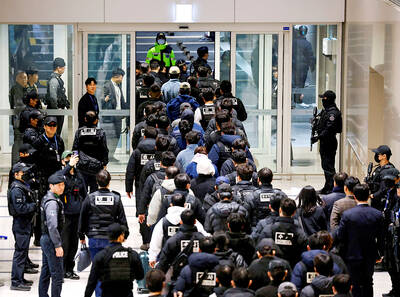
SCAM CLAMPDOWN: About 130 South Korean scam suspects have been sent home since October last year, and 60 more are still waiting for repatriation Dozens of South Koreans allegedly involved in online scams in Cambodia were yesterday returned to South Korea to face investigations in what was the largest group repatriation of Korean criminal suspects from abroad. The 73 South Korean suspects allegedly scammed fellow Koreans out of 48.6 billion won (US$33 million), South Korea said. Upon arrival in South Korea’s Incheon International Airport aboard a chartered plane, the suspects — 65 men and eight women — were sent to police stations. Local TV footage showed the suspects, in handcuffs and wearing masks, being escorted by police officers and boarding buses. They were among about 260 South


 RSS
RSS