


A Nepal government commission has found King Gyanendra responsible for a bloody crackdown in April against pro-democracy demonstrators that left at least 19 people dead and hundreds injured, officials said on yesterday.
A report by the commision said that the king should be punished, but the penalty to be imposed remained unclear.
Nepal has no laws concerning how to punish crimes committed by a king and the landmark case marked the first time a monarch faced investigation in a country where kings have traditionally been revered as near-deities.
The commission handed the report to Prime Minister Girija Prasad Koirala, who said those found guilty in the report would be punished.
Commission member Harihar Birahi said because he was the chairman of the Cabinet at the time of the crackdown, the king was responsible for the crackdown on pro-democracy protests.
Protests
The protests eventually forced the Gyanendra to cede power and reinstate parliament after 14 months of direct royal rule.
Parliament then quickly stripped Gyanendra of his powers, his command over the army and his immunity from prosecution.
Several people who worked under the king during the period of direct rule that ended in April were interrogated by the commission. It also questioned several other ministers and top government officials.
The commission also sent written questions to the Gyanendra, but the king did not respond.
Birahi said the investigation focused on official misuse of power and state funds and human rights abuses during the king's authoritarian rule.
In addition to Gyanendra, the commission also found another 201 officials serving in the king's administration responsible for the bloody crackdown.
Among the officials were the chiefs of the police and the armed forces. The chiefs of both police branches have been suspended, while the army chief has retired.
Activist
Hundreds of pro-democracy activists were also detained during the April crackdown, and some have said that they were tortured while in prison.
Meanwhile, as many as 4,500 children have been recruited by communist rebels in Nepal over the past month, a local human rights group alleged yesterday.
Thousands of children under 18 have been recruited by the rebels since Oct. 29, most of them in the past few days, said Kundan Aryal, heads of the National Coalition for Children as Zones of Peace group.
Aryal said the recruitment drive was undertaken despite the guerrillas' recent moves toward peace with the Nepalese government.
"It is in clear violation of all agreements with the government and the peace process," he said.
A statement by the UN said the world body "remains greatly concerned that even now children under 18 are still being recruited, voluntarily or forcibly, by Maoists, in violation of international standards and their own commitments."
The rebels, however, denied recruiting children as fighters: "We do not recruit children in our military wing, however, there may be some underage boys and girls joining our various organizations," said Dev Gurung, a member of the rebel's peace talks team.
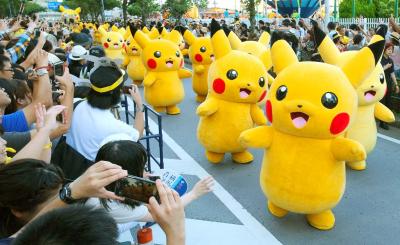
China’s military news agency yesterday warned that Japanese militarism is infiltrating society through series such as Pokemon and Detective Conan, after recent controversies involving events at sensitive sites. In recent days, anime conventions throughout China have reportedly banned participants from dressing as characters from Pokemon or Detective Conan and prohibited sales of related products. China Military Online yesterday posted an article titled “Their schemes — beware the infiltration of Japanese militarism in culture and sports.” The article referenced recent controversies around the popular anime series Pokemon, Detective Conan and My Hero Academia, saying that “the evil influence of Japanese militarism lives on in

DIPLOMATIC THAW: The Canadian prime minister’s China visit and improved Beijing-Ottawa ties raised lawyer Zhang Dongshuo’s hopes for a positive outcome in the retrial China has overturned the death sentence of Canadian Robert Schellenberg, a Canadian official said on Friday, in a possible sign of a diplomatic thaw as Canadian Prime Minister Mark Carney seeks to boost trade ties with Beijing. Schellenberg’s lawyer, Zhang Dongshuo (張東碩), yesterday confirmed China’s Supreme People’s Court struck down the sentence. Schellenberg was detained on drug charges in 2014 before China-Canada ties nosedived following the 2018 arrest in Vancouver of Huawei chief financial officer Meng Wanzhou (孟晚舟). That arrest infuriated Beijing, which detained two Canadians — Michael Spavor and Michael Kovrig — on espionage charges that Ottawa condemned as retaliatory. In January

A sign hanging from a rusty ice-green shipping container installed by Thai forces on what they say is the border with Cambodia reads: “Cambodian citizens are strictly prohibited from entering this area.” On opposite sides of the makeshift barricade, fronted by coils of barbed wire, Cambodians lamented their lost homes and livelihoods as Thailand’s military showed off its gains. Thai forces took control of several patches of disputed land along the border during fighting last year, which could amount to several square kilometers in total. Cambodian Kim Ren said her house in Chouk Chey used to stand on what is now the Thai

NEW RULES: There would be fewer school days, four-day workweeks, and a reduction in transportation services as the country battles a crisis exacerbated by US pressure The Cuban government on Friday announced emergency measures to address a crippling energy crisis worsened by US sanctions, including the adoption of a four-day work week for state-owned companies and fuel sale restrictions. Cuban Deputy Prime Minister Oscar Perez-Oliva Fraga blamed Washington for the crisis, telling Cuban television the government would “implement a series of decisions, first and foremost to guarantee the vitality of our country and essential services, without giving up on development.” “Fuel will be used to protect essential services for the population and indispensable economic activities,” he said. Among the new measures are the reduction of the working week in


 RSS
RSS