


The people of Iraq must face up to their differences and realize that they have no future except together, US Secretary of State Condoleezza Rice said yesterday.
Rice, speaking to a gathering of world business leaders at an Asia-Pacific summit in Vietnam, said she was not downplaying the challenges Iraq faces. She reiterated Washington's determination to stay the course and work with the Iraqi people for peace.
But she said that ultimately, success depends on the people of Iraq themselves -- just as Vietnam has chosen to put aside the antagonisms of its past.
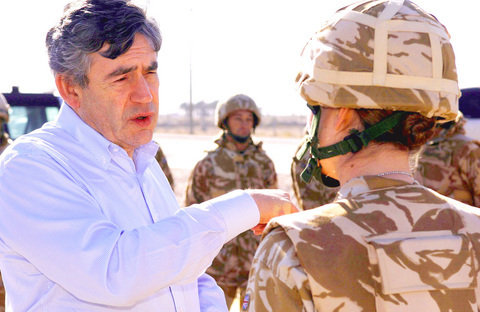
PHOTO: AP
Iraqis should make good, tough decisions like Vietnam did, face up to their differences and "realize that they only have one future and that's a future together," Rice said.
"They don't have a future if they try and stay apart," she added.
"If they do that and if we support them and if we remain committed to them and if we realize that the stakes in Iraq are literally the stakes for a different kind of Middle East that can form the center of a more peaceful world ... they can and will have a better chance," she said.
Meanwhile the top leadership in Iraq's Shiite-dominated government fell into deeper disarray, with an official close to the prime minister disavowing an arrest warrant issued against the country's most influential Sunni leader.
The official, with intimate knowledge of Iraqi Prime Minister Nouri al-Maliki's thinking, said on Friday that the Iraqi leader had not known his interior minister was planning to call for the arrest of the revered leader of the Association of Muslim Scholars, Sheik Harith al-Dhari.
"We will work so that the arrest warrant is not acted upon," said the official, who spoke on condition of anonymity because of the sensitive nature of the internal Shiite conflict.
For his part, al-Dhari said the government's bid to arrest him was illegal, and his spokesman urged Sunni politicians to quit the parliament and government.
The brewing crisis threatened the already shaky al-Maliki government and could provoke an even more violent surge in Iraq's sectarian conflict as the country teeters on the edge of civil war.
The new upheaval began late on Thursday when Interior Minister Jawad al-Bolani, a Shiite, announced on state television that he had issued the arrest warrant on grounds that al-Dhari allegedly incited terrorism and violence.
The move enraged moderate members of Iraq's Sunni minority, who had already threatened over recent weeks to walk out of government and parliament and take up arms. They have charged the al-Maliki government with discrimination and failure to act on measures important to the Sunni community and necessary for national reconciliation.
After al-Bolani announced the warrant was issued, government spokesman Ali al-Dabbagh, also a Shiite, sought to minimize it as an "investigation warrant." The spokesman said it is up to judicial authorities to issue an arrest warrant.
Deputy Prime Minister Barham Saleh said the Cabinet and the president's office had no knowledge about the arrest warrant. He called for an urgent meeting of political leaders to review the government's work.

School bullies in Singapore are to face caning under new guidelines, but the education minister on Tuesday said it would be meted out only as a last resort with strict safeguards. Human rights groups regularly criticize Singapore for the use of corporal punishment, which remains part of the school and criminal justice systems, but authorities have defended it as a deterrent to crime and serious misconduct. Caning was discussed in the parliament after legislators asked how it would be used in relation to bullying in schools. The debate followed stricter guidelines on serious student misconduct, including bullying, unveiled by the Singaporean Ministry of

As evening falls in Fiji’s capital, a steady stream of people approaches a makeshift clinic that is a first line of defense against one of the world’s fastest-growing HIV epidemics. In the South Pacific nation — a popular tourist destination of just under a million people — more than 2,000 new HIV cases were recorded last year, a 26 percent increase from 2024. The government has declared an HIV outbreak and described it as a national crisis. “It’s spreading like wildfire,” said Siteri Dinawai, 46, who came to be tested. The Moonlight Clinic, a converted minibus parked in a suburban cul-de-sac in Suva, is

A MESSAGE: Japan’s participation in the Balikatan drills is a clear deterrence signal to China not to attack Taiwan while the US is busy in the Middle East, an analyst said The Japan Self-Defense Forces yesterday fired a Type 88 anti-ship missile during a joint maritime exercise with US, Australian and Philippine forces, hitting a decommissioned Philippine Navy ship in waters facing the disputed South China Sea, in drills that underscore Tokyo’s rising willingness to project military power on China’s doorstep. The drill took place as Manila and Tokyo began talks on a potential defense equipment transfer, made possible by Japan’s decision to scrap restrictions on military exports. The discussions include the possible early transfer of Abukuma-class destroyers and TC-90 aircraft to the Philippines, Japanese Minister of Defense Shinjiro Koizumi said. Philippine Secretary of

‘GROSS NEGLIGENCE?’ Despite a spleen typically being significantly smaller than a liver, the surgeon said he believed Bryan’s spleen was ‘double the size of what is normal’ A Florida surgeon who is facing criminal charges after allegedly removing a patient’s liver instead of his spleen has said he is “forever traumatized” by that person’s death. In a deposition from November last year that was recently obtained by NBC, 44-year-old Thomas Shaknovsky described the death of 70-year-old William Bryan as an “incredibly unfortunate event that I regret deeply.” Bryan died after the botched surgery; and last month, a grand jury in Tallahassee indicted Shaknovsky on a charge of manslaughter. “I’m forever traumatized by it and hurt by it,” Shaknovsky added, also saying that wrong-site surgeries can happen “during


 RSS
RSS