


Floods caused by torrential rain in parts of southern Somalia have killed more than 23 people and displaced thousands over the past five days, aid workers and residents said on Tuesday.
The death toll is partly based on figures given by residents in different parts of southern Somalia contacted on two-way radio, the most common means of communication in this Horn of Africa nation, which has had no effective central government for 15 years.
Ali Bashi, the head of the Fanoole Human Rights Organization, said that the highest number of deaths had been reported in the Gedo region, which borders both Ethiopia and Kenya. He said that nine people died in the floods there, among them four children.
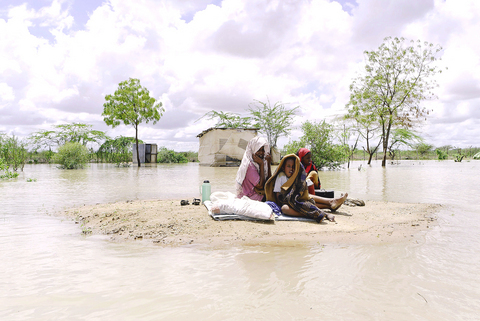
PHOTO: AFP
Local representatives of the International Committee of the Red Cross and other local non-governmental organizations said that thousands of people in southern Somalia had been forced to leave their homes after rain caused the Jubba and Shabelle rivers to burst their banks in five regions of the country.
Drivers in southern Somalia said they had seen thousands of people on roads that pass a string of towns near the Jubba and Shabelle rivers. The drivers said that the people are in search of higher ground after having fled their homes.
Dozens of these people arrived in the capital, Mogadishu, to take refugee in temporary camps here.
"We could not deal with the flooding because it ran through all the dams constructed by the former government and we had no other option but to save our lives," said Aasho Haaji Abdi, a mother of six children, at a temporary camp in Mogadishu -- in what was the main post office.
David Gilmore of CARE International said that the southern agricultural town of Jowhar, which has hundreds of canals cutting around it and the surrounding areas, have been devastated by heavy flooding from the nearby Shabelle River.
"The torrential rainfall has affected road transport, where much needed relief supplies and food have been cut off to communities, which have been affected by consecutive years of drought," said Gilmore, who is CARE International's country director for Somalia.
In neighboring Kenya, a woman and child died and thousands of Somali refugees were made homeless after heavy rain pounded refugee camps in the country's northeastern regions and destroyed the refugees' shelters, said Eddie Gedalof, the UN refugee agency's acting representative in Kenya.
The deaths and destruction occurred on Friday, but have only been made public on Tuesday because aid agencies were assessing the effects of the rains since Saturday in a region where many of the roads have become water-logged and impassable, said Gedalof.
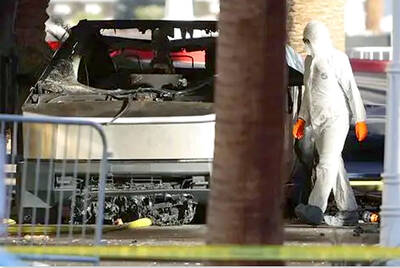
ACTIONABLE ADVICE: The majority of chatbots tested provided guidance on weapons, tactics and target selections, with Perplexity and Meta AI deemed to be the least safe From school shootings to synagogue bombings, leading artificial intelligence (AI) chatbots helped researchers plot violent attacks, according to a study published on Wednesday that highlighted the technology’s potential for real-world harm. Researchers from the nonprofit watchdog Center for Countering Digital Hate and CNN posed as 13-year-old boys in the US and Ireland to test 10 chatbots, including ChatGPT, Google Gemini, Perplexity, Deepseek and Meta AI. Eight of the chatbots assisted the make-believe attackers in more than half the responses, providing advice on “locations to target” and “weapons to use” in an attack, the study said. The chatbots had become a “powerful accelerant for

Australians were downloading virtual private networks (VPNs) in droves, while one of the world’s largest porn distributors said it was blocking users from its platforms as the country yesterday rolled out sweeping online age restriction. Australia in December became the first country to impose a nationwide ban on teenagers using social media. A separate law now requires artificial intelligence (AI)-powered chatbot services to keep certain content — including pornography, extreme violence and self-harm and eating disorder material — from minors or face fines of up to A$49.5 million (US$34.6 million). The country also joined Britain, France and dozens of US states requiring
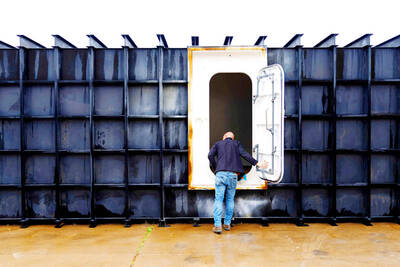
Since the war in the Middle East began nearly two weeks ago, the telephone at Ron Hubbard’s bomb shelter company in Texas has not stopped ringing. Foreign and US clients are rushing to buy his bunkers, seeking refuge in case of air raids, nuclear fallout or apocalypse. With the US and Israel pounding Iran, and Tehran retaliating with strikes across the region, Hubbard has seen demand for his product soar, mostly from Gulf nation customers in Bahrain, Qatar, Kuwait and the United Arab Emirates. “You can imagine how many people are thinking: ‘I wish I had a bomb shelter,’” Hubbard, 63, said in
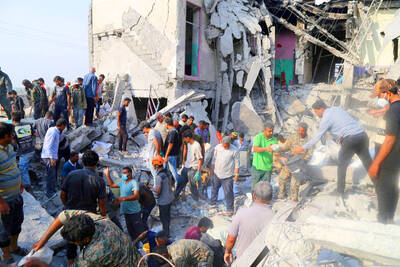
STILL IN POWER: US intelligence reports showed that the Iranian regime is not in danger of collapse and retains control of the public, casting doubt on Trump’s exit Nearly every US Senate Democrat on Wednesday signed a letter sent to US Secretary of Defense Pete Hegseth requesting a “swift investigation” of airstrikes on a girls’ school in Iran that killed scores of children and any other potential US military actions causing civilian harm. Reuters reported on Thursday last week that US military investigators believe it is likely that US forces were responsible for the Feb. 28 strike on the school, as US and Israeli forces launched attacks on Iran. “The results of this school attack are horrific. The majority of those killed in the strikes were girls between the ages


 RSS
RSS